
Feed aggregator


The Last Breath
by Liam Hogan
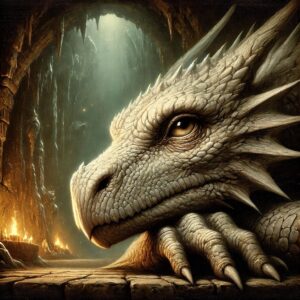 “When I’d seen her, sixty years earlier, she’d been no rainbow, sure, but the edges of her scales had still glimmered with colour.”
You don’t get to the age of two hundred and seventy-eight by being stupid. Or careless. Or, worst of all, trusting. Yet there I was, trapped and shackled by dragon iron. The accursed chains were as ancient as I was, the skills of their forging lost in the great wars, but they were as unbreakable as ever. It was best to conserve my strength; so, thoroughly annoyed with myself, I lay on the dark cavern floor, legs stretched before me and my head resting on them, waiting for whatever came next.
Whatever came next was a flashily dressed royal-type. Hopes rose. Kings and princes were, in my experience, vain creatures, easily flattered and bargained with and most of them quite short-lived — relatively speaking. There would, I was sure, be an out, even if I had to outlive him to get to it.
He halted at the far reaches of the dreary subterranean void, a distant, insignificant figure, well out of reach of my constrained claws. Possibly not out of reach of my tail, though it would require an impressive back flip to whip it that far in his direction. Nor, I supposed, would he entirely escape the extremities of my fiery breath. I could, at the very least, singe this arrogant human’s neat beard. Though that was definitely a last resort.
“Dragon,” he said, the feeble sound lost in the vast space.
“Count the limbs,” I growled, “It’s wyvern, Prince.” Wyverns — and dragons — have deep, gravelly voices. It comes from the heavy smoking.
“And it’s King, not prince,” he said, with a degree of hauteur that he must have practised in front of a full-length mirror. “King Ulfred.”
He was young to be a king, no more than three decades. I had half a mind to ask who he’d bumped off to ascend to the throne, but like I said, royal types can be awfully short lived. Especially if they’re stupid, or careless, or trusting. I didn’t want to antagonise him too much; just enough to show I wasn’t cowed.
“You all look the same to me,” I yawned, and there was a yelp from the man-at-arms trapped beneath my claw.
The King’s eyes widened. “Is that man still alive?”
“Yes.”
“May I ask… why?”
“I thought he might be important to you. Call him a peace offering, if you will.” I smiled, all teeth. “A sign of good intentions.”
The King didn’t smile in reply. I could have warned him: it ages you, maintaining such a severe expression. Well, it ages humans.
“The men were picked to be disposable.”
“That explains the laughably thin armour.”
He shook his head. “They were nothing more than a distraction, while my elite guard approached with the restraints. He means nothing to me. Do with him as you will.”
There was a whimper from beneath me. The man had been admirably still, no trouble at all, albeit under the threat of a very messy death. It would be wrong to say I felt anything for him, any more than the King would for a chicken destined for his table. And yet…
“I don’t much like canned food,” I quipped, though the quip would fail to land for a good number of centuries. I lifted my claw and prodded the prone man into action. He stumbled to his feet and fled — away from my wickedly sharp talons, and away from his uncaring King, deeper into the cavern where less frequently glimpsed dangers lurked. You try to do a good deed…
“What is it you want from me, King Ulfred?”
“I’m at war, with King Francisco—”
“If I could stop you right there.” Like I said, we have deep voices, it’s easy to talk over someone when they’re just a leaf rustling in the wind. “You want to use me as a weapon?”
“Well, yes.”
“What makes you think I’ll let you?”
He finally smiled; I preferred the frown. “I’ll only release your chains, not the shackles. You want out of those, you do exactly as I say.”
Cunning. And dastardly. Like sharks and crocodiles, wyverns never stop growing. Imprisoned by dragon iron, my limbs would be crippled over time. A slow, painful future.
I peered down my nose. “You might make me promise, instead?”
“And that would hold you?” The frown was back.
“A wyvern’s promise is far more binding than iron, King Ulfred, even dragon iron. As I’m sure your advisors told you. Or perhaps you don’t listen to them, hmm? Anyway, you’re barking up the wrong tree.”
“Oh? Am I?”
“Yes, if you want a weapon, you want the biggest, baddest flying monster you can find. And that’s not me. What you need is an ash wyvern.”
“An ash wyvern? I’ve never heard of such a thing.”
“Oh, they’re very rare. Hardly surprising you don’t know about them in these blighted backwaters.” I watched, delighted, as he bristled. Such thin skins, humans. “Most who encounter them don’t live to tell the tale. But the tale is worth telling.
“An ash wyvern is larger than I am, and, as you might guess from the name, they’re silvery-white and appear as ghosts. But its their breath that makes them unique, and uniquely feared. They have the most destructive, fiery breath in the world. A breath that brings death, far more so than any mere dragon or lesser wyvern like me. It is a breath that melts stone, that eats through metal like a hot knife through butter. As for what it does to flesh, well, you can imagine. Most of all, it is a breath that, once unleashed, cannot be restrained. It consumes everything in its path, until all is laid to waste for leagues around, ash and dust, even the wyvern who breathed it.”
King Ulfred stroked that neat beard of his. “A mighty weapon, then. But one that can only be used once?”
“Trust me, once is too many times. You never actually want to deploy an ash wyvern! Genies out of bottles and all.” I wasn’t sure he’d get that reference either. Not an anachronism this time, more a whole other mythology. “Me, I can swoop down and kill a half dozen soldiers in each pass, though it’s the scare factor that gets enemy cavalry all riled up and sends unwashed rabble scurrying for cover. But an ash wyvern…” I shook my head ponderously. “Once it is unleashed there won’t be anything left that didn’t have the foresight to crawl under a very large rock. No crops, no forests, no livestock, no army or farmers, no castles and certainly no rival king. All wiped from the face of this Earth. Ultimate destruction from the ultimate weapon.”
It was quite horrid, how his eyes glittered as he listened. “So,” I pointed out, feeling the need to join the dots, “just the fact you have one, will guarantee you victory. The scare factor. Because against such a terrible threat, only a fool would attempt to stand.”
“And you tell me this, because?”
“Because, in return for my freedom, I can get you an ash wyvern.”
“Indeed? Very well. But the same rules apply. I won’t release your shackles, just your chains. And you must swear—”
Here it came…
And then it didn’t.
Perhaps he had heard of genies after all. Or other magical beings, whose words were like the reflections of the moon on a cold pond. Deceptive, and impossible to grasp. This was the point at which he could have done with those neglected advisors. In the end, he didn’t do too badly. Perhaps I underestimated him.
“You must promise,” he finally said with infinite care, “Not to cause me harm, directly or indirectly, to the best of your abilities. You must promise to bring me an ash wyvern. And…”
It’s always the third bite at the thorax, isn’t it?
“…you will only be freed once victory is mine!”
“I don’t see how I can promise the last part, since that is in your hands,” I said, deflating his triumph.
“Well…” He looked confused; perhaps I had overestimated him. “Then promise the first two parts, and I’ll look after the third.”
I promised, reluctantly, and the chains (but not the shackles) were released. I grinned my most evil grin and ducked my head sharply towards the king, who was now very much in range. “Say,” I said, and he squealed and fell over backwards as his royal guards scrabbled for their swords and spears. “You don’t have a history of heart problems in your family, do you?”
He shook his head, unable to speak, or even squeak.
“Well, that’s good,” I said. “It’s hard to keep my oath if I don’t have a full medical history, if I don’t know how sensitive you might be to shocks and scares and the like. To the best of my abilities, right?”
With that, I squeezed up the narrow crevice to the outside. Thankfully, it was daylight, a wan sun working away at the morning’s mist, just enough to warm my wings. There was a gathering of the King’s men watching as I stretched, shaking the water and fallen dirt from my back. I thought of snatching a few — travelling snacks for my journey — but concluded that this might indirectly harm the King. Pesky thing, promises.
It was good to be in the skies again, even though I wasn’t entirely sure where I was headed. North, was my best guess. If it hadn’t been for the shackles around my ankles and the irksome promise, I’d just keep going. Find somewhere with no dratted Kings, no dragon iron, maybe no people at all. Not that there were many places like that any more. The Earth was getting awfully crowded, and the humans I did encounter never seemed happy to see me. Can’t understand why. I preferred their cattle to their children, or their women. The older the better — richer flavour and more to chew on. And yes, I’m still talking about cows.
I stopped to ask the way from a sun-basking griffin. She couldn’t help smirking as she glanced at the bands of dragon iron, my twin badges of disgrace, and I’d have clipped her wings if she hadn’t given me such promising directions.
The way was up into the hills, low cousins to the mountains that crowded the horizon, wearing capes of snow that never melted. Well, not for the next half a millennia or so. A wyvern’s ability to glimpse the distant future meant that things that seemed constant weren’t, and things you keep expecting to change, don’t. Or not in the ways you expect. There’s a certain circular inevitability to history, to stupidity, and yes, to war.
The abyss the griffin had guided me to, at the far end of a dark lake, was suitably ominous. A cleft in the hillside, a stream trickling from its mouth, a fetid smell wafting from its depths… Even I had a shudder of apprehension as I entered the foreboding ravine, wriggling my way until I came to a pitch-black chamber, where I had the sense of being minutely inspected.
“Hello, younger brother.” A voice as ancient as the rocks sighed.
“Altran; thought I might find you here. Kin. Sister. Friend?”
“I see you got yourself captured.”
“Ah, yes. Though how can you…?”
“I can taste the iron, Shurni. Not just any old iron, either. Dragon iron. Haven’t smelled that sour stench for over a century. Chaffs, I’ll bet? Someone must really want you to do something for them.”
“Well… they did.”
“Oh?”
“And now they want you to do something for them.”
“ME?!” the voice thundered, rocks rattling from the roof, and I had a grim vision of the two of us buried forever beneath that lonely hill. In better news, the rumble let a thin sliver of light creep into the Stygian depths. In worse news, the light revealed the remains of what Altran had been surviving on while she wallowed in her misery, the discarded bones and tattered fleeces of snow-blind sheep and scraped goats that had strayed into these tunnels. It explained the crunch underfoot. Amazing she could pick out cold iron over all of that. I suppose she must have gotten used to it, though heavens knew how.
“Yes,” I said. “You, sister. I need you.”
“For what?” Her measured reply was far more dangerous than her exclamations. She was from a clutch two centuries older than mine, and that was why I’d appended the hopeful “friend?”. We might be related, but we didn’t grow up together. My plan — such that it was — relied on her willing cooperation. As did my life.
“I want you to join an army.”
You could hear solitary drips of water pinking into some pool somewhere. I held my breath. The hillside held it’s breath. Even Altran was very, very still.
“What sort of an army?”
“A… human one?”
“Have a care, brother!”
“You won’t be asked to do anything!” I protested. “Just to be seen!”
“Just, my inane little brother says. Just be seen. I should have crushed your entire clutch when I heard mother was laying again!”
“Well, that’s—”
“Look then — look, if you must!”
She reared forward and into the tendrils of light from above. Altran’s entire head was bone white. Colourless, other than the two spots of blood red that flashed in her furious eyes.
That’s the problem with fire breathing, for wyverns. Dragons have it relatively easy, employing a different technique of igniting their flames, as different as the stings of wasps are from bees. For wyverns, breathing fire changes you. Each fiery breath consumed a firestone from our crops, just as our flames consumed wood, or flesh.
You started your life, it always seemed, with plenty of stones, flaming at the drop of a hat when you were young and foolish, when you were at your most vulnerable. But wyvern lives are long, if you escape infancy. By the time I’d reached what most wyvern would consider young-middle ages, I was rationing my remaining firestones, eating my food raw, and flaming only when necessary. Each time you breathed fire, each time you lost a stone, you also lost the vibrant hue it imparted, the reds, greens, and purples with which we were streaked. Each flame leached colour until you had only one stone left, barely enough to keep your internal engines going. Just one fiery breath from extinction.
Wyverns do not, as a rule, die of old age. Once we pass through the perils of our youth — other siblings, whether the same age or, like Altran, two centuries older, the odd accident (dragon iron can make more than chains and shackles, though there are also natural hazards, like cavern roof collapses…), and the hazards of courtship flights, themselves a great consumer of firestones — there was relatively little that could harm us. Even dragons gave us a wide berth.
Instead, we die a little with each exhaled inferno, each proof of our awesome power. For wyverns, fire is a defence mechanism. Which is why we do not, on the whole, make very good weapons.
I had not known Altran was on her last breath. When I’d seen her, sixty years earlier, she’d been no rainbow, sure, but the edges of her scales had still glimmered with colour. This explained why she was skulking far from prying eyes.
“You’re perfect!” I exclaimed, covering my gasp. “I was going to suggest chalk, or some other sort of make up, but no, sister, you are absolutely perfect!”
“I am nothing,” she spat. “Waiting for such prey as falls into my lair. I’m washed up, no weapon, and certainly not one to strike fear into anyone’s heart.”
So I told her my plan. Slowly, with much shaking of her mighty head and many a weary grunt, I won her around.
“It does rather seem, little brother, that it is my life you’re putting on the line?”
It wasn’t easy, this winning her around bit.
“A myth, then. If this is to be my end, Shurni, then at least it will make for a good story.”
“No end, sister.”
“You promise?”
I held her gaze, though that was mighty hard to do. “If I could, I would. But…”
“Hah! Promise bound and shackled by dragon iron… a sorry state. It might be worth climbing out of this hole, just to watch you try and dig yourself out of yours.”
With that, I think, I knew I had her.
“With your help, Altran. If you do as I’ve suggested — with your own particular flair, of course! — If you remain aloof, and haughty, and imperious… Do you think you can do that?”
She thought long and hard. It was so gloomy down there, in Altran’s lair, that I had time enough for visions. Strange, unsettling visions. Skies criss-crossed by shiny, winged creatures whose wings never flapped. Metal-skinned monsters that flew higher than a wyvern has ever flown and left no room for us, or for dragons, or for griffins. Soulless, lifeless things built by man. Portentous omens indeed, though from the fuzzy nature I could tell it was a far distant vision of a far distant future. My concerns were very much with the present, with the here and now. I still wasn’t certain which way Altran would go.
The cavern rumbled and groaned with her laughter. “Alright, little brother. Let us go and visit this King of yours. I grow tired of mutton. If there is venison and aged beef enough for a decent meal, at least I will not die empty stomached.”
“Grand, grand!” I was delighted, for both of us. “Though before we feast, we will need to make a small detour?”
“Ah yes, that part of the plan. Risky.”
“To which end, any idea of where we should detour to?”
Altran considered, then nodded. “I think I know the place. Though… best let me do the talking, yes?”
* * *
A sight it must have been, two wyverns flying south, one as pale as the clouds, the other darker, as though its shadow. Except in mating dances, neither wyverns nor dragons tend to fly together. And though Altran hadn’t exactly been gorging herself of late, she was still four centuries old and even I was awed by her size. Big sister, indeed.
I circled the King’s castle, flashing the manacles at my ankles to show that it was me, and swooping towards the elevated courtyard in front of the keep in a clear message: clear this space, or be landed on!
Before the stir of guards and onlookers even had a chance to re-arrange themselves, Altran soared in and settled on the roof of the keep itself, skittering down slates and loose stones from the parapet, and extended her wings to look utterly regal and badass and not unlike the heraldic figure she would some day, quite soon, become.
One advantage of me being down below, and Altran being up there, other than her looking like an absolute queen, was that it was obvious that I was the one who would be doing the talking.
“King Ulfred.” I lowered my head. Not a lot, a half-bow, a mark of mutual respect that wasn’t reciprocated. I ignored the consternation of the gathered courtiers, servants, and guards, who, I guessed, hadn’t got the memo that the King had enlisted a wyvern.
“You returned,” King Ulfred said, with a glance to check his elite guard was between me and him.
“Of course. And with an ash wyvern, as promised.”
“Yes, well…” He peered up to the lofty heights of the keep.
“…to whom I promised a half dozen cows.”
“Did you now?”
“Yes. Hungry work, being the most dangerous weapon in existence. But not to worry–they don’t have to be productive cows.”
Ulfred tutted, but fluttered a hand towards one of his flunkies, an implicit see to it.
“So,” I asked, all casual. “When do we go to war?”
He stared for a moment, as if able to see through the walls of his castle and towards his not-so-distant enemy.
“Tomorrow.”
“That soon?”
“No time to waste. My army is ready, and, for now, I have the element of surprise. And you, wyvern, will be by my side on the glorious day.”
I may have groaned. I should have expected this. “I have done as you asked–”
“You brought me an ash wyvern, yes. And I am a man of my word. But my word was that you will only be freed once victory is mine. And it is not mine yet.”
There was hope for him, advisors or not, though it’d be better if he seriously toned down the smug. He also wrongly assumed I was bound to protect him. But my promise had been that my actions wouldn’t cause him harm, it didn’t say I had to put my body between him and arrows and the like. Not as long as I choose to interpret it that way.
“You know, I think you should own the moment,” I whispered. Naturally, everyone within the grounds of the castle heard me. “It being the eve of war and all.”
“How so?”
“Here you are, with two wyverns not ripping you and your army apart. Given our arrival probably sent a few of your less brave conscripts scurrying for the nearest ditch, a display of your mastery is called for, to settle nerves. You should tell your men what you intend, in battle tomorrow. It would do wonders for morale.”
“Well, yes.” He looked surprised. Unasked for, helpful advice. “That does make sense…”
“And don’t forget the cattle.”
He scowled. “Just see to it that your ash wyvern stays on the roof. And extends his wings again?”
Her, I could have corrected him. But I didn’t want to spoil the entertainment.
“Gather my commanders and have the army prepare for my orders. Promise them a cask of ale or two. That’ll still their impatience.” Off the King and his flunkies stalked to advise his generals and to dress in over-polished armour, before addressing his troops. Meanwhile, I caught the distinctive whiff of very nervous cattle. They were scrawny things, I should have asked for two more, and they were doing their best to escape the men dragging their unwilling carcasses into the upper courtyard.
“Where should we…?” a man said, arms bulging as he pulled at the rope. There was something familiar about him… Ah! Our man-at-arms from the cavern had managed to find his way out. Good for him. Now demoted to wrangling supper for wyverns, but that was a better fate than I would have predicted for him.
“Oh, leave them here and close the gates behind you,” I said, gesturing to the roof where Altran waited. “I’ll take them up.”
I probably shouldn’t play with my food, but a wyvern likes to hunt. I caught them, one by one, and carried them to the roof, still struggling in my claws. That way, no-one could see how many Altran ate and how many I snaffled. Not that I felt any remorse about taking my due. I’d flown twice the distance she had, even if I was only half the size.
As we ate we listened to the King’s speech, offering our critique, in wyvern-ese of course. We picked at our meal as the King took my possibly not entirely accurate description of an ash wyvern, and exaggerated it further still. A little light spraying of half-crunched bones happened despite our efforts not to laugh.
But the speech had a rousing effect, as the terrified, skyward gaze of conscripted soldiers gave way to a look of awe, and of possible hope.
“That’ll do it, you think?” Altran asked, after I’d made her stand tall and spread her wings as both King and wyvern basked in rapturous applause.
“We’ll see. Tomorrow. There’s half a cow here, if you…?”
“You have it, little brother. It’s been a while since I’ve eaten so much. Though I think I could get used to it again.”
* * *
We marched out at dawn. An immense throng of men, the steady clank of arms and armour, a painfully slow shuffle forward with Altran and I to the sides so that we didn’t accidentally crush half the army. The horse that the king rode, though blinkered, could sense we were there and wasn’t happy about it. It can’t have been a comfortable ride.
We ascended a low rise, beyond which stretched the open plain where tradition dictated battles between these two nations were fought, much to the ire of those who traditionally lived there. King Francisco’s army was arriving just as we were, and above the bristling tips of spears and pennants, there was—
“The enemy! The enemy have an ash wyvern as well!” King Ulfred exclaimed. “I am betrayed!”
“You are fortunate,” I told him. “That you got one when you did, otherwise you would be at a serious disadvantage right now.”
The King frowned, but returned his attention to the battlefield, as the opposing forces closed the gap between them, while the respective Kings and their respective wyverns kept their respectful distances.
And then… nothing seemed to happen.
For quite a while.
The King’s frown alternated with an expression I can only describe as startled.
“Why are their armies not engaging?” he demanded.
“Probably because you have an ash wyvern, your majesty. A wyvern of mass destruction. Or W.M.D., for short.”
“Well… why aren’t my armies engaging, then? Why do our archers not fire?”
“Because they have a WMD, too. And you did so wonderfully describe what one could do, in your rousing speech yesterday.”
He groaned. “So they’re both just sitting there?”
“I guess.”
“Make them fight!”
“That would be unwise.”
“Why, for hell’s sake?! That’s what they’re here to do.”
Evidentially, his stalemated-pawns had reached the necessary conclusion faster than the King. Perhaps if he’d been a little closer to the sharp edge of the action? I explained, for his benefit.
“If it looks like you’re winning, then the enemy will lose nothing by unleashing their wyvern. And if it looks like they are winning, then you might do the same. A king, at the point of losing his kingdom, does not make entirely rational decisions. As soon as one side unleashes their wyvern, so will the other. Both kingdoms laid to waste. Mutually assured destruction, your majesty. Neither side can afford to deploy their most fearsome weapon, because to do so would guarantee the enemy would use theirs. I’d say the safest thing to do… Hmm. Is to not engage?”
The king stared at me, aghast. He shook his head. “What about you?”
“Me?” I said.
“I have two wyvern on my side. Doesn’t that give me the advantage?”
I’d almost forgotten this is how it all began, with King Ulfred wanting to use me as his weapon. I shrugged. “Sure, but compared to an ash wyvern, I’m neither here nor there. I’m not immune to an ash wyvern’s breath. Nothing is, not stone, not iron, and certainly not flesh. I change nothing. Nor would an army twice as large. Against a WMD, these are lesser matters. On the apocalyptic scale, two Kingdoms each armed with an ash wyvern are evenly matched, regardless of any other forces involved.”
The king scowled. “So what do we do?”
“Isn’t that obvious?” I peered over the vast battle plain, where two armies stood ready and unwilling to hack and maim and kill. “You should try not fighting.”
“Not fight?”
“Yes. I believe it’s called diplomacy. Whatever your quarrel with King Francisco, have you considered talking it out? A negotiated peace? Of course, since you each have an ash wyvern, you’re on equal footing, so there won’t be a lot of concessions made by either side. You’re probably going to have to forgo and forget a lot of historic insults and aggression. Bygones, yes?”
His face was like thunder. There was a snicking noise as Altran restrained her mirth.
“But think on the bright side!” I offered, loudly, to cover them. “Consider the advantages of a strategic partnership, bound perhaps by a royal wedding? Just think; two mighty kingdoms, working together, each armed by the ultimate weapon. Who could stand against you?”
“No-one,” he said, rather sourly. “Unless they had an ash wyvern as well.”
I did my best to act surprised. “They are rare beasts, King Ulfred. They are not given out free with breakfast cereals.” Another allusion that would not make sense until a very long time from now.
He groaned. “I’m worse off than before I captured you!”
“I don’t see how,” I said. “Though of course, if you really think so, I could send your ash wyvern away, tell them you don’t need one any more.”
“But then my enemy would have one, and I wouldn’t!”
“Ah… True. Best look after yours then, hey?”
“What do you mean?”
“Your ash wyvern isn’t a captive, like I am, your majesty. You have no chains or shackles on it — and before you get any ideas, don’t even try, unless you want her flames turned on you and your kingdom. She’s here because she chooses to be, yes? Best treat her well, encourage her to stay. Look after her, feed her, and respect her. Don’t worry, maintaining an ash wyvern is far cheaper than sustaining a standing army. And in good news, nobody died today! I count that as a victory, yes?”
I held out my shackles, to be unlocked.
* * *
Back on the roof of the castle keep, as the army celebrated the — um, draw? Not dying? — feasting on cooked cuts of what we ate whole and raw, (though it would be cooked, before it hit our second stomachs), Altran turned lazily to me, picking between her teeth with a discarded halberd.
“You know Shurni, the whole mutual assured thing doesn’t stand up to scrutiny.”
I grinned. “I am aware.”
“Did you do all of this just for the pun? Wyverns of mass destruction?”
My grin grew wider. That was the problem with anachronisms. You either had to have another wyvern or dragon as an audience, or wait a few centuries for the pun to land. Since humans didn’t live anything like that long, most of our best jokes were mistaken for particularly obscure oracular prophecies. Ho hum.
“Not entirely…”
“Never mind the hyperbole, the blatant exaggeration; able to destroy an entire kingdom, indeed! What does anyone think they could actually do, to convince me to expel my last breath, knowing it spells my certain doom?”
“Quite.” I yawned. It had been a long day. Plus, I’m always sleepy after a good meal, and the King’s men had been even more generous than the King.
“Let alone convince me to use that breath in a specific, towards-the-enemy direction? One wonders why anyone fell for any of it.”
“Because it’s better than the alternative?” I suggested.
“But how long can it last?”
“Stalemates have a tendency to persist, until something radically changes the playing field. As long as both you and—?”
“Bartok.”
“As long as you and Bartok play your parts, I can’t see any reason why we can’t spin this out at least for a generation — of Kings, that is. Ulfred and Francisco are both relatively young.”
Altran drummed her claws on the masonry, leaving deep grooves. “Twenty, thirty years, perhaps? And during that time… do you condemn me to a senescence of silence?”
“Only with humans,” I protested. “You’re not missing much there. I’ll visit as often as I can and there’s nothing stopping you going on the occasional trip. In fact, the worry that you might not come back will do wonders for how attentive they are when you do. I’ve told them what you like to eat and that you enjoy being read to.” I shrugged. “It’s better than spending your remaining days festering in a dank hole, I hope?”
There was silence, as we watched the baleful glow of the setting sun, softened by the smoke of hundreds of campfires around the castle. Tomorrow, most of those soldiers would go back to their villages, to farming and patching up their hovels and whatever else they did when not forced to bear arms.
“Why didn’t King Ulfred remove your manacles?” Altran asked. “I thought I saw the man who carried the keys?”
“You did. But I asked him not to.”
“Why?”
“Altran, how many wyverns are on their last breath, would you say?”
“A few,” she admitted.
“And how many kingdoms are there, on this continent?”
She laughed. “A recruitment mission? With manacles as your calling card? W-M-Ds for all? Well. You’re nothing if not ambitious. Though don’t leave those shackles on for too long, brother, or eat too heartily. They constrict, do bands of dragon iron.”
For the first time I noticed the darker marks on my sister’s ankles. Probably wouldn’t have seen them, if she hadn’t been the colour of ash. The moment hung heavy.
“You know, you may not be doing us a favour, in the long run,” Altran said.
“Oh?”
“This… cold war between humans. It is not quite the same as peace. I know you mean well, Shurni, but it is all under false pretences. It might stop the bloodshed for a while, might give us ash wyverns a temporary home and respite in our old age, but less bloodshed does inevitably mean more humans.”
“Yes… I suppose.” The thought hadn’t struck me.
“Ones who will undoubtedly seek other outlets for their irrational hostility.”
“You think I should make their wars hot, again?” I asked.
Altran sighed. “It probably doesn’t matter in the long run. Our time is nearing an end, little brother. Surely you’ve had the visions?”
I was silent again, for a while. “What happens to us, sis?”
“Who knows? Nothing good, perhaps. If we went elsewhere, you might think our visions would be from there, instead of a dragonless land. Perhaps there is no elsewhere. Or perhaps our visions do not pierce that veil. But that is for the future. Today, at least, we are safe, and I am well fed!”
Altran beat her mighty wings, and lifted into the air, circling King Ulfred’s castle, warning anyone watching from beyond the walls that an ash wyvern was in attendance, (and taking the opportunity to void her bowels over the moat at the same time). Then she settled in the upper courtyard, to listen to bards tell tales of heroes and gods and monsters, accompanied by lilting harp music, while the spot between her ears was scratched by a halbard wielding, very grateful and still somewhat bruised former man-at-arms.
* * *
 About the Author
Liam Hogan is an award-winning short story writer, with stories in Best of British Science Fiction and in Best of British Fantasy (NewCon Press). He volunteers at the creative writing charities Ministry of Stories, and Spark Young Writers. Sci-Fi collection: A Short History of the Future (Northodox Press). Fantasy: Happy Ending Not Guaranteed (Arachne Press). More details at http://happyendingnotguaranteed.blogspot.co.uk
Unmaking Extinction
by Liz Levin
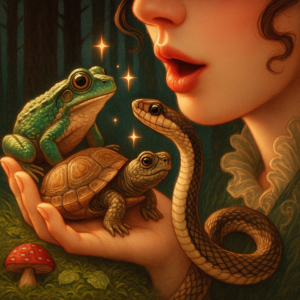 “I barely catch the American toad, common garter snake, and snapping turtle that fall from my lips.”
I get the alert about Corinne’s death while Terrible and I are fighting about words. Namely, which ones I should say next time I’m around other humans. He’s lying in the river beside the cottage. Each time he speaks, he heaves his head out of the water. When he’s done, he lets his 300-pound noggin crash below the surface, splashing everything. I’m standing on the muddy riverbank, soaked.
He’s named for terrible crocodile, the English translation of Deinosuchus, his most likely genus. Generally, I don’t speak reptiles or amphibians into existence that died out before we humans spoke English (or existed). Terrible is an exception. He’s demanding I read Chaucer around humans. I remind him I’ve barely begun reciting the Oxford English Dictionary’s nearly 50,000 obsolete words. At a rate of two dozen a day, I’ll finish in five years.
Terrible isn’t convinced.
“But I was alive during the Cretaceous! You think my mate hides in a list of barely dead words?”
“Why not?” I ask. “A common word created you.” He drops beneath the water, soaking me to my neck. “Merde. Keep your head above water while we’re talking. You’re over 30 feet long. You’ll empty the river.” Terrible was designed to eat dinosaurs, and it shows.
“Common word,” grumbles Terrible. “There’s nothing common about me.”
I couldn’t agree more, but we both know I wasn’t capable of linguistic feats on my curse day, five years ago this Saturday. Terrible was born on that day, before I found the cottage and before I started recording what I say within earshot of humans so I can replay it to determine which species belongs to each word. I’ve tried to recreate those first impassioned sentences I said in front of Mama and Corinne, but as much as I try, I’ve never birthed another Deinosuchus. And though I’ve uttered the curse that made Serpent, that word has never birthed another.
You may wonder why I say birth or born. After all, lizards and amphibians drop from my lips when I speak English within earshot of humans, not from my womb (thankfully). I ask you, are there better words? I’ve tried vomit. None of the creatures born speaking like that.
“Is he still complaining, Vivienne?” asks Serpent, gliding across the mud to coil up my leg and around my waist, like an ornate belt. He’s pretty enough to seduce Eve. His skin bears a geometric pattern of emerald, sapphire, and gold. “Living gems,” he likes to say, “much better than your sister’s dead rocks and flowers.” He’s not wrong. “You haven’t made a girl for me, and you don’t hear me complaining.”
“Another of you?” I cross my arms and shiver, even though it’s 86 and humid. “Terrifying. Last thing we need is you reproducing.”
“Impossible to improve perfection,” Serpent says. “Too true. But I came to tell you your light-up machine interrupted my sunbath.”
I glance at my phone on the picnic table, a safe distance from the river. Electronics and brackish water don’t mix.
“I’m working on it, Terrible.” He’s moved his head below water again. I talk to his bulbous eyes. “I know you’re lonely.” I am too. I don’t say it aloud. I don’t want to offend anyone.
“Putain de merde.” Corinne Barreau, Wife of Phoenix’s Golf Course King, Dies at 22.
The service is Saturday, on the fifth anniversary of our curse.
* * *
I ride my mountain bike along deer trails until I reach the Phoenix exit. Turning back toward the woods, I see an electrified fence topped by razor wire. Signs caution: Toxic dumping site. Stay out. Behind the fence lies desert. If I turned back with the intent of entering, I would find an unlocked door. Behind it is a primeval forest with sequoia-sized trees.
That’s the ecosystem outside Phoenix, but the woods are a patchwork of habitats, from deciduous forests to tundra, from peat bogs to estuaries, like the one by our cottage. I’ve wondered whether our cottage is beside an estuary because it’s where women with our curse always live (if we survive) or did the cottage move to the biome Terrible would need?
I’ll leave it to you to answer that question.
I like to think that this wild place contains all the famous cottages, even Baba Yaga’s chicken leg house. So far, I’ve found it disappointingly empty of humans and witches.
And fairies, thankfully.
Serpent is cozy in the granny basket as I ride six miles to the Golf Course King’s estate, a.k.a. Hugo Von Brandt, my ex-fiancé. It’s dawn and Phoenix is unbearable. I arrive early to wash up in the pool house. Unscrewing the pineapple-shaped finial from the iron railing beside the door, I retrieve the key. I change from dusty cutoffs to the requisite black dress, and an opaque black veil looped to catch anything that drops from my mouth. I don’t plan on speaking English. Mama spoke French in our home. I’m fluent enough to pass as a native, a ruse I’ve played before, but it’s dangerous here. After all, Mama thinks I’m dead.
I shoulder my backpack, leaving it open at the top and cautioning Serpent not to stick his head out. He’s a curious snake.
The service is in the greenhouse. My veil sticks to my face in the humidity. My sister is the only one here, lying in a sapphire-colored casket beside the podium. I walk down the center aisle, past empty chairs. Before I revealed Mama’s lies and poisoned our engagement, Hugo and I were to be married here.
Oh, Corinne. In death, she looks like porcelain. Fragile. Like someone who would shatter under an ambition like Mama’s.
As the favored child, I had years to build defenses against Mama’s avarice disguised as affection. People say I looked like Mama from birth, and so, like a good little narcissist, she loved me at first sight. Corinne, my junior by a year, looked like the lover who left her. Accordingly, Mama handed her a broom when she was in kindergarten.
Classmates thought it better to be me than her, even though they adored Corinne. They saw Mama lavish me with unmerited praise; they saw the patches on Corinne’s hand-me-downs. They were right enough. I helped when Mama wasn’t watching, but after Mama caught me chopping fennel for Mama’s favorite bouillabaisse — my recipe perfected over years — she punished Corinne.
Mama ordered her to draw water from the new wishing well that had appeared the day after the mayor admonished the media for implying Phoenix was running out of water. Corinne returned and Mama emptied the pitcher on the cacti while scolding her youngest. Corinne’s apology yielded a tiger lily, uncut emerald, and thorned rose that dripped blood. Mama sent me to the now blessed well.
“You can still save this engagement, mon bijou. If your pathetic sister can win a blessing, so can you.” I suggested she go in my stead. She rubbed her neck, swallowed, and gestured toward the door. Oh Mama, I understood you well. Even then. You knew the price.
When a fairy disguised as a princess requested water, she looked as though she stood behind a screen of bloody thorns. I refused and she cursed me. Or so the story goes. The well disappeared. Mama said we needed to talk, drove me to an empty patch of desert, and left me. If I hadn’t uttered that curse after she left, birthing Serpent who led me to our cottage, I would have died. Even with his help, I nearly did.
Someone moves beside me and the casket. Trim in a custom suit, blond hair freshly cut, skin leathered from the links: the Golf Course King of Phoenix, Hugo Von Brandt, the golden chariot to wealth Mama raised me to catch.
Hugo doesn’t recognize me in my veil. “Gorgeous, isn’t she?” He nods to Corinne’s heart-shaped face and soft brown hair. “You knew her? We all miss her more than words can express. She had so much left to offer.”
I choke back a curse before it becomes a word. It sounds like a sob. To offer? Like diamonds for the price of a word? How would Hugo pay to water his expanding empire now? I bow my head before I walk away. He doesn’t comment on my silence.
During the ceremony, I lean against a shadowed pillar and listen to Spanish-speaking servants praise the late Mrs. Von Brandt who always spoke to them in their language. The chef tells a humorous story about her notorious hatred for smart phones, and how she tricked him into giving his phone to her for the day to help him overcome his addiction. I straighten at that. What were you planning, Corinne? Hugo or Mama manufactured her hatred of phones, for certain. If her curse worked as mine does, she could type English words without activating her blessing. My movement wakes Serpent. He drapes himself across my shoulders, hidden by the veil, whispering questions in my ear while I shush him.
The group in front of me gossips through the last speeches.
“Did you hear how she went?”
“Choked.”
“My ex performed the Heimlich on a guy at a steakhouse.”
“She wasn’t eating when she died.”
“They say they found her—”
I squeeze through the crowds until I’m in the main house, on my way to the room Hugo said would belong to me after we wed. Serpent and I search for anything that will tell the story of Corinne’s death, or life. He slithers under and behind while I scrutinize photographs of carnivorous flowers hanging from clothespins. She had an artist’s eye, even if photography was never her specialty.
After moving a three-shelf bookcase, at Serpent’s suggestion, I find a safe built into the wall. Or magicked there; it resembles the one in my cottage. Just like mine, I find no obvious lock. There is an iron sculpture of a carnivorous pitcher plant. “Do you think it works like mine?”
“Only one way to tell.”
With trepidation, I lift a finger to the bulbous flower, preparing to plunge it into the dark opening. My safe features a cobra’s open mouth. I survived my first attempt to open that safe. Unlike this one, it was designed for someone with my cursed blessing. “Wish me luck!”
“You already have me.”
I’m not surprised when the flower’s cylinder constricts around my finger. I feel a sharp jab before the pressure releases and the door pops opened. My finger numbs, then my hand. Already it’s spread more than my safe’s toxin does. I’m immune to reptiles’ and amphibians’ toxins and venom. Here’s hoping flower toxins are similar enough. Only my immunity is magical, not biological, and there’s no promise I’d be protected even if the safes’ toxins were chemical twins. The numbness creeps above my wrist before I panic.
“Serpent, help!” I whimper. He strikes, biting the inside of my elbow, right above the line of numbness. The sharp pain of Serpent’s venom chases back the numbing effect of the safe’s toxin. It’s like the blasting away of cobwebs, followed by the clarity of knowledge.
After wiggling my fingers to shake away the pain, I open the door to the small safe and slide her journals into my backpack. I hesitate before adding the pouches of gemstones. I’ll make better use of them than Hugo or Mama would. In the attached bathroom, I wash my face and change back. I wrap a floral scarf over my hair and around my face to hide my identity (it’s too lightweight to support births) and leave this gilded cage.
* * *
I’m pushing up my kickstand, congratulating myself on my smooth exit, when Mama finds me. “Vivienne! I thought that was you, my sweetest daughter!” she cries in French. She’s wearing white, elbow-length gloves with shiny black buttons and a black sundress with a scattering of white roses trailing down the belled skirt. Her chestnut hair is gathered in a soft roll. She looks chic, just as I remember her. “I thought I’d lost you, but here you are, like a miracle on the day of my greatest sadness.” I don’t respond as she smooths away my veil and kisses my cheeks. She misunderstands my silence. “Oh, sweetest girl, you can speak to me in French. Your… gift. It only happens when you speak English. Use our mother tongue and you will have no worries.”
Gift? I wonder, tensing. Why does she think I have a gift? She was first to call it a curse. It is never good when Mama changes her mind. I sit forward on my bike. She stands in front of the wheel, grasping the handlebars. Trapping me in her false affection. I shift forward slightly, testing her hold. She gives a nervous laugh and takes a step back on her red-bottomed heels. “Careful, sweetest! You only have one Mama. Best not to run her over.”
I shrug. “You didn’t lose me, Mama,” I finally respond, in French. “You kicked me out. I almost died.”
She tilts her head and smiles. “But you aren’t dead. You left the car when I was distraught, incoherent, unable to give chase, and you survived. You thrived. You are still so beautiful, my sweetest Vivienne, even like this.” She caresses my head, masking her sneer. My hair is long, like hers, but the chestnut waves are dull and snarled. I ran out of conditioner last month and haven’t gotten a chance to buy more. I’ve been selling rare breeds of reptiles and amphibians to the San Diego Zoo. I like their conservation programs and my contact. We speak in Spanish, his first language. He believes that French is mine. Sometimes he tries to teach me a few English words. I decline. His hair is black, shoulder-length, glossy. I’m sure he uses conditioner.
“I need to go, Mama.” I turn the wheel and rock forward on my bike. Just a bit more and I’ll be able to roll by her. We’re far from the parking lot and I know this area. I’ll lose her, easily.
“No, don’t you leave.” She’s replaced sugar with steel. This is her Corinne tone. Is it any wonder my younger sister acquiesced when Mama finally coated her words with sweetness and acted as though she’d always loved her? But that won’t be me. “I figured out your sister’s gift,” she says, drawing a gold notebook from her clutch. She opens it, revealing a handwritten lexicon so like the one I left in the cottage, it makes my eyes smart. These moments are the most devastating. When Mama does something that demonstrates that she was right. We are the same. Even our handwriting is almost identical. “See, at first the gift seems random. You speak, and out fall hideous toads and frogs, of no value to anyone. But all we need to do is what I did with your sister. We just need to find the words that make the valuable things, like alligators that can make beautiful bags. She caresses her clutch. The pattern is subtle, just like the smooth skin of an alligator’s belly.
“Can I see?” I ask, reaching for the notebook. She steps to the side to hand it to me and I’m off, wheels spinning over the pavement, past split-levels with hardscaped yards and alleys until I’m out of the city and on my way home.
* * *
I stop a few times to hydrate and make frogs outside gas stations. I duck my chin into my open backpack, pretending to search for something. I speak the words as customers enter and leave convenience stores, just loudly enough to register without inviting a response. I know the words that create males and females of all six species of leopard frog endangered in Arizona. I choose a species and make two dozen males and two dozen females. Serpent grumbles from his spot beneath the frogs.
I stop at a sheltered spot on the way to the Phoenix entrance and acquaint them with their new habitat. None of them talk to me. It isn’t surprising. I’ve created a lot of leopard frogs over the years. Mostly, they only speak when they are the first of their species.
“Home?” asks Serpent. I nod. “Finally.” He falls back to sleep on top of my funeral veil and dress.
I study Corinne’s journals before bed. Most are pre-curse, filled with charcoal drawings of high school friends drawn with scales and tails, fawning over a sad doe wearing Corinne’s face. They offer her small things — pencils and dandelions — while gossiping about her helplessness. Small breasts, small bones, small dreams. Mama is absent. When I appear, I am human and alone, clenched jaw and furrowed brow. If she saw me now, I’d look the same.
I open the last journal. The top two-thirds of each page is filled with colorful scenes of monstrous people, interspersed with words, each composed of a particular flower or gem. The words drip in blood that dries beneath the too-bright sun. The bottom third of each page depicts charcoal caves beneath the earth’s surface where humans lie on hammocks, dreaming.
This is Corinne’s lexicon, I realize. Not the tidy gold journal filled with Mama’s even loops.
* * *
Sharp knocking wakes me the next morning. I’m lying on my side, a wedge pillow at my back and a body pillow between my legs to keep me in position. Serpent lies coiled beside my face, ready to bite me if I roll over onto my back. These are just precautions. Even if I talk in my sleep, my words shouldn’t matter because I’m the only human around.
“That we’ve seen,” Serpent would caution. If I believed his horror stories, I’d think there are hordes of humans outside this cottage, with their ears pressed to the thin walls, just waiting for me to mumble something in my sleep.
The knocking. There are people and I’m not dreaming. I rub my face and crawl over pillows, tripping my way to the bathroom. It’s small, with a corner shower and a pedestal sink, but it’s plenty of space for me. I wash my face and gather my knotted hair into a bun. I’m wearing sleep shorts and a camisole, but anyone who is at my door at the tender hour of… noon… can deal with it. This is my first visitor so it’s on me to set low expectations.
I walk through the family room, past an overstuffed sofa, and gecko-print-covered recliners. (No, I didn’t buy it. The cottage knew I was coming, just as it will know when you’re on your way.) The artwork changes each time I sleep. Today, a black and white photo of Terrible spans the sofa’s width. His mouth is open, showcasing his teeth. I open the door, and Mama drops the bronze salamander-shaped knocker. She’s incongruous in her pleated black slacks and cream blouse. Behind her, an Escalade sits on a freshly paved driveway that connects to a road. Last night, there was a dirt trail barely wide enough for my bike’s tires. My gaze skitters between the new features. Finally, I say, “There’s a road?” I barely catch the American toad, common garter snake, and snapping turtle that fall from my lips.
“In French,” Mama reminds me, shouldering past me into the cramped family room. “Really, sweetest, did you just wake up? You’ve wasted half the day.” She sets her alligator-skin purse on the coffee table, shifting aside my dogeared copy of Amphibians of North America, and directs a blinding smile my way. “Are you ready to get to work? I’ve made a list of all the best ones.”
Maybe she’ll leave if I ignore her. I walk into the dining room and open three of the empty terrariums sitting on the long table. I place an animal in each, add water and dried food, and return to the family room.
Mama is still there, now holding a green notebook. Her smile is gone. “Is this any way to treat your mama? You offer food to those pests before you offer me a glass of wine? What happened to the manners I taught you, Vivienne?”
“I don’t have wine,” I say in French.
“No matter,” she says, gesturing as though to wipe away the last ten minutes. “As I was saying, I know how to make us rich.”
“Aren’t you already rich?” I ask. “Don’t tell me you didn’t profit off Corinne’s gift.”
Mama glances away, widens her eyes at Terrible’s photo, before meeting my gaze. She takes a deep, yoga breath, exhales, and sits on the edge of the couch with her back to the photo. Hoop earrings shimmer like pearls. Nacre, or mother-of-pearl, the luminescent secretion mollusks use to coat errant grains of sand. Pearls are rare. Mother-of-pearl coats the inside of every mollusk shell. The earrings are cheap, considering.
She sighs, rests her face in her hands, rubs it gently. When she looks up, lipstick, liner, foundation, and powder are unmarred. “I made a mistake, mon ange. I went straight to your ex-fiancé and shared the news of Corinne’s gift. He married her, of course. He was no fool. After that day, he never left me alone with Corinne. Not until he left town for business. And then we barely got started before…”
She pauses, shakes her head as though to redirect her thoughts.
“But with you, I’ve learned. You were always the better daughter, sweet Vivienne. I’m so sorry I didn’t see your potential at once.” She opens the green notebook. There, in slender loops like mine, she has written a plan to monetize my curse, because if I used it the way she suggests, it would curse all who breathed life through my words. “Some of them aren’t pests, see? Some have purpose.”
I take the book, her earrings swaying as I pull it from her grasp. I glance away before she notices my tears. In French, I say, “Mama, why don’t you get yourself a glass of water while I read.”
I open the door, muttering “mother-fucking nacre” before I’m out of earshot. I catch a warty toad for the compound adjective and an unknown crocodilian. I set them on the picnic table, rubbing my finger across the crocodilian’s back. I’d forgotten nacre was identical in English and French. I’d research its species later. On the muddy banks of the river, I draw my knees to my chest and wait.
It isn’t long before Serpent joins me. “You heard?” I ask.
“I was under the couch. Slid out the snake door when your mother was in the kitchen.”
Terrible splashes up from the river, hoisting his front legs onto muddy land. I glance at my drenched sleep shorts and camisole, thankful I’d chosen black. The sun is at its zenith, drying the beads of water off my arm. I rest my head on my knees. “I don’t know what to do about her,” I say.
No one speaks. Terrible wasn’t there to hear Mama, but he knows the stories. They both do. Five years together. Worth more than my twenty with Mama.
“Did you hear what she said about Corinne?” Serpent finally says.
“What did that witch say?” Terrible asks. I’m surprised. He likes the witches in the stories I read to them. He says they have the best parts.
Serpent’s voice shifts to a high-pitched whine that sounds nothing like Mama. “’After that day, he never left me alone with Corinne. Not until he left town for business. And then we barely got started before…’” It takes me a moment to ignore the voice and process the words.
“You think…”
“I do.”
“What do you think?” I ask. I don’t even know what I think.
“That the witch killed your sister,” Terrible says. “That’s how it always goes.”
“I don’t know,” I say.
“Ask her,” Serpent says.
“And then?” I ask.
* * *
I move the picnic table closer to the water. I set the green notebook on top. Terrible’s bulbous eyes watch me. Serpent slithers across my shoulders, silent. I say, “Our plan is horrible.” I touch the green notebook, thinking of Mama, the crimes she’s proposed, and the one she may already have committed. “Maybe she didn’t do it.”
I return to the cottage to gather Mama. “Let’s sit in the sun to talk.”
She follows, grimacing at the muddy ground and weathered bench. She sits and disturbs the air with talk of alligator hides and import laws. “But don’t fret. I’ll handle logistics. You study your gift. Do you know which words link to each species? So often it’s nonsensical. You know what Corinne said for opal?” She whispers a crude word. I laugh, surprising us both.
“Mama, what happened to Corinne when Hugo left? I know something happened.” I pause, rest my hand on top of hers. “I won’t blame you.”
Her eyes glisten. She cried in just this way — a few tears that didn’t smudge her eyeliner — when she drove me to the desert five years ago. “Oh, Vivienne, mon bijou, it was tragic. We finally had time alone, our first since the wedding, and your sister refused to help. She just wanted to talk. In French! I gave her wine and a few pills, just to relax. She was so tense! I tucked her into bed like when you were girls.” She never did that. For either of us. “Left for a moment — to grab a glass of merlot and our notebook — and when I returned, she was still.”
“Why, Mama? Why was she still?”
“Her mouth, her throat.” She looked up at me and her face was wet, eyes smudged. “Filled with pearls.” She looked around, probably wishing for her purse and its tissues, before she rubbed her hands across her face and dried them on her pleated black slacks. “But that’s all in the past. Now I, we, can start over.”
“You’re right,” I say. “Stay here a moment, Mama. I’ll get your tissues for you.” I look to Terrible as I leave, all but his eyes beneath the water, invisible if you don’t know where to look.
I wrap myself in a robe before sitting on the gecko-patterned recliner. Even after an hour in the sun, my clothes are damp. I lean back and study Terrible’s photo. After the third sniff, I open Mama’s clutch and dig out the package of tissues.
I think about pearls. A common grain of sand inspires its creation; common words produce them. Before Mama left me in the desert, she punished Corinne for my curse. “You ruined your sister,” she said, as she held the painting Corinne had gifted her on Mothers’ Day over the kitchen sink and set it on fire. Corinne cried, “Mama, stop, mama, stop, mama, stop,” and black and white pearls bounced across the floor.
When I left my childhood house, I still believed Corinne was gifted. She’d leave, I thought, Mama would have nothing, and Corinne would have everything.
I almost died in the desert. Serpent saved me, led me to the cottage. Years later, when I made it out of the woods, I learned of her marriage. Hugo is an ass, I thought. But at least she’s away from Mama.
I should have known how much a person will do for a bit of sweetness, after a lifetime without. Delirious from a mix of alcohol and sedatives, Corinne pleaded with the woman who cried only crocodile tears. And she died, choking on pearls.
* * *
I shower and change into clean clothes before I go outside. Mama is gone. A hybrid pickup sits in the Escalade’s place on a drive that now curves toward the San Diego entrance. I lift the cover on the truck bed to find it filled with premium habitats. I sigh, not happy, exactly, but relieved that the cottage agrees with my choice.
Terrible lies beside the river, bulbous eyes closed. His back looks like a mountain range, burnished copper in the sun. Like Serpent, he is a living treasure. “Well?” I ask because I probably should.
He grunts.
“Indigestion,” Serpent says. The unknown crocodilian lies beside Serpent, sunbathing.
“Do you know the species?” I ask because I’ve given up predicting what Serpent knows.
“She hasn’t said.”
Terrible raises his head from the water and lets out a nauseating belch. I pinch my nose until the odor clears. I wipe the tears from my eyes and rest my palm on the ground beside the baby crocodilian. “You speak?” I stroke her baby-soft skin. Someday the nubs on her back will be craggy mountain ranges. Today, they look like strings of burnished pearls.
“I’m not mother-fucking nacre,” she snorts. “I’m mother-fucking Necrosis. Pleased to meet you. And especially you,” she says, turning her snout toward Terrible.
My laugh, when it comes, is more than a little hysterical. “Cell death? Terrible, her name means cell death.”
“She’s perfect,” he says, gently resting his snout on the riverbank so that the mate who just traversed my narrow esophagus can touch her nose to his.
I leave them to it. Inside, I gather Corinne’s journals and add them to our safe. They join the lexicons and diaries written by the women who have made it to our cottage. (There are gaps. Sometimes we do burn in the desert or freeze in the woods.) They belonged to ages when everyone witnessed the power of magic, or prayer, or science. None witnessed the power of dinosaurs. Perhaps you will.
* * *
 About the Author
Liz Levin lives near Chicago with one vociferous cat and the three other humans who cater to his needs. An alum of the Stonecoast MFA program and Clarion Science Fiction and Fantasy Workshop, her work is published or forthcoming at MetaStellar, Flash Fiction Online, and Metaphorosis.
Silver Bones
by Michael Steel
 “In another world, a simple rat like me might be the king of the world. Kings don’t need beautiful graves to be remembered.”
My ma always said if I was going to die, I ought to get a beautiful grave, with a nice tombstone and everything, so when I was long gone every rat that passed by would know I existed once. Graves, she said, are the only places that little rats like us can affect the world once we’re gone. Not that any of the bigfolk would notice it. They’re too busy with their bigfolk nonsense to even notice us when we’re scurrying underfoot. That’s better for us, though — anytime they do notice us, they stamp us out. But you’d know all about that, wouldn’t you?
Somehow, I don’t think my ma would call this a beautiful grave. A filthy subway tunnel in New York City, with only the rumble of the trains and the chatter of the bigfolk to keep me company. And you, of course. You’re always here, in the murky dark shadows. Watching, lurking, waiting for me.
I think the walls were beige once, but now they’re an awful, filthy gray. It stinks in here. Stinks like rotten banana peels and misery. I don’t want to die surrounded by the smell of misery. And I can’t stand bananas.
I was stupid today. You see that bigfolk over there? Yeah, that one, in the rags. The one who’s stinking the whole place up. He probably hasn’t cleaned himself since before I was born! He always hangs around here, but he never gets on a train like the other bigfolk. He just sits on that bench there, and sometimes he smokes. Today he had a sandwich. A sandwich sent from heaven. The smell was so good, you’d never believe it. I thought I was dreaming at first, but I knew it was real. I watched him for a while as he ate it. Watched him from my hidey-hole. I could feel my stomach screaming for the sandwich. I wanted to scream for it. It had bacon in it, you know. Bacon!
Finally, the dirty bigfolk put the sandwich back down onto the floor. I thought I’d just scurry over and snag a piece of bacon. Nothing big, nothing he’d miss. I got the bacon in my mouth, and oh boy it was the most beautiful thing I’d ever tasted. I couldn’t stop myself, I ate it right then and there. If only I had just run back to my little hole, the bigfolk would have never even noticed me. But he looked back down and saw me. His eyes, they were gray, such a dirty, dark gray. Like the water down in the sewers. They were furious, though, and sewer water never gets furious.
He yelled something at me, and before I could run there was a boot in my stomach that sent me flying and now I’m here, dying under the subway tracks and I’m just so tired, old friend. I’ve seen you so many times over the years, taking my ol’ ma, my brothers. Taking even bigfolk sometimes. And now that I’m the only one left, I guess you’re here for me.
I keep thinking, over and over, no! No, not yet. But it is my time now, isn’t it? Or else you wouldn’t be here. Old buddy. Old pal. You’ve been here as long as I remember, always following me around, floating over my shoulder. Only I never turned around to see you, even when you were everywhere. It’s only been a year. Hardly a year. I only ever saw one winter. Please, I don’t want to go yet. What about my beautiful grave?
I had no say in any of this. Why aren’t I a bigfolk? Why did I have to be a rat, downtrodden and hated by everything? In another world, a simple rat like me might be the king of the world. Kings don’t need beautiful graves to be remembered. But here I search for food in rotten dumpsters, until some bigfolk notices me enough to end my life, without barely caring. How is that fair? They can kill us with a swift kick of a boot or a quick shake of a poison bottle and never think of us again. They end so many lives, every single day — and they don’t even care.
I guess I could appeal to the heavens, the rat gods, and the rulers of the real world, but I know they won’t listen. I’m just a little sewer rat drowning in the filth of the subway tunnels. Why should they care if I live or die?
The only thing left for me to do is run.
I can hear my life leaking out of me when I pant and wheeze. My claws hurt from running on the concrete. I’ve spent my whole life down here, and somehow only now I’m lost. The tunnel is so dark now, rushing by like the fleeting life of an unloved rat. I’m running as fast as I can, but you’ll always catch me. You’re in every shadow, every dark corner.
The tunnel’s getting bigger, I know it is. I’ll never find the exit now. Why are you doing this to me? I don’t want to die.
I don’t want to die alone. I could have been a world champion, if only somebody had cared. When I’m dead, I’ll be nothing more than just another mangled corpse, another dead rat out of thousands of dead rats. My dusty bones will lie in the mud for four centuries, slowly turning to silver in the darkness. And even in my silvery death, I’ll be beautiful, more beautiful than the foolish bigfolk who crushed my ribcage for a bacon sandwich. He will never be as pearly perfect as my cold, dead bones.
I will be my own beautiful grave. I hope my ma’s proud of me now. Maybe one day somebody will find my smooth white skull and they will hang it on their bracelet. Maybe then somebody will remember me.
I’m ready now. Take me home to Ma.
* * *
 About the Author
Michael Steel is a high school student currently living in Vancouver, British Columbia. He lives with his parents, brothers and ridiculously fluffy cat, Taco. His hobbies include fantasising about rats, writing about rats and playing Block Blast.
Queen of the Hungry, Queen of the Few
by Leo Oliveira
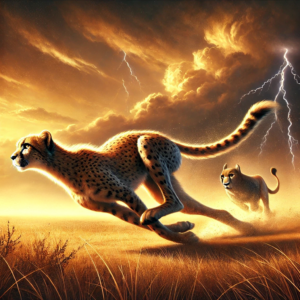 “Lions are no easier to fool than anyone else, but they were built to chase lightning wherever it strikes. That’s what thunder does.”
Before the lions came and ate our mother, she filled our nursling ears with tales of The One Who Races the World.
“Races the World was as quick on her feet as she was in her mind.
“She was a queen among cheetahs. A legend across the savanna.
“Impala frightened their cubs with invocations of her name. Hyenas did not steal her kills, for she was strong as well as fast, and she could drag the carcass of a water buffalo up a tree like a leopard, so that only the boldest of baboons would dare challenge her for it.”
Races the World was like a goddess to me. Countless silver nights curled up together in the long grass sheltering under a fallen acacia, begging our mother to tell us another, and another, and another. Of Races the World’s adventures, I could never get enough. I used to wish my mother had given me a proud name like hers, a bold name like hers, but I am only The One With Tiny Spots.
My brother is The One With A Dancing Tail and my sister is The One Who Sheds Black Tears. We had seen the rains come but once and we were three days and nights alone. Three days and nights as orphans. Several times that spent hungry, near starved. Our mother could not feed us anymore; not while she fed the fly-bitten bellies of lions.
Dancing Tail complained first of his empty stomach and how weary he’d grown of running, so I stopped him in the brush to chase down the fresh scent of a hare.
“I appreciate you,” Dancing Tail said, stretching out his long limbs beneath him. I considered giving him a warning not to grow too comfortable, but we’d not rested since before, and we were all tired and hungry. I didn’t have the heart to push him. Not even if our mother’s stories had taught us to be stronger.
Black Tears said nothing. She was the better hunter of us, what little practice we’d been given. But her eyes — measured, focused, and still — told me not to make a mistake. They said that she would not help me if I did.
* * *
I stalked the hare like our mother had taught us to stalk, patient and slow. “We are cheetahs, and we are not given second chances.” If I did not understand it before, I understood it then.
The hare was young and reeking of milk-scent. I followed her trail between brush stalks and golden swaying grass reeds until I spotted her ears. Somewhere out there was a litter of hare cubs, squirming and blind and useless. Possibly fur-less. All they had was their mother, and they would die quickly without her.
The first impala we ever ate was a young female our mother had brought down at the edge of the plains. She’d taught us between heaving breaths how to pull the skin free, how to split open the belly, how to fill our stomachs with the best parts of a carcass quickly, before hyenas or lions or painted wolves came to steal it.
I had never seen a dead impala before. I did not know the moist-slick mass, still blue with its fetal sack, was an unborn cub until our mother told us. I’d crunched through its soft skull, and I did not feel any guilt. I felt none for the hare now, but I twinged ever-so-slightly imagining her litter, tiny and helpless and so much like me and my siblings — my chest clenched with hurt.
Then I ran.
The One Who Raced First was born from a bolt of lightning that’d lanced down and struck the first of the First Cats. We are bolts from the black. We are energy incarnate. We burst to top speed from standing in three heartbeats flat.
Young and underdeveloped as my bones and muscles were, I closed in on the hare. It had not one hope of outstripping me. The ground became a blur. I stopped moving my legs for it was them that moved me. Inertia and instinct.
“If you think, you fall,” my mother had said to us. But that was why Black Tears caught more prey than I ever did.
A scent hit my nostrils through my next gulp of air, and I could not help myself. I slid to a halt. The hare’s fleeing footsteps faded in my ears, but I was not watching. I did not care.
We were born from lightning; lions came from the thunderclap after.
* * *
“The lions! The lions are here!” My fur trembled, feverish with race-rot — that sinking, heady feeling that follows a sprint to the edge, when the world swims before the eyes and the sun glares inside the skull.
Dancing Tail sprang to his feet. “What, where? Did you see them?”
Black Tears remained sitting. “I thought you left to catch a hare.”
“I called off the hunt because I smelled them. They’re close. I don’t know how close, but we must leave before they find us.”
“You smelled them, but you did not see them, and so you abandoned the hare.”
I have never wanted to kill my sister, but at that moment I came close. Her callousness dug into me like her tongue was tipped with poisoned spines. I hissed and spat in frustrated circles. I held my own tongue, but I held it barely.
“We don’t have to fight each other,” Dancing Tail said. “We’ve tricked them before.”
And indeed, he was right. The lions had not been content with our mother. This was not the first time their scents had drifted down to us on the breeze — they weren’t even hiding, that’s how we knew how little we meant to them — and we made use of the environment every time they came near. Switchbacks through the brush, false trails, looping paths that intersected with one another and shot out in different directions.
These had also been tricks our mother had taught us through the old tales of The One That Moves Shadows. If Races the World was like a goddess to me, Moves Shadows was like a goddess to Black Tears.
Black Tears gaped her jaws wide in a tongue-curling yawn. I forced my twitching tail to lie still.
“Let’s get it over with,” Black Tears said. “Hopefully you didn’t scare all the prey off with your yowling.”
“Only the ones slow enough to be caught by you,” I said.
“All of them, I see.”
I glared at my sister. She gave me a blank glance back. Then she turned away from us.
I sighed and pawed at the parched orange dirt. I wished she didn’t follow so closely to Moves Shadows’ favourite lessons, the ones our mother had so often repeated:
“The strong cheetah she is; she hunts alone.”
* * *
It took us until the first high heat of the day to finish our rounds. By then we had no appetite for hunting. Fear is one of the great constrictors, and we had spent so very long afraid. But we couldn’t risk standing still, either. While cheetahs sleep at night, lions are wide awake. To stop was to die. We needed to take every opportunity we had to make distance.
So, we started off and did not stop until tingling exhaustion forced us to. I sank onto my side, soaking in the cool dry earth. Dancing Tail curled up beside me. I shed heat through my open mouth, and each inhalation raked in great lungfuls of evening scent.
The musky tang of distant zebras and wildebeest skipped across the breeze to me. Dust, pressure, and the coming rains. Beetles and bugs and moisture in the air. My sister, my brother, and—
Lions.
I scrabbled upright, huffing, filtering through the scents for new and old, strong and weak, predator and prey. I had not been mistaken.
The lion scent had not gone away. If anything, it had grown stronger.
“Wake up,” I said, nudging Dancing Tail and Black Tears in the ribs. “The lions are coming.”
I could tell right away that they did not want to believe me. But the chance of ignoring a serious threat for a few fleeting moments of ignorance was not worth the trade, so they parted their jaws and confirmed my findings for truth.
“That’s impossible. How did they find us so fast?” Dancing Tail shivered. He was already the smallest of us, and he seemed to shrink further.
“They learned what we were doing.” Black Tears’ tail tip flicked up as if batting off flies. “That’s what we get for doing the same things over and over again. And whose idea was that?”
“Don’t hiss at him,” I said.
“Then you better hope you have a plan.”
I hesitated. This was not for lack of an idea, but for the nature of the idea I had. But both my littermates were staring at me, waiting, and I lowered my eyes as I said, “There’s always the Wall.”
The Wall was a dangerous place. A deadly place. Our mother had warned us in thrice as many words: humans with loud sticks and dogs, rock beasts on baking black paths, fields upon fields where nothing grows. The whole world changed on the other side of the Wall, but what other choice did we have?
“Maybe the lions won’t follow us past,” I continued. “Nobody crosses the Wall. And we can’t be far from it by now. See the baobab splitting the rocks? It’s the vulture skull stones.”
Our mother had brought us to the edge of that baobab once to tell us it was the edge of her territory. When we’d asked her why she didn’t go further, that’s when she told us about the Wall.
Neither of them liked my plan; I could tell this too. But nor did they see any other option.
“All right,” said Black Tears. “To the Wall.”
* * *
The lions stalked us throughout the night.
Several times we swerved off to the side and attempted to bed down, but the lion scent strengthened in half a cooling cycle or less without fail. They kept on coming. We had no recourse but to forget about sleep. Forget about resting. Move and move and move some more.
Cheetahs were not made for the night. We were born of lightning and nursed by daylight. Divots and grooves appeared beneath our paws, and any misstep into darkness could lead down gulleys or dry streams or crocodile-infested rivers. We had no way of knowing. We’d never been there before, and we could barely see.
At the point when the moon had begun to arch its descent, Dancing Tail took the lead. It was his turn to sweep the earth and guide us through the treacherous landscape. I kept my nose to his tail-tip, ignoring how it made me itch and sneeze. It was about the only way to keep together, our scents mingled and muddied as they were.
Then my brother disappeared.
“Dancing Tail?” I called out as he yelped — a sound that grew dimmer beneath a shatter of small stones down below.
Black Tears crouched beside me. Her ears flattened. “He must’ve fallen.”
Wordlessly, cautiously, we picked our way down the slope. It stretched near vertical from where Dancing Tail had stepped right off, and I had more than a couple close calls tempting a similar fate.
When we reached the bottom, Dancing Tail was hissing in pain, but alive.
I let relief brush through me before I saw his front right paw. It was twisted. Almost backwards. Broken.
“It hurts,” he said.
“Tiny Spots….”
“I know it hurts, but we must keep moving. Do you need help up?”
“Tiny Spots….”
“Come on, just lean on my shoulder. You can stand.”
“Tiny Spots!”
“I know what you want,” I hissed back at Black Tears. “It isn’t happening.”
Black Tears was no more than a pale outline in the deep grey gloom behind me. Still, I thought I could see the disapproval in her twitching whiskers. But by some miracle, she protested no more — not when we lifted Dancing Tail up on either side, not when we slowed our pace to a creep carrying him between us, and not when the lion scent began to overpower the scents of strange rock and dead wood closing in from the distance. Not one of us said anything as dawn came overhead. Not until we saw the Wall.
Black Tears stopped first, her eyes open wide.
I could not help but do the same.
The Wall stood as tall as a full-grown cheetah on her hind legs. Impenetrable. Thin bones of glittering rock crisscrossed each other, all strung together so as not to allow even a mouse to slip through the cracks. The very top was tipped in thorns.
“We’re trapped,” Dancing Tail wailed.
Neither Black Tears nor I responded, because we both saw it to be true.
“There must be a way around,” Black Tears said after a moment. “How else would stories get in?”
And then I glimpsed it: a break in the glimmering mass, a hole farther down the Wall the size one of us might squeeze through. “There, quickly!”
We pushed ahead as swift as we were able. It wasn’t fast enough.
The grasses behind us crunched under confident paws. Growls understood without a word to accompany them. The markers of killing intent. It wasn’t long before we saw their golden fur, too, along with their golden eyes.
The lions.
“We won’t make it,” Dancing Tail cried.
He was right. The lions spread out around us, carving the shape of a crescent moon. They would spot the gap; they would run us down. This I knew as I knew my own spots. So, I did what only someone as brave and brilliant as Races the World would do.
“Keep moving to the gap in the Wall,” I said. “I’ll lead them away.”
“Don’t you dare!” Black Tears said, but I was already running.
Lions are no easier to fool than anyone else, but they were built to chase lightning wherever it strikes. That’s what thunder does.
Where my littermates went to one side, I veered to the other. Taunting, close, like prey bolting out of instinct. Fear. The lions caught on like flame, and suddenly the grasses burst alive with giants.
This is also true about lions: they are much larger than even a full-grown cheetah. Our heads fit right in their mouths. I have seen this with my own eyes. My mother’s shoulders fit, too.
My courage wilted in a blink.
There were a dozen lions now — all leaping and lunging out at me, their paws bigger than my head, their claws thicker than my spine. They could kill me in a moment. I tensed my tired limbs and ran.
What started as a distraction turned on a fang-tip to survival. I raced without a thought for where my littermates were, or why I was running, or where I was leading the lions to. I didn’t think about why, or how to slow down to ensure the lions kept up, or what I would do once Black Tears and Dancing Tail escaped. I felt hot breath against my fur. I felt death closing in. I felt my heart beat faster, faster, faster, until I was sure it stood moments from giving out of race-rot.
Then Black Tears caterwauled. Loud and insistent. It was a dying wail, a fear wail, and it drew the lions up short to stare.
I am ashamed to admit it, but it’s true: I did not look twice. I did not glance around. I did not take in what had happened or where my brother and sister were. I flung myself through the gap in the Wall and I did not slow down until I tripped and rolled under a dry bush beyond.
It was only afterwards that I searched the grass for my littermates. Black Tears padded to my side, head bowed.
Alone.
“Where is Dancing Tail?” I asked. I already knew. I had to have known.
Black Tears lifted her eyes to mine. There was a defiant gleam in them. Defensive. “He wouldn’t have survived.”
I don’t remember if I did or said anything right after this. I only remember moving, and then Black Tears saying, “You don’t want to see.”
I didn’t listen.
When the lions ate our mother, we could not bear to watch. I could not bear this time any better, but just as strongly I could not make myself turn away.
Dancing Tail was already dead. I am glad that he was. Had he still been suffocating in a lion’s jaws, had I crouched in the long grass watching, I might have thrown myself back into the pride’s claws out of guilt.
I watched the lions finish eating what they wanted of him. I watched them purr and hum and groom each other. I watched the vultures descend. I watched the lions stand up, stretch, and leave.
“They were going to catch you, Tiny Spots,” Black Tears said. “You know they were. If I hadn’t brought the lions over, it would be both of your skeletons in the grass. I saved your life. And even if we’d saved him… He died quickly now; he would have died slow and alone much later.”
There is one more part to the legend of The One Who Races the World, and that is how she died. The story had always upset me — pouting and mewling for days after I’d heard it, but our mother would groom my ears and tell me it was important to listen. There were things that even Races the World could not outpace. Age, the rising heat, and the selfishness of our own kind. As she lay down, old and dying and mere paces from water, seven cheetahs passed her. Not one stopped to help. She died like that, a goddess to me, nothing and no one to anyone of her time.
I did not look again at my sister. I watched the vultures pick our brother clean.
“Please don’t hate me,” she said.
“This is the way things are,” she said.
“Cheetahs hunt alone,” she said.
She must have left soon after, for she didn’t say anything else. Eventually I fell asleep where I sat. My dreams were filled with storms, and every cloud pierced a hill with blue lightning, but lightning does not last forever. Lightning lives for a blink. A moment. A speck of time in the skies above the grasslands: beautiful and striking and gone much too soon.
* * *
 About the Author
Leo Oliveira is a queer writer from Ontario, Canada, where he harbours a soft spot for rats, pre-history, and flawed queer characters. His work has appeared or is forthcoming in Radon Journal, Fusion Fragment, and Port Crow Press, and has been nominated for the PEN/Robert J. Dau Short Story Prize for Emerging Writers, Brave New Weird, and Best Horror of the Year.
Herdhunters
by Mike Robinson
 “Instinct told her to turn back, but what possessed her was not normal instinct. It was herdwind, maybe even greater, too, the winds of many herds well beyond her own, fanning a deathbringing fire.”
Southern Africa
3 Million Years Ago
1.
They never believed her until she described the screams. She knew why. Recalling the brain-goring terror of those sounds, from the high squeals to the deep, resigned rumblings, broke open all the realness of that night through her, and her telling of it.
Sweetfoot liked surprising others, especially youngkind. Bigcats threatened the young, some might say, but that threat was finite, and the calves were safe within the thick forest of the herd’s legs and trunks and the canopy of their tusks. In general, the bigcats knew not to even try.
But that was why she told them of the Five Waters: the only place with bigcats bold enough to take down grownkind. They would come at night, lurking on the edges of the grounds, letting themselves be sensed at choice moments. It was artful spooking, a slow build-up of panic. Consisting mostly of females, the bigcats would circle closer, scouting, floating in and out until they’d managed to isolate a young unattached bull, one usually wedged in mud.
At the time, Sweetfoot was only a few seasons old. She couldn’t see much, as it was dark and her clan had quickly enveloped her. Her Clan Mother had insisted they leave the Five Waters. But through the surrounding bodies, she caught glimpses of what was happening: the bigcats perching themselves on different ends of the young bull, one clutching the trunk while others held the legs and all digging in like parasites with tooth and claw. Still more awaited their role of taking out the eyes, which would unleash the worst of the screams.
Today, as a Clan Mother herself, Sweetfoot told that story mostly through those screams, so that the youngkind might always be vigilant. Particularly her own male child, Two-Step, a season-cycle old and a clumsy walker since birth.
Every newborn, it was told, was delivered from the Windrealm, and so had trouble steadying themselves. Yet Two-Step’s struggles were unique, his legs misshapen, maladroit — it had taken many tries just to stand him erect for longer than a blink. Using mostly his front legs, he had, with effort, begun pulling himself forward. He staggered. Hopped. Eventually, over many days, with the supervision of Sweetfoot and the clan’s other mothers, he found his strength and his balance. Because of all this, his Name had come swiftly.
Still, Two-Step had proven the most spirited of her offspring. He played as much as he could, squeal-crying his frustration when he could no longer keep up with siblings or playmates of other clans. Periodically, Sweetfoot would have to right him. It made her anxious, seeing his Windblown spirit struggling against glaring weakness.
Hearing of the bigcats at the Five Waters, Two-Step wondered aloud when he might be much bigger than the biggest of all bigcats. Impatient, Sweetfoot replied that it would take many seasons. As demonstrated by her story, not even a young bull could guarantee escape from the interest of bigcats.
Were there bigcats so big, Two-Step asked, that could swallow whole clans — or herds? His cousin Springtrunk had remarked on herdhunters: great rare roving beasts that outmatched even the mightiest kin.
Always, it came to this: the morbid wonder of the young. There was thrill in grand unknowing, in imagining the many beings that might populate the savannah, its trees and waters, its rocks and burrows.
But no, Sweetfoot told him, the notion of “herdhunters” was not true. Unlike her account at Five Waters, it was a fanciful idea, passed from clan to clan, herd to herd, mainly to titillate the young and not a few of those grown who still enjoyed such stories. But nothing encountered by any of their kind — not the bigcats, spotted or otherwise, the toothy water-dwellers or the hook-beaked birds — would ever presume to destroy an entire herd. Nothing walked that might threaten whole groups of grownkind.
2.
Sweetfoot’s own Name had been given late. In those early days, through the Five Waters era and for seasons beyond, she was among two in her clan simply called Littlewind, a common placeholder for those who had not yet earned the distinction of a Name.
Earning a Name meant you had been delivered here in full, in this world, in this body. One could not fully control when that happened, though — it was up to the winds, perennially unpredictable.
One night, as Clan Mother, Sweetfoot slept and crossed into the Windrealm, where memories blew together to make dreams. She felt young again. She was small and restless, back with her old clan in the northerly territories.
Her Clan Mother had brought them to the tree of the dizzyfruit. Higher in the branches, two smaller dark forms stirred, clearly agitated with the clan’s approach. Their vocalizations were hesitant, cautious. Their smell was unique, too, layered and ripe.
Tree-dwellers, they were called. Light-furred and walking mostly on two legs. Trees were their refuge, though not so much from the larger spotted bigcats. Yet much like her kind, tree-dwellers appeared to find strength in family bonds. They coalesced against threats.
Locking her tusks on the heftier branches, Clan Mother wrestled the tree, and the dizzyfruit rained about, where others sniffed for them, trunks curling and whipping overground.
She wasn’t sure why, but in a burst of impishness, Sweetfoot began stomping the dizzyfruit, smooshing their innards all over the bottom of her feet. She found it fun. Cathartic. Until the disapproving honk from Clan Mother, forcing her own mother to step in and halt her play.
Soon after, when she’d eaten enough dizzyfruit, and the world tilted and spun and she laid down, she felt the tickle of other trunks on her feet, and realized other youngkind were scraping off her what they could while she lay there. It was all so silly, a pleasant memory they would all keep.
And so it was, decreed Clan Mother, that she had fully entered this world as Sweetfoot.
Somehow, though, right now, Two-Step was here, among those eating pieces of dizzyfruit off her. In the body of her younger self, she saw him less as a child than a peer. His curiosity was palpable, too, heated like a presence.
She wanted to ask him: why are you here?
But then, in a blink, she awoke. Newday sun glowed dimly on the horizon. She rose to her feet and grazed a little, feeling groggy and oddly disoriented.
Moments later, Two-Step awoke, too. To her astonishment, he recounted what he had seen during the night. Her old clan. The tree-dwellers. That he knew now why she was called Sweetfoot. How he had enjoyed the taste of the dizzyfruit.
Sweetfoot was confused. Had the Windrealm played some sort of trick on her? Or was she still dreaming? No. The sun was rising, the savannah taking steady form around her.
No doubt: she had awakened. Returned.
How, then, did Two-Step know of her dream?
Two-Step himself seemed not to think much of the strangeness. He was happy they had shared an intimate, unexpected moment. He liked seeing her so young, closer to his age.
She considered he might be special, in ways she couldn’t comprehend. Yes, he had been given a name. In all manner of body, he was here. But perhaps some portion of his spirit remained elsewhere, in the shadows of the Windrealm.
*
The season was warming, the sun higher and lingering and driving moisture into the earth. Once eight members strong, Sweetfoot’s clan had come to include several other families, bolstering their herd to over thirty which she now led as they trekked for water, swaying in a loose line of dusty backs lined with dried mud.
Several days in, Sweetfoot heard a cry. Far away, but she was fairly certain—a tree-dweller.
She knew they did not tend to travel far in droughts, which could mean, potentially, that there was a water source near them. As the herd walked, she and several of the younger mothers also picked up scent traces of water on the wind, coming from a northeasterly direction.
Two-Step was now three season-cycles old. Though he managed to keep general pace with the herd, his gait remained awkward, slower. As always, there was a mismatch between his body and his spirit, the latter of which (perhaps because he didn’t move as fast) seeking to pry and to poke at things unwelcoming of his touch: the ground-dwellers in their burrows, or the limbless slithers in the tall grasses. Occasionally, when they were grazing, he would wander, as if in search of some other, unknown food. Angry horn-heads had once charged him away from their herd of hundreds. For this, he had received taunting tremors from even younger males.
One day later, they reached the water source — a murky pool, too small for a water-dweller. A skinny bigcat crouched at the edge, lapping away before sauntering off.
There were tree-dwellers near, too, little more than dark lumps dozing in the branches. Sweetfoot had smelled them well before. Their odor was unique, and could ride the wind — likely what made them vulnerable, and why they remained mostly treebound.
The herd gathered round and drank what they could. At some point, Sweetfoot lost track of Two-Step. Smelling the air and surveying, she found him maybe fifty paces away, standing in grass halfway between the water and the place of the tree-dwellers. She called to him, but he didn’t respond — he was spraying dust on himself in curt, playful snorts.
She went to him.
A sudden, extra plume of dust rose from the grass. As Sweetfoot drew closer, ears perked, she spotted a young tree-dweller. A female, by the smell. Very young. She made soft chirpy noises as she scooped up dust with her limbs and tossed it all over herself. She coughed — a little puff. Her eyes projected light. It was impossible not to see her playfulness. Like she was imitating Two-Step, and enjoying it.
But when Sweetfoot came close enough, the young tree-dweller grew alarmed and scampered back to the tree, where her elders received her. They issued minor yelps, which might have been challenges, or scoldings. Either way, they didn’t concern her.
She told Two-Step to rejoin the herd, thinking distantly, shapelessly, how amusing it was that the winds of play reached every young form — and spirit — of the world.
3.
It was multiple seasons since Two-Step left the clan when Sweetfoot, for the first time in her life, knew the intimate brutality of an attack.
Once part of a larger herd, her new clan had broken off and now numbered about fourteen. She led them west, where grazing promised to be more robust. This was also the general direction of the Five Waters, though of course they would not be going there.
At first, she thought maybe the memory of those screams was the cause of the sudden, terrible unease which had descended on her, and which slowed her movement. The rest of the clan slowed with her. Some issued curious grumbles and tremors.
But she kept to herself, which appeared to make them that much more anxious. They wanted to know what was wrong. Yet Sweetfoot could hardly respond for the weight that had struck her out of nowhere — not in body, but in spirit. A Wind harsh upon her. A dream, ambushing under the waking bright of the day.
There was sharp bigcat smell. A dreadful sense of being pulled down. There was twisting. Wrenching. Biting. Ripping. More: the wailing, the anguished cry which seemed to have carried over from her memory of Five Waters, but which she knew belonged to another, younger male, one she could not see, nor smell, nor see — not in body, not now — but who in the throes of death had reached out to her, in his special way, across the Windrealm.
Without any contact with him, she knew, in that moment, that somewhere Two-Step had fallen.
Sweetfoot stood still. Terrified. She had not encouraged him too strongly to leave the clan. She had left it up to him, and he had chosen to go. It was not surprising, considering his restlessness. He might have joined a clan of young males, though that was unlikely. He had set out alone, and probably stayed alone, traversing the savannah with his strange, clumsy walk, not fully grown. Small enough for the larger, more determined bigcats.
Chaotic as the vision had been, she sensed that Two-Step’s attackers were large young males, well-maned and maybe siblings, traveling together.
A flame of Threat sprang up inside her. The feeling of omen. This portended bad things—a growing Threat from the biggest of bigcats, who, generation by generation, might just be growing big and bold enough to take on more grownkind.
She would warn the other mothers in her clan. They would seek other clans and become a herd again. Perhaps, together, they ought to concoct further stories to frighten and instruct the young — tales of enormous, tree-sized bigcats that could circle whole clans with their patient pawing stride and death-lit eyes, that might just be big enough, vicious enough, to become true herdhunters.
*
The vision of Two-Step’s death haunted her, across miles and nights and even a whole season. It was the way of males of a certain age to leave a clan, to wander and seek out similar-aged males and female otherkind. The risks to them were clear, but necessary. Her other male, Moonback, had left well before Two-Step, yet she had not thought much about him.
She had, however, thought quite a bit about Two-Step. Through the seasons, he had kept close to her in spirit, if not body. Part of her imagined the winds would guide them together again.
Cold season was coming, the insects fewer and water more plentiful since the recent rains, which had lasted days and which still blurred the horizon in great pilings of clouds. Leading her clan to better grazing, she tried to downplay the distress, but could feel inquisitive tremors about her, and knew they wondered.
They passed a tree full of tree-dwellers, sleeping and clumped together for warmth. Did their males leave, too? She never saw them alone.
Along the way, she led them to the site of a fallen youngkind, a place she remembered from her early days as a mother, before becoming Clan Mother. It had been another solitary male. No one had known how he had died, yet no one thought it had been the bigcats — even as they, and other sharptooths, had taken swift advantage.
Only scattered bones were left now, including a partially buried skull. One whole tusk jutted from the earth. Sweetfoot caressed it with her trunk, issued perplexed, agitated murmurings. She had never known this male’s Name, nor his former clan. But he was their kind, part of a much greater herd: all those who had come from the Windrealm, and those who had gone back to it.
Anger rose in her, which she released in low, ominous grumblings. Had she spotted a bigcat just then, or even something that looked like one, she might have broken all chains of obligation to her clan to chase it down and destroy it.
The rest of the clan gathered close, unsure as to the nature of this visit, or this deadkind. Yet they maintained quiet respect, even as they especially did not understand why she referred to these bones as Two-Step.
4.
Half a season-cycle later, she dreamed — finding herself in the Windrealm.
Darkness pressed palpably at her eyes. She heard only the soft hurried chatter of the wind and, more alarmingly, smelled only decay. Death colonized her whole trunk, creeping up and filling her skull with its own nightmarish herd.
She also detected ash.
Gradually, the darkness broke into discernable shapes. There were hills and trees and grass, much like the world she knew, but all of it felt different — sinister, like a creature waiting in camouflage. Her trunk grasped about for anything. It made its way upon bone, familiar in its contours and sockets and dimensions. And there were more, forming out of the earth and shining dully not by any moon above but by an eerie negative light.
The ground was littered with the skulls of otherkind. None of them felt right, though, because something was missing.
Their tusks. None of them had tusks.
A slow, subtle terror rose in her. This was new. It represented some unknown, terribly unprecedented Threat. Tusks were marvels, artful in display, useful in defense, a feature unique to their kind.
She felt tremors underfoot — rumblings — and knew instantly who was speaking to her. She smelled him, too.
She turned and faced Two-Step, now standing aways from her. He was much more grown, and seemed to walk without difficulty. Any happiness at seeing him, however, was tarnished by the memory of what she’d felt of his death.
And, it seemed, whatever he was trying to convey.
A warning, she thought, frightened.
He came closer, enough that she could see him more clearly. Half his face was gone, the exposed skull dully aglow like the other bones here and the flesh of his trunk and remaining ear hanging in bat-like strands. He was his own cloud of deathsmell. His tusks, however, remained intact.
Sweetfoot sent her own tremors: a jumbled conveyance of her guilt and confusion and fear. She couldn’t think or vocalize straight, and it frustrated her. But then, maybe she wasn’t supposed to talk — maybe her words were just dusting over what Two-Step had come to tell her.
Finally, in a bolt of clarity, Two-Step’s voice reached her:
They will be coming.
Who? Another herd? Clan?
Herdhunters.
She was puzzled. Herdhunters were not real. But there was only one creature that could fit the role.
Sweetfoot answered: Bigcat.
He just stood still. Then, after a moment:
No.
He undid his trunk, unleashed a cry. His ears perked. He backed up a step, trembling such that dark chunks rained down off his frame. Sweetfoot turned to see what he was reacting to and startled at the large object that had suddenly sprouted there.
It was a tree, or something like it. It glowed like the bones and the skulls around her but that was because, she realized, it was made of tusks. Like they were at once the branches and the thorns, arranged as frozen white flames against the night.
But it wasn’t this tree of tusks that ultimately commanded her attention. It was the eyes among them, peering out at her like stars. She stepped closer, raised her trunk and smelled the wind and knew instantly that odor, layered and ripe. Distinct. The eyes moved and the shadows came alive and there were sharp cries, too, which she’d heard many times and considered almost precious.
Tree-dwellers.
Her bewilderment only grew. As did, it seemed, Two-Step’s agitation. He stomped, kicked up dust and ash, ear-flapped like any fight-ready young male.
The tree-dwellers moved in a way she’d not seen before. They seemed to pour down from between the tusks, mobilizing with a strange, headstrong confidence, unlike those she knew who often took anxious refuge in the trees, and who tended to avoid high grass.
Reaching the ground, they split off one another, eyes still staring ahead. Then, remarkably, their shape and their smell began to change. They rose — standing straighter and taller. Their hues and textures varied, too. They carried strange objects.
Threat overwhelmed her, as did unexplainable anger. They were dark spirits, these new tree-dwellers, long gestated in the silly bodies she knew. When they would shed their current forms for these taller, stranger ones, Sweetfoot did not know. But it was, somehow, inevitable.
One of these new tree-dwellers raised a stick-like object (their own trunk? she wondered for a second) and suddenly there were short, resounding thunder-bursts and a series of bright flashes and pop-whiffs of smoke.
A thing struck her — or bit her, she couldn’t tell. More bursts and there was thumping pain which grew worse. Threat crashed down upon her like it never had —these tree-dwellers wielded thunder, had somehow ripped it down from the sky.
She trumpeted and charged, driven less by her own intuition than by forces unseen, as if, in these Windrealms, the spirits of many otherkind had found her, and filled her limbs.
The tree-dwellers broke away. Their definitions blurred into the gloom of the grass. More thunder around her, though she couldn’t sense the source. Two-Step was gone, a lingering deathsmell. Sweetfoot cried out for him, and there was an answer but it wasn’t him — it was Many, a storm of tremors underfoot, great echoes of desperate calls from her kind issued down countless seasons she would in fact never see but which, dimly, she understood would darken with the blood of every generation as the tree-dwellers came with their thunder, surrounding her and surrounding them, all of them, the way bigcats might wounded prey yet these stranger tree-dwellers circled not just one of them or even a clan but a whole herd, and not even just one herd but—
She awoke. A singular sensation had overtaken her: a greater drive, Windblown into her limbs.
By the time she was even half-aware of what she was doing, Sweetfoot was moving, climbing to her feet and hurrying away from the clan. She sent out tremors, letting them know she would return. They sent back baffled cries and vocalizations. A young mother named Tornear almost trumpeted. But she had to go. Two-Step had sought her across the Windrealm in order to warn her.
Sweetfoot made her way across the land. Instinct told her to turn back, but what possessed her was not normal instinct. It was herdwind, maybe even greater, too, the winds of many herds well beyond her own, fanning a deathbringing fire.
Nor far away, other creatures watched with dull interest as she passed—horn-noses, and some of the smaller, more graceful ones that could outrun the spotted bigcats. With a flyflick of the ear, the horn-noses returned to grazing.
She had seen tree-dwellers impaled on those horns, when they drew too close. She had seen tree-dwellers hopelessly mauled by every manner of bigcat. Surely some had been lost to the jaws of the water-dwellers, those that sat like logs before hunger-whipping their prey.
How, then, could tree-dwellers pose a threat to their kind? Or, more astonishingly, to herds? Herdhunters were a thing of myth.
Soon, she found herself facing the tree they’d passed, across a long stretch of grass. She could make out no movement, but with her trunk she knew that ripe unique smell. Her reaction to it had changed suddenly, bringing with it darkness and decay.
Sweetfoot strode forward. The smell was curiously strong. As if—
Then, there was movement — close. A dark figure hopping in the grass. Definitely a tree-dweller. Anger flared in her.
She stepped closer. The odor clarified. It was a breedready male, and he appeared to be chasing something. She caught whiffs of a small ground-dweller.
Closer and closer, she stepped. The creature didn’t even seem to notice her as he jumped about violently. This was strange. It was unlike them to spend much time in high grass.
As Sweetfoot edged toward him, there was a squeal as he raised his arm and slammed it down over and over. He was holding something, too — a stone, which increasingly smelled of blood.
He was killing, over and over. Then he lifted the battered body of the ground-dweller and when Sweetfoot saw and smelled this in full she broke out in terrible aches, as though she and the ground-dweller were the same.
In one explosive moment, she charged this creature.
The tree-dweller screamed and tried to run, dropping his prey and bolting, arms swinging but managing only a few paces before she overtook him and jousted with her tusks, bucking him forward where he sprawled limply, screeching for the rest of his clan who’d now come alive in the tree thrashing and crying.
There was no way to stop her, though, as she stained her soles with the blood of this dweller, felt the pathetic ease with which his whole body broke under her power.
At some point she could no longer distinguish the ground from the body. The smell and the cries only enflamed her resolve, and she turned her back toward the tree and charged, trunk raised higher. The tree-dwellers jumped and screamed and clambered, dark shadows in the dark of the canopy.
She circled the tree, wide-eared, bellowing sharp, raspy trumpets. Several dwellers climbed higher. Others hurled things at her, mostly fruit and feces.
In the excited panoply of smells, Sweetfoot picked up one she knew better than others: a female. Younger. Familiar.
Yet that broke nothing of her temper. The image of Two-Step — face ripped, skull aglow like all those lying tuskless at her feet — burned deeper into her. She charged the tree and the tree-dwellers scrambled higher, and Sweetfoot rose on her hindlegs and sent her trunk curling up and grasping the branches and she ripped one down, catching an older male tree-dweller who plummeted shrieking to the ground. On her feet she mixed the other male’s blood with his, bones pop-snapping and the screeching cut short and the rest of the tree exploding in screams and crazed across the canopy. She grabbed at what branches she could and tore them down, and she leaned her bulk on the tree for leverage but the furry creatures were all unreachable and then they started dropping down the other side of the tree and hurrying away in erratic trails through the grass. Sweetfoot ran after them, catching an older female and shattering her lower half before seeking another, training on the smell and the wayward paths and the shrieks echoing over the savannah.
In the storm of this moment, new sensations bombarded her, making her feel both ill and empowered. Not unlike the effect of too much dizzyfruit.
The grass grew higher. Wind picked up. The tree-dwellers fanned out, but with her height and her trunk full of wind and odor Sweetfoot could still follow them. Another of the older slower ones fell easily. She now had generations of tree-dweller blood on her feet. She turned, trumpeted, charged again, acuity sharpening with every kill.
She paused, took in the air. Their smell-trails had lowered. Picking up one stronger, steadier odor, she followed it across the field.
When the grass parted, she halted for the sudden drop-off, steep and muddy down to a body of water connected by a thin ravine to a larger body of shallowing water.
Crouched just under her was a female tree-dweller. Her foot was twisted, and she was crying out. Sweetfoot recognized her. It was, indeed, the young, playful female who, several season cycles ago, had imitated Two-Step by tossing dust on herself.
Except she was older now, clearly breedready, as indicated not only by the menstrual smell but the whimpering child, now clinging to her fur.
The tree-dweller struggled a few paces between Sweetfoot and the water, injured, terrified. Sweetfoot huffed and stepped to the side, the tempest in her calming. Slowly, the empowered feeling left her, leaving only the illness.
Here, below her, was mother and child. Here, below her, was the tree-dweller who had interacted with Two-Step as if, briefly, she were of their kind.
In the water, soft ripples appeared. A pointed shape drew closer.
The tree-dweller clutched her infant as she limped — or tried to — up the slippery mudslope. Her utterances grew higher, more erratic as she kept glaring back and forth at Sweetfoot and the edge of the water.
Much as with her anger, Sweetfoot could not comprehend that which now spread through her. It was like sunlight, warming away cold. She vocalized, but not in a challenging way. It was a surge of alarm for the pathetic broken creature and her child strewn just under her.
She set her front feet down on the incline, then reached out her trunk. The water-dwellers were of their own world — an alien one, with which Sweetfoot could find no sympathy. But there was a distant spark with the tree-dwellers. Even a kinship, one which had nothing to do with body but which dwelled, perhaps, on the Wind. At some level, a gust out of their eyes could reach her.
Her trunk hung there. She curled and flipped it, hoping the tree-dweller might somehow understand. She sent reassuring tremors — futile.
The water bubbled slightly. Sweetfoot acted, lunging and slipping her trunk around the shoulder of the tree-dweller just as the water exploded with teeth, and she pulled up, mother and baby yelping and drag-kicking a deep groove in the mud quickly covered by the girth of the water-dweller.
Sweetfoot released the tree-dweller atop the ridge. The baby fell helplessly but the mother scrambled and hastily scooped it up. With a brief, harried look at Sweetfoot, she raced away into the grass which swayed with her path, until her motions became the wind’s.
She stood there a moment, sniffing after them, rumbling to nowhere, no one.
Dazed, Sweetfoot made her way down to the water’s edge. The water-dweller had returned to the murk. It wouldn’t bother her. She waded into the shallow end and drew up a volume which she drank, desperately. Her pulse slowed. Then she sprayed her back, cooling her body. Rinsing the dust which felt like ash on her.
* * *
 About the Author
Born and raised in Los Angeles, Mike Robinson is the award-winning author of multiple novels and dozens of short stories, most of them speculative fiction. His work has appeared in Clarkesworld, American Gothic Fantasy, Storyteller, Cirsova, ClonePod, December Tales II, Underland Arcana, Thirteen Podcast and many more, and has received honours from Writers of the Future, the Next Generation Indie Book Awards, Maxy Awards, The BookFest, Kindle Book Awards and others. His novel Walking the Dusk was a semifinalist in Publishers Weekly’s BookLife Prize.
As an editor, he has worked with hundreds of authors, including National Book Award finalists, and is the red pen behind J.P. Barnett’s bestselling “Lorestalker” series. A book coach and senior editor with Wordsmith Writing Coaches, he also co-created the New Author Plunge, a workshop for beginning writers, and is on the advisory board of GLAWS, the Greater LA Writers Society, He is also an illustrator, and the screenwriter of the film Blood Corral, which recently hit the international festival circuit.
Migration Mismanagement
by Dana Wall
 “Oh, and one more thing – the flock has requested that you install TikTok. Something about documenting the journey for their followers.”
“Your Projected Migration Efficiency Rating has dropped to 62%,” the sparrow from HR chirped, adjusting her tiny glasses with one wing. “That’s well below the industry standard of 85%, Ms. Honksworth.”
Gloria Honksworth, Senior Migration Consultant at Wingways Solutions LLC, fought the urge to roll her eyes. Twenty years of guiding geese across continents, and now she was being lectured by a bird who’d never flown further than the office park.
“With all due respect,” Gloria said, straightening her neck feathers, “traditional metrics don’t account for the current situation. The warm fronts are arriving three weeks early, the cool fronts are stalling out over the Great Lakes, and half our usual rest stops have been converted into parking lots.”
The sparrow – Ms. Twitterton, according to her name tag – consulted her tablet. “Nevertheless, your last three migration groups have all deviated significantly from their approved flight plans. The Canadian contingent ended up in Miami instead of Mexico City. The Atlantic seaboard flock somehow got lost over Kansas. And let’s not even discuss the incident with the Hudson Bay formation and that squadron of fighter jets.”
“That was a scheduling error! How was I supposed to know the Air Force would be running drills in our airspace?”
“By filing the proper flight path documentation,” Ms. Twitterton replied primly. “Which you haven’t done correctly since last spring.”
Gloria’s neck feathers ruffled in indignation. “The standard forms don’t have checkboxes for ‘freak thunderstorm’ or ‘entire lake dried up’ or ‘wind patterns completely reversed from historical data.’ I’m having to rewrite the whole playbook here!”
“That’s not protocol–”
“Protocol?” Gloria spread her wings, knocking over a stack of migration maps. “I started flying these routes before you were an egg! Back then, we had reliable seasons, predictable weather patterns, actual wetlands to land in. Now? I’ve got elderly geese getting heatstroke in October, goslings who’ve never seen snow asking why we bother migrating at all, and don’t get me started on the mess with the GPS signals…”
Ms. Twitterton made a note on her tablet. “Speaking of GPS, your requisition for new tracking devices has been denied. The budget committee feels the current equipment is adequate.”
“Adequate? Half of them still think magnetic north is where it was in 1990!”
“Ms. Honksworth.” The sparrow’s voice took on a warning tone. “Your attitude isn’t helping. Now, we’ve assigned you a new group for next week’s migration. They’re a young flock, very tech-savvy, very modern. They’ve requested a more… contemporary approach to navigation.”
Gloria’s heart sank. “Please tell me they’re not the ones with the smartphone app.”
“MigrateGr8 is a perfectly valid navigation tool–”
“It’s designed for human road trips! It doesn’t account for wind speed, wing fatigue, or the fact that we can’t just pull into a Motel 6!”
The sparrow sighed and pulled out a final form. “This is your last chance, Ms. Honksworth. Get this flock to their destination on schedule, on route, and within budget, or we’ll have to discuss early retirement options. Do you understand?”
Gloria stared out the office window at the autumn sky. The wind was all wrong for the season – warm and southerly when it should be a crisp northerly blast. Just like last year, and the year before that. But nobody in management wanted to hear about climate change or habitat loss. They just wanted their neat little reports and their efficiency metrics.
“Fine,” she said finally. “I’ll do it. But I want it noted that I’m flying under protest.”
“Noted.” Ms. Twitterton gathered her papers. “Oh, and one more thing – the flock has requested that you install TikTok. Something about documenting the journey for their followers.”
After the sparrow left, Gloria slumped at her desk, surrounded by outdated maps and useless weather reports. On her computer, another email popped up: “10 Hot Tips for Modern Migration Management! You Won’t Believe #7!”
She closed it without reading. Instead, she pulled up the satellite imagery for next week’s route. The weather models were a mess, showing three possible storm systems and unprecedented temperature variations. The rest stops she’d used for decades were mostly gone – drained, paved, or dried up. And now she had to guide a flock of influencer geese who probably thought “ground effect” was a photo filter.
But as she studied the maps, a plan began to form. The official route was impossible – but there, cutting across an unexpected urban heat island, and there, following a new wind pattern she’d noticed last season… It wouldn’t be pretty, it wouldn’t be protocol, but it might just work.
She opened a new document and began to type: “Alternate Migration Strategy: Adapting to Modern Realities.”
Let the HR sparrows chirp about protocol. Gloria had a job to do, and she’d do it the way she always had – one wing beat at a time, adjusting to whatever the changing world threw at her. Even if it meant learning TikTok.
She just hoped the younger geese knew how to fly in formation while taking selfies.
* * *
 About the Author
Dana Wall traded balance sheets for prose sheets after years of keeping Hollywood’s agents and lawyers in perfect order. Armed with a Psychology degree that finally proved useful when creating complex characters and an MBA/CPA that helps her track plot points with spreadsheet precision, she ventured into the haunted halls of Goddard College’s MFA program. Her work which has appeared or will appear in Intrepidus Ink, 96th of October, Fabula Argentea, Summerset, 34 Orchard, Eunoia Review, The Shore Poetry, Dreams and Nightmares, Bright Flash Literary Review and Sykroniciti confirms that words are more reliable than numbers, though occasionally harder to balance.
The Passing of Lore
by Anne Larsen
 “My dam’s eyes do not glow. Why do you smell like her? Where is she?”
My dam remembered when Lore was a sorrel mare with a bad hock. By the time I was foaled, Lore was a dun mare faded by sun and salt water, her muzzle going grey and her eyes — well, Lore’s eyes are what they are: green and gold, like no other horse in our herd’s heritage.
“Can she really see the wind, mama?” my third foal asked.
“My dam said she could, but how can we know?”
“Did you ever talk to her?”
“Only the lead mares speak to her. Sometimes the old aunties graze by her and listen. She tells them the stories they must tell the weanlings.”
“What stories?”
“Soon enough, you’ll know, won’t you?”
He leaned into me then, lipped my udder enough to show that he appreciated my milk, though he didn’t drink much these days. His foal fuzz came away in patches revealing his bright bay coat, a gift from his sire. By late summer my colt would be off with the others of his year learning all the things a horse needs to know to live among his kind on this harsh place: how to see patches of sucking sands, how to brace side-by-side with cousins, rumps to the storm wind and heads low in the lee of their shoulders, how to run and spar in the bachelor band where friend and rival are the same thing because they both strengthen you. But for now he stayed close, bending his knees to graze in the shelter of my body when the wind off the water blew cold.
As my foal would soon do, I had learned Lore’s stories grazing among the senior mares who no longer bore foals but guarded and guided the weanlings into maturity. She remembered sweet grass in marshes far back before men, when only the wind’s hands had touched us and we carried no burdens. She remembered generations when ice locked the land and when it had weakened, she had led her people north to new pastures fed by the waters of its retreat. She remembered the hot, golden hills we had run before we came here, packed in the dark bellies of wooden ships that crossed the saltwater.
One evening, in the dusk after sunset, with the offshore wind fading and the herons settled on their high nests, Lore called us all to Gather. She had never called a Gather in this land before now, but we all recognized the summons as it lived in our bones and blood. The lead mares sent the bachelors up and down the island, leeward and windward, to bring every horse to hear her. Last to come were those on the far side of the fence that humans had stretched from inner sea to outer sea, nonsense dividing the sand. Those horses skirted it by swimming around the sunken end. Rumor said they had left a great pile of manure banked against the sun-warped planks.
By moonrise we were with her in our hundreds, mare and foal, weanling, bachelor, and herd sire. We surrounded her, the lead mares at the center and the rest of us around them, circle around circle, silent but for tail-swish and hoof-stomp when flies bit. The Gather Truce prevailed, so none of the young stallions challenged their elders or one another for mares. They knew the penalty for disturbance was exile, as good as death, for no horse can live alone.
Into our minds she came, silent as snowfall, showing us what we needed to know and what we had to do. “Far over the gray ocean in the direction of morning,” Lore said, “lies an island with a fiery heart. That heart swells and will soon break, shattering the island above it. Most of its body will fall into the sea, making a great wave rise and run. In less than a day it will travel from there to here. When it arrives, it will shrug the ocean over this island and roll far inland across the channels, washing everything before it, then drag the shattered mess back out to deep water. The flood will run faster than we can, so we must leave now to be far away and safe when it comes.
Lore’s plan was to take us across the channel to the smaller sister island, through the town there, across the second channel, then over fields and into a forest we had never seen. She knew some of that country from the times she had been caught in the high summer penning-day, when many of us were driven across the water and into the town to be looked over by humans, with some youngsters taken while the rest of us returned. Because they were her kindred, Lore could touch the minds of those horses carried away to new pastures, so she knew roads and open land none of us did. She selected our destination inland from what she had learned from these distant lives.
The vision of tall, dense trees startled us, for we were creatures of this windswept, watery place, living on seagrass between sand and sky. But for horses, the sense of home is the same as the sense of safe, not tied to a bit of ground, but to a feeling of peace, where a watchful eye is all we need to keep our foals and families from harm.
Lore sent urgency rippling through our spiraled herd, and the outermost bands peeled away, trotting toward the channel crossing. The senior mares led; their stallions took the rear guard, guiding the youngsters between them. As the great mass of us moved out, I felt the other lives of the island stirring. The white tips of fox tails flickered through the scrub, and I heard the light footfalls of deer shadowing us.
The wading birds, who have their own ways of knowing, lifted from the shore in skiffs and swirls, strangely silent. I had never seen herons leave their rookery so close together, one after another, long legs behind them and their wide wings scooping the night air, the lines of them long strands like a tail swept back in the wind. The egrets, large and small, were easier to see, their whiteness gathering the scant moonlight. By the time the first horses entered the channel, the air above was filled with birds, the differing rhythms of each kind’s flight blurring together into a whoosh like rushing water.
When I plunged into the channel my foal pressed close to my shoulders. He’d splashed in the ocean shallows with me before to escape the black flies but this was his first real swim. It was low tide, so there was little current in the narrow stretch of water. His brave muzzle never wavered as he swam, ears swiveling to listen to huffing breaths around him and the murmur of crossing wakes as our band pressed forward. The moment his hooves found the far shore he bounded onto the beach, soaked tail high with pride. He nuzzled his year-mates as they checked one another, affirming that all were here.
Whitetail and sika deer had blended into our great herd, but sifted themselves apart as soon as they landed, bounding away across the yards and gravel roads toward the leeward beach. Foxes and raccoons arrived in our wake, staggering on the trampled sand as they shook water from their pelts before disappearing with the deer.
Lore came in the middle group, but all the bands waited for her to take the lead in the next part of our journey. She led us past the wooden houses and yards of short, thin grass, sending her peace outward to soothe dogs startled awake by our footfalls. We walked so the foals and eldest could rest and so the muffled rumble of our hundreds passing would wake no human sleepers. The island’s captive horses heard us, though, and some called to Lore. She quieted them, but I believe she gave them the message because several of them ran their fence lines and rattled the gates that kept them from joining our numbers.
“Will they die here?” my foal asked.
“I don’t know. I think the humans will leave the island and take their animals with them in a few hours.”
Our great herd bunched together on the leeward shore as Lore assessed the condition of our weakest and then considered the best crossing. Marshy sand spits littered the inner channel, some of them standing proud at low tide and others merely clots of reeds trapping muck that gave no rest or purchase to a tired horse. Lore’s light touch in our minds asked us to attend her again.
“It will be a long swim, maybe hours to reach the far shore. Some will be lost to the water.” The lead mares nodded, their ears twisting with fret. “But there is another way. We take the narrow road above the water that goes straight across. We could trot and canter that distance, reaching the far shore with enough night left to hide us as we run inland.” The adults raised their heads to study the distant ribbon of stone and steel. Ever reckless, the bachelors nudged one another, their feet shifting in anticipation.
“We might meet with humans crossing. We would have to share the road with their machines as there is no way to leave it once we have begun. Are you willing?” Mares and herd sires pressed together, necks arched and muzzles close, seeking reassurance from one another. Shifting along the shore road, the herd shuddered as each family band made its choice. One by one the lead mares sighed their assent and the entire herd stood still, waiting.
“Together then,” Lore said. She led us up the island, the stallions keeping our long herd clustered on the road. Past houses and cars and buildings we walked through the silent town. Most of the adults had walked through the town on penning day, so the shapes were familiar. The waning moon was high now. Lore turned onto the wide, white road that ran over the water. Lead mares and stallions kept us bunched close on the shallow rise to the road. It was wide enough for us to travel several abreast, the mares with foals at heel. My colt and I trotted near the front. We could see Lore’s pale coat glint in the moonlight, her dark tail held half-high, signaling her concern. From the well of my heart through every muscle and sinew I knew she would keep us safe.
Lore kept our trot steady, a cadence to cover distance without exhausting our youngest and eldest. The bachelors longed to break and run, but lead mares pinned their ears and drove the males back into line with nips and glares. My colt’s boldness pleased me as he matched my pace. I raised him with that courage. In a different band I would be a lead mare, but my older sister guides us, the strength of her spirit rare and worthy, so I am content to follow. Perhaps one day she will leave our band to go with her chosen mate when he is displaced by a younger stallion, and I will step into her place. Until then I trust and obey her and insure all my foals do as well.
The road crossed reed beds that hissed in the sea breeze, the long stems rippling like water above the water. Now and then we heard deer splashing over the sand spits, traveling in pairs and severals with few fawns among them. I doubted that fawns could survive the long swim, so many does had not started this part of the journey. By now all the birds had vanished inland so the sky above us was deep and calm, though on the far shore lights from another town tainted the dark horizon and smothered the stars. The rhythm of our two-beat pace blurred into a low thunder on the hard road.
We had reached the place where the road crosses the deepest, widest water when the truck came, heading toward the island. I had seen one of these at rest in the town last penning day. It was huge, three times our height, and its face lights flashed as it roared toward us.
“Move over!” Lore commanded, and the whole herd flowed sideways to the upwind side of the road, crowding many horses against the low metal fence. The truck made so many different sounds that it seemed to be more than one creature. I heard thumps like a woodpecker on a hollow tree, though there never was so huge a bird. I pinned my ears against its mind-piercing squeal.
The horses in the front bunch balked and those behind them piled into one another, screaming. Some that were crushed against the low rail leapt off the bridge, and I heard their bodies hit the water below. A filly panicked, breaking out of the herd and running blind toward the beast, screaming for her dam. Lore spun and leapt, shoving her back into the stumbling mass of us. The filly found her dam but Lore could not escape the truck’s path. It hit her broadside, throwing her several lengths down the road.
She lay still.
The truck halted, its eye-lights glaring at the heap of her golden body.
The mass of plunging, panicked horses milled on the road. My colt squealed and the lead mares cried out, frantic to contain their bands and push them past the rumbling truck. It was not moving anymore, but clouds of smoke billowed around its feet, its eye-lights shattered our night vision, and a human had climbed down off of its side. He yelled at us and waved his hands but the horses at the front ignored him. Beside his deadly, reeking beast, he was no threat at all. The leading band had tangled in rage and fear, stomping on their own youngsters and not even the stallion could shift them by driving from the rear of the group.
“Lead them. They need you now. Get them across the water.” Lore’s voice steadied me, directed my attention away from the press of legs and the roiling sea of necks, manes, and haunches. “Go on. This is who you are. They are all, every one, yours to lead.”
“I am not a lead mare,” I answered. I could not keep my feet still. Terror had streaked my shoulders and flanks with foamy sweat.
“You are far more. Now you are Lore. Call your people together and they will follow you.”
“How can they hear me?”
“The same way you hear me now. Believe with your whole heart — know with your whole mind — that they are your people. Then speak.”
I turned away from the empty body on the road to look at the shuddering line of horses stretching far back toward the island we had fled. My night vision returned and I saw them, each one, knew their names, their lineages, their strengths and sorrows. White feet, blazes, stars, patches, and tails gleamed under the waning moon. Scents of fear-sweat and mare’s milk whipped past me on the landward wind. My colt found me, ducked under my neck and pressed himself against my chest, his voice quavering in time with his skittering feet. I bowed my neck over his back and laid my cheek against his face.
“Shall we leave, beloved?”
He bleated in answer.
“Follow me, stay close.”
I turned my mind inward, stroking the memory of every horse I knew here, discovering that somehow I knew them all, even the bands from the north whom I had never met.
“My people, my family, follow. We move forward now.”
I stepped around the dead mare and passed the hot body of the truck, pausing only to bare my teeth and strike at the human so he would step back. I arrived at the front of the line, nibbled my colt’s curly foal-mane to reassure him, and spoke again with my whole body, a strong trot ringing on the hard road as I stepped into the darkness beyond the horror.
“Follow, follow,” my two-beat gait sent a tempo through the herd. The confusion at the front dissolved into order, the simplicity of the trot, and with motion came clarity and calm.
All down the herd the lead mares matched my call, walking until the ripple of forward movement opened space for them to trot. I directed one of the old bachelors to keep the human pinned against his truck until we were all past that narrow place. I knew, somehow, when the last horse was on the open, empty road, and I pulled the whole herd into a canter.
On the road we crossed the main channel, then the marsh islands and the smaller channels. A knowing, rather like a scent, came to me that the horses who had leapt into the sea were making good time. All were strong adults who could smell the mainland.
“We will wait for you on shore,” I told them. “We will rest until you join us.” There was no lead mare in the water with them, so they could not answer me, but I felt them take heart and stroke onward.
I cantered above the last marsh island. The road was level with the land again and swung left a short way onto the shore. It lay beside the ocean’s edge for as far as I could see, short grass and white sand on either side. I saw a fence glint in the darkness, but there was enough space on our side of it for all of us to gather. I walked onto the grass, my colt walking beside me, his body trembling with exhaustion.
“We will rest here and wait for the swimmers,” I told the arriving bands. “The foals need to feed and sleep. Come close to the fence, away from the road. Our band, led by my sister, stayed near me. We claimed a space and I dropped to my knees, then to my side, rolling to rid myself of the sweat and distress of that crossing. I stood and shook, then invited my colt to nurse. He drank all I carried, and was asleep, flat on the grass but for his round belly. I felt the last of our herd, mud-caked and staggering, rise from the channels and marshland and rejoin us. They found their bands and lay down, their need to rest greater even than their desperate thirst. I also sensed does and fawns on the bridge, their hard, tiny hooves tapping as they followed our lead, foxes and other small animals scampering among them, pulled far from their home ranges by their terror of being left behind.
“Ask the aunties to watch for a time so you can sleep,” I told the lead mares. More tired than I had ever been in my life, I lay down beside my foal and slept.
In my dreams, Lore’s power and knowing flowed into me, blending my own life’s experience with that of all the generations of our people who came before, like a tributary stream joining a great river. I was still myself, a dark paint mare of six summers and three foals, but now I also carried in myself so much more. I wandered the memories of these horses, of their sires and dams going back to a place I had never seen. Hot, stony mountains and hard land, sparse grass, black cattle. Men on tall horses used long poles to drive us and the cattle to high meadows season on season. I dreamt of the wooden ships that bore us over the water, not to our island but to a place far to the south, hot and wet. We carried humans, pulled wagons and plows, walked beside sheep and cattle, and plunged into the noise and stink of battle, steel spurs sharp against our sides, urging us into the blood and hurt and press of angry, frightened bodies. Horses came north, dispersed across forest lands and grass lands. So many places, so many seasons, and yet we were one people under a clear and fair justice meted out by the lead mares. At the edge of my awareness, further than eye can see or ear can hear, bands of horses ran under the setting sun with their own Lore among them, as all horses across the broad face of the world, mountain to desert, grassland to island, have a Lore among them who keeps them safe.
I dreamed each member of this herd: the white-faced foal born deaf, the exiled stallion going blind, the fierce, wild minds of the young bachelors, the foals like marsh lights, faint glimmers at birth but burning bright and steady by weaning. The lead mares bound together all other mares connected by blood and friendship, the strands among them gleamed like a dew-touched spider web on a clear morning. Now I stood at the center of them all, promised to them and promising them, bearing in my body all we are and will be. This is how it has always been, Lore passing from one mare to another, shifted by deaths sudden or slow, always a shock to the anointed one. I would never be our band’s lead mare. I would not bear another foal. I no longer belonged only to myself, but to all of us, and I loved each quick-footed foal and senior stallion, each vigilant dam and cocky bachelor, and every one of the brave lead mares. I loved them all with a fierce, determined, sheltering understanding of who we had been and who we will be.
I woke, rose, and snatched at the short, tough grass, frantic and ravenous. While I grazed, I sought out the memories Lore had left to me of the way from here to safety. My awareness drifted inland, following the tendrils of memory from other island horses who had lived here for generations and guided by the minds of those who lived here still. The living horses showed me that fences closed off the most direct path to a forest. They also shared the knowledge of ponds and creeks where we could drink.
The light grew brighter long before the sun lifted above the water. My colt stirred, blinking and groggy. He rolled onto his belly, braced his forelegs wide and shoved himself up, shaking himself from nose to tail tip. I lipped his forelock and invited him to nurse. He looked up at me and scrambled backwards, legs splayed and the whites of his eyes bright against his dark face. He fell into a frightened heap, struggling to rise.
“Who are you?” he bleated.
“You know me, beloved,” I said, sending my breath to comfort him.
“My dam’s eyes do not glow. Why do you smell like her? Where is she?”
“My eyes glow? I did not know that. I am who I have always been for you, though now I am also more.”
He sorted his legs out, rose, and bolted toward our lead mare. My heart twisted in pain to see him so afraid. My sister met him, curling her piebald neck over his and nibbling his withers to calm him. When his trembling eased, she shouldered him back toward me.
“She is your dam, child, always,” my sister said. “Close your eyes, take in her scent, and you will recognize her.”
I closed my own eyes and held myself still, but I could hear the panic in his feet as he scrambled beside my sister.
“What happened?” he snuffled against her flank.
“On the bridge, Lore passed from the mare where she had been into your dam. She is now Lore, keeper of all the stories, guide and watcher, the wisdom of all horses living among us.”
My foal made a soft sound of fear and loss and only the steady presence of my sister kept him from bolting. Grief rose in me then, a stain in my tributary as it entered Lore’s ancient river. I knew now that every mare who has ever been Lore had felt this loss, though knowing I was not alone in this did not comfort me.
“I will look away so you can feed,” I said. But my colt would come no closer, and did not ask to nurse again. My sister released him to join the other weanlings in our band. She shared her breath with me, taking in some of my sorrow at this loss. We groomed one another for a time while my heart ached.
A few cars passed us on the road, going out to the island. They slowed or stopped to look at us before driving on. The ground beneath me felt wrong, not the way that sucking-sands do, but dangerous and unfamiliar. Refreshed by sleep and light grazing, my people’s thirst made them restless. I chose to follow this road to its end, then turn into the farmed fields and travel over them to the nearest woodland.
“Rise now,” I said to the herd, “I know you are hungry and thirsty, but we must move away from here. We are not yet safe.” The bands stirred, mares nosing foals up for a quick meal, stallions circling their charges to bunch them together.
“Follow me. We will go to water first, and then take shelter from what is coming.” Speaking to all of them this way disoriented me as I gathered glimpses through the eyes of each horse as my mind touched theirs. I shook off my confusion and set out in a slow trot that would carry us miles though we were still tired.
We stayed off the road when we could, trampling the grass alongside it rather than bruising our feet on that hard surface. Each time my hooves touched the earth, it felt wrong, as though the ground should not be trusted. I wanted to move us faster but forced myself to keep to this easier pace.
Not long after sunrise the earth moved. The tremor swept past us from seaward to landward, a shiver like flanks beset by biting flies. Horses squealed and bucked, scattering. Several foals went down hard and their dams stood over them to fend off the trampling, panicked hooves. Then, as suddenly as it shifted, the earth quieted. None of us trusted that stillness now. Inland and from the islands, we heard the wail of human alarms.
“Follow, follow,” I called and we set out again, the lead mares hard put to keep their bands from tangling in the confusion. The few cars on the road had stopped, their humans out and walking, gesturing to one another. They had had no warning. They stopped talking as we swept by them in our hundreds. The road turned away from the ocean and headed straight inland. I stepped into a canter. We had so little time before the humans would swarm. Now they knew what was coming and we must be out of the way of their rush.
I learned from the horses living nearby that the road went straight from here, and soon we would reach open land. An old gelding paced us along the fence of his pasture, telling me where to find the creek on the far side of the long field. The sun was well up and more cars appeared, so I was relieved when we arrived at the place where we could leave the road. I sent my sister and her band on toward the water and waited while the herd flowed past me. The bachelors, unfettered by mare rules, bolted into the wide field, their hooves flinging up clots of mud and small plants as they tore away, tails flagged high and eyes wild. I joined the last band to leave the road, stepping between them and a group of humans approaching on foot, yelling and waving their arms. We left them their road, and they did not follow us.
I joined my sister at the creek. My son clung to her flank and would not look at me even when I nickered at him. I turned away from the pain in my heart, keeping my attention on the stragglers far across the field. Horses arranged themselves along both banks, upstream and downstream. They dipped their muzzles into the chilly water and drank, lifting their heads in turn to keep watch while the water settled in their bellies. Then others paused and took the watch so the first could drink again. The foals pranced into the creek up to their knees so they did not have to strain past the length of their legs to reach the water. As horses soothed their thirst they stepped away, allowing the latecomers access. There was no grazing for us here, just scrub and a small patch of trees. But there were also no humans here, so sighs of relief rippled through the herd. No one relaxed, as we were in unknown territory, but we were not threatened. The earth beneath was still for now, but I thought it might move again. It was the coming shift in the ocean that threatened us, though, and we had to be further inland before that happened.
When I set out in the lead this time, I kept us at a walk. Even the younger horses kept this pace, as the terrors of the night and morning had drained them. Each band kept its members close, but the bands themselves drifted apart in this open space. It was bigger than any flat, empty ground these horses had ever seen, and it spoke to their blood and bone as good land for horses. We could see any danger coming from far away, and there was ample room for all of us to move if we had to flee.
It took much of the morning for all of us to cross that ground. It was all as flat as our island, which is why we had to go so far away from the shoreline to escape the coming water. We saw only one human far away, a man on a machine that stirred the sandy dirt. He stopped his machine and stood on it so he could watch us pass. I looked back and saw him turn his machine and leave the field.
At noon we reached a place with patchy scrub and some grazing, so we stripped it bare. The foals nursed and slept, and the elders lay down in the cool shade. I stood apart, listening to the minds of horses far from here. Those native to this place showed me that their humans hurried, moving their families and animals inland. I found some of the horses on the small island and saw through their eyes the fear and haste as they, too, prepared to leave with their humans. A filly in a trailer on the long bridge shared her eyes with me, and I saw there was no open road, only a stretch of cars and trucks creeping toward the far shore. I breathed gratitude into the afternoon breeze that Lore had Gathered us when she had.
Late in the afternoon I called, “Follow, follow me.” We left the scrubland and walked another long field, always heading inland. Human alarms blared in the distance. I pushed the herd through fine pastures though many wanted to stop and graze. Even so far from the ocean, I could feel the wrongness in the turning tide, though I could not convey this to my people. They trusted me when I moved them on at a brisk trot. We stopped just once for water.
That evening we reached the forest I recognized from Lore’s memory. She had meant for us to go among the trees, as they held this land fast with their bodies and no great wave or storm surge had ever shifted them. We needed only to spend a night and a day in their shelter; then we could return to open country. The herd bunched against the borders of the forest, unwilling to step into the dimness under the dense branches. Born and bred under wide sky and constant wind, the trees felt confining, and to us, that meant dangerous.
“Come in, my people, come under these trees,” I coaxed. “This is where we will wait. The water is coming, and in a day or two it will retreat. Then we graze under the sky again. In time, we can return home.” The lead mares coaxed their bands from the sunlight into the deep shadows. The bachelors were the last to enter, skittish and resistant to the lead mares’ instructions. I directed seven of the senior stallions to drive the reluctant young males, with teeth if necessary, into the forest. When the entire herd settled at last in this strange shelter, I spoke to the Gathering, my mind touching each of them.
“Come close around me,” I said. “I will tell you stories through this time we must spend far from our island.” The wind in the trees sounded like surf. “We will be safe here.” Away to the east, I sensed the ocean arrive and the world we had left snapped and splintered under the running wave. My breath caught as horses and humans trapped on the road, and those who had not yet left the island were swept under. Sweat formed on my flanks and neck and dripped off my shoulders while those around me stayed dry and calm. I took a deep breath and released a long sigh. I forced my attention back to the shuffling of hooves in leaf litter and the call notes of tiny birds astonished by our arrival. I decided to tell my herd about the golden mountains and the black cattle. “Long ago and far away,” I began, “we lived in a different land and ran with another people.” Even the bachelors stood still to listen.
* * *
 About the Author
Anne Larsen writes in a bio-diverse household that includes mammals, birds, and plants, in particular a gang of Venus flytraps that rule a dangerous neighbourhood on one windowsill. In addition to direct guidance from her animal family, Larsen draws on biology, history, mythology, and religious studies in her magical realism.
Issue 25
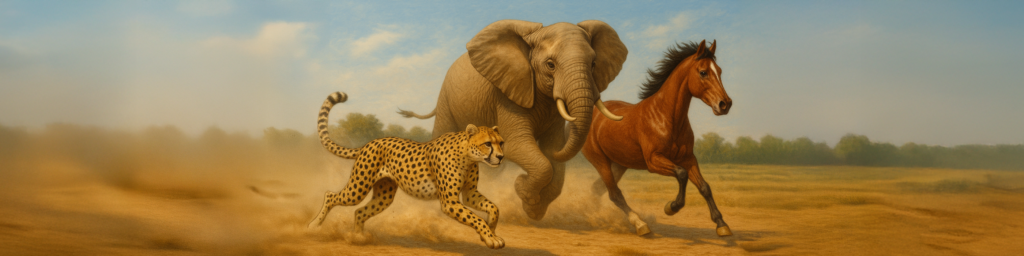
Welcome to Issue 25: Migration and Survival
The world changes, and creatures great and small, wise and simple, old and young — all of us — must move on to survive. Gallop with horses, feast on festering fruits with elephants, and fight for your very life with cheetahs, rats, and practically extinct reptiles. But as you do, keep an eye to the future and the path you’ll have to follow to arrive there. The animals certainly do.
* * *
The Passing of Lore by Anne Larsen
Migration Mismanagement by Dana Wall
Herdhunters by Mike Robinson
Queen of the Hungry, Queen of the Few by Leo Oliveira
Silver Bones by Michael Steel
Unmaking Extinction by Liz Levin
The Last Breath by Liam Hogan
* * *
Zooscape will be re-opening to submissions on February 1st, 2026! We will stay open for at least a month, and announce our closing date with at least one week of notice. However, the exact length of our open period will depend on the volume of submissions we receive. You can learn more on our guidelines page. If this open period proves as successful as the last one, we hope to go back up to releasing issues four times a year.
As always, if you want to support Zooscape, check out our Patreon. Also, you can pick up e-book or paperback volumes of our earlier issues, complete with an illustration for every story. The e-book of the sixth volume just released today, and the paperback for it will be coming soon!
Should He Move to Exciting Chicago and Start Fresh, or Stay with Mom in Michigan?
I just finished school and am trying to decide where to go from here. I've been living with family in Michigan throughout my 20s to save money, but all my family members have moved out of my hometown to the southern part of the state because it's gotten too expensive to live up north in the resort town I grew up in. My mom got a house in Port Huron (a smallish city just north of Detroit) and invited me and my brother to live with her, though to be honest, Port Huron seems kinda dull.
I have been thinking of moving to a big city for a while, and I had my eyes on Chicago because I've been there before. It's not too far from family, it has good public transit, and it's cheaper than a lot of big cities. My brother said he would come with me if I decided to go.
I'm still hesitant, and I'm wondering if I actually want to live in a big city, or if I just like the idea of it. I've never liked driving, and I like using public transit and being able to walk everywhere. I'm moving to Port Huron in the spring, and I plan on staying there for maybe a year to save more money before deciding where to go from there.
o be blunt, my degree isn't all that useful, but I work for a big company and can transfer, and I do furry art commissions on the side. I went to college on and off throughout my 20s and struggled at first because of undiagnosed ADHD, which I started taking meds for just a couple of years ago. I mostly just finished my degree to make my mom happy. I've also considered doing some kind of online certification to get a better paying day job I don't hate, but I question if it's even worth it since even people with "useful" degrees can't find jobs right now.
I was just curious if you had any advice. Sorry if my letter is kind of all over the place. I'm just a little overwhelmed.
Stee (age 30)
* * *
Dear Stee,
Thank you for your letter. Your query is a bit vague, but let me see if I can encapsulate it in one sentence as: "Do you think it is wise for me to move from Michigan and settle in Chicago at this point in my life?" Sound good?
First of all, as someone who lived in Michigan for many years (mostly in the Detroit and Lansing areas), I am familiar with Port Huron. Although I hear, like any city, it has its problems, I think it is still a nice place overall, and it wouldn't be horrible to live there. It is in a beautiful area and is quite affordable. Also, I understand it has a very good bus system that runs on natural gas, so you shouldn't have too much trouble getting around, especially if you live near a bus stop. I can understand your mom moving there.
While Port Huron does have some fun stuff to do, especially if you like nature walks and boating, it is indeed a bit calmer than a large city like Chicago, which has a thriving arts and theater community, a wonderful waterfront, great restaurants, etc. etc. So, if you like living in the city, it's a good choice. I lived in Wheaton not far from Chicago for a while and visited a number of times. I do like Chicago. And if you like heavy food like Chicago-style pizza and hot dogs, you certainly can't go wrong. Remember, though, that it isn't just a town's amenities that make it interesting. If you are in a home located near a lot of friends and family, then even, say, Needles, California, could be a nice place to live. On the other paw, if you are in a big, exciting city like New York or Chicago but are completely friendless and alone, it would be a pretty sad place to be. Home is where friends and family are.
Okay, so now imagine you are in Port Huron with your mom. You've decided to hang out for at least a year. Chicago is not that far, and you can drive there (I assume you can drive even though you prefer public transit; if you don't have a car, rent one), or you can take a hopper plane, OR you can travel by train! Go to Chicago and check it out for a week or two. See if you like the feel of the city. Also, see if you really are able to transfer to Chicago or nearby through your company (you might think you can, but that is up to your bosses, and they might not want to move you; I don't know, but check on that before you make big plans). If you know anyone who lives there, see if you can hang with them for a day or two and get their impressions of life in Chicago. In short, look before you leap. You might decide Chicago is fantastic and want to try to move there right away; you might decide it's not so great but that, once you've been in Port Huron awhile, you find it surprisingly nice and want to stay. Or maybe, while you're in Chicago, you decide to drive a little north to check out Milwaukee and fall in love with that city.
The point is that you should never make decisions--especially life-changing decisions--without doing some research first. Before I moved from Michigan to the Coachella Valley, I took a trip to Palm Springs and researched the housing market and came up with a plan. Now, I had lived before in SoCal, so the area wasn't completely new to me, but I hadn't been there in years, so it was worth looking into again. Also, as a freelancer, I could live anywhere, so the job thing wasn't an issue. Everyone's circumstances are different.
Cultures are different, too. The culture in Palm Springs is waaaaaaaayyy different than in Lansing, Michigan. Similarly, Chicago does have its own culture. Even the accent of a Chicagoan is different. You really should try to take a trip there for a bit and absorb the surroundings, observe people, try to talk to them, and so on. Again, you might find you love it, you might not.
When it comes to degrees, that is a tricky subject indeed. I'm one of the few people I know whose job is actually related to their undergrad degree. There are also people with kind of, well, useless degrees who succeed anyway in other fields. I have a dear friend who I often use an example. His degree is in American Studies. Ack. But after college, he worked his way up at a law firm from data entry to head of the IT department. He later worked on Comedy Central's website. He has no degree in computer science, but he is very good with computers, nonetheless. My late husband, Jim, had an associate's degree in communications and worked his way up to be the news director at an NBC station. Unless you're in a very specific skill such as medicine or engineering, college degrees are kind of something you do to show you're smart enough to do the work. Nothing I do today as an editor and publisher has much to do with my B.A. I learned how to edit books on the job; I taught myself typesetting; I taught myself how to start a business. Experience is what matters. Remember, people like Bill Gates, Steve Wozniak, Steven Spielberg, Frank Lloyd Wright, Ted Turner, President William McKinley were all college dropouts.
And yes, a lot of people get graduate degrees in supposedly important fields like computer science and find they can't get employed and are now hugely in debt. Also, AI is profoundly changing the job market, so you have to keep that in mind, too. So, ask yourself what you are learning in your current job; can it be applied to a job you might enjoy more? If not, will getting a certification in a specific area help? If so, then go for it. You have to know what you want to do in life before you can pursue it. Hopefully, you won't pick a career just because you think you will make good money at it. That can lead to quite an unsatisfying life.
Now for the broader picture: You're not here in this world to get a college degree or to have a great career. You're here to experience life. While there are practical things to worry about (earning enough to have shelter and food, duh), you only have a few decades on this planet--and that's if you're lucky. What do you really want to do with that time? What do you wish to experience? What kind of life do you truly want to live?
Without answering these questions, you're really just wandering about aimlessly, which makes it difficult to have goals and plans to reach those goals.
So, there you are. A rambling question receives a rambling answer, despite my trying to keep it focused LOL. Let me try one more time. . . .
Question: "Do you think it is wise for me to move from Michigan and settle in Chicago at this point in my life?"
Answer: "You can only answer that if you do some research first. Understand where you are going and why you want to go there before you try to get there."
Not sure if this helps at all, but perhaps it will give you some things to think about.
Take Care,
Papabear
Gumshoes and Gowns
At Lightbox Expo this year we met Kyky Yang, an animation artist and designer from Taiwan who’s living in Los Angeles now. She’s become well-known for her black & white “lesbian furry” web comic Detective Alice — and now, she’s self-published her first collection of it as a paperback graphic novel. Follow the adventures of British cat detective Alice and her maid Amaryllis. Visit the official web site — or check out the intro video on YouTube.
image c. 2025 by Kyky Yang
Doki Monsters: Quest Review - Nostalgic Yet New
If you’re like me, you probably grew up with a Game Boy Color back in the day and poured hours into 8-bit adventures. I fondly remember my time with games like Dragon Quest IV, Oracle of Ages and a few others. Back in those days, the technology wasn’t very sophisticated, so game design was much simpler and exploration wasn’t guided by nav points. It’s that kind of nostalgia that Doki Monsters Quest chooses to invoke. Memories of bygone days where game mechanics were explained in booklets rather than in the game itself. This philosophy of old meets new works to both Doki Monsters benefit and its deficit.
Brandon's 2025 at GF: A Look Back

Welcome to something a bit different. Rather than a traditional Game of the Year style list where I choose my favorites, I’ve instead decided to just take a look back at the various games I played and reviewed on this site alongside a few highlights. My work for GF this year has mostly been these reviews with the occasional preview and news article. Speaking of news, one of the biggest things to happen was the Nintendo Switch 2 and while I probably won’t be getting one for a while, it’s already seen a ton of coverage and support. I’ve covered the news surrounding it a few times and what I’ve seen of it has looked pretty good. It does mean however, that support for Switch 1(at least from first-party developers) is nearing its end. But it's been great to do reviews on my Switch for as long as I have. Cheers Nintendo. I got a few more memories with you this year at least.
TigerTails Radio Season 16 Episode 46
TigerTails Radio Season 16 Episode 46 Join the Discord Chat: https://discord.gg/SQ5QuRf Join the Telegram Chat: https://t.me/+yold2C77m0I1MmM0 Visit the website at http://www.tigertailsradio.co.uk. See website for full breakdown of any song credits, which is usually updated shortly after the show. Credits: Opening music: Magic by Hedge Haiden (Double Hedge Studios) Character art: Fitzroy Fox - https://www.furaffinity.net/user/lunara-toons / https://bsky.app/profile/fitzroyfox.bsky.social Background art: Charleston Rat - https://www.furaffinity.net/user/charlestonrat / https://bsky.app/profile/charlestonrat.bsky.social If you like what we do and wish to throw some pennies our way to support us, please consider sending a little tip our way. https://streamlabs.com/tigertailsradio/tip * Please note, tips are made to support TigerTails Radio and are assumed as made with good faith, so are therefore non-refundable. Thank you for your support and understanding.
TigerTails Radio Season 16 Episode 47

TigerTails Radio Season 16 Episode 47 Join the Discord Chat: https://discord.gg/SQ5QuRf Join the Telegram Chat: https://t.me/+yold2C77m0I1MmM0 Visit the website at http://www.tigertailsradio.co.uk. See website for full breakdown of any song credits, which is usually updated shortly after the show. Credits: Opening music: Magic by Hedge Haiden (Double Hedge Studios) Character art: Fitzroy Fox - https://www.furaffinity.net/user/lunara-toons / https://bsky.app/profile/fitzroyfox.bsky.social Background art: Charleston Rat - https://www.furaffinity.net/user/charlestonrat / https://bsky.app/profile/charlestonrat.bsky.social If you like what we do and wish to throw some pennies our way to support us, please consider sending a little tip our way. https://streamlabs.com/tigertailsradio/tip * Please note, tips are made to support TigerTails Radio and are assumed as made with good faith, so are therefore non-refundable. Thank you for your support and understanding.