
Stories
The Last Breath
by Liam Hogan
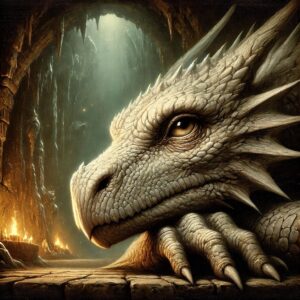 “When I’d seen her, sixty years earlier, she’d been no rainbow, sure, but the edges of her scales had still glimmered with colour.”
You don’t get to the age of two hundred and seventy-eight by being stupid. Or careless. Or, worst of all, trusting. Yet there I was, trapped and shackled by dragon iron. The accursed chains were as ancient as I was, the skills of their forging lost in the great wars, but they were as unbreakable as ever. It was best to conserve my strength; so, thoroughly annoyed with myself, I lay on the dark cavern floor, legs stretched before me and my head resting on them, waiting for whatever came next.
Whatever came next was a flashily dressed royal-type. Hopes rose. Kings and princes were, in my experience, vain creatures, easily flattered and bargained with and most of them quite short-lived — relatively speaking. There would, I was sure, be an out, even if I had to outlive him to get to it.
He halted at the far reaches of the dreary subterranean void, a distant, insignificant figure, well out of reach of my constrained claws. Possibly not out of reach of my tail, though it would require an impressive back flip to whip it that far in his direction. Nor, I supposed, would he entirely escape the extremities of my fiery breath. I could, at the very least, singe this arrogant human’s neat beard. Though that was definitely a last resort.
“Dragon,” he said, the feeble sound lost in the vast space.
“Count the limbs,” I growled, “It’s wyvern, Prince.” Wyverns — and dragons — have deep, gravelly voices. It comes from the heavy smoking.
“And it’s King, not prince,” he said, with a degree of hauteur that he must have practised in front of a full-length mirror. “King Ulfred.”
He was young to be a king, no more than three decades. I had half a mind to ask who he’d bumped off to ascend to the throne, but like I said, royal types can be awfully short lived. Especially if they’re stupid, or careless, or trusting. I didn’t want to antagonise him too much; just enough to show I wasn’t cowed.
“You all look the same to me,” I yawned, and there was a yelp from the man-at-arms trapped beneath my claw.
The King’s eyes widened. “Is that man still alive?”
“Yes.”
“May I ask… why?”
“I thought he might be important to you. Call him a peace offering, if you will.” I smiled, all teeth. “A sign of good intentions.”
The King didn’t smile in reply. I could have warned him: it ages you, maintaining such a severe expression. Well, it ages humans.
“The men were picked to be disposable.”
“That explains the laughably thin armour.”
He shook his head. “They were nothing more than a distraction, while my elite guard approached with the restraints. He means nothing to me. Do with him as you will.”
There was a whimper from beneath me. The man had been admirably still, no trouble at all, albeit under the threat of a very messy death. It would be wrong to say I felt anything for him, any more than the King would for a chicken destined for his table. And yet…
“I don’t much like canned food,” I quipped, though the quip would fail to land for a good number of centuries. I lifted my claw and prodded the prone man into action. He stumbled to his feet and fled — away from my wickedly sharp talons, and away from his uncaring King, deeper into the cavern where less frequently glimpsed dangers lurked. You try to do a good deed…
“What is it you want from me, King Ulfred?”
“I’m at war, with King Francisco—”
“If I could stop you right there.” Like I said, we have deep voices, it’s easy to talk over someone when they’re just a leaf rustling in the wind. “You want to use me as a weapon?”
“Well, yes.”
“What makes you think I’ll let you?”
He finally smiled; I preferred the frown. “I’ll only release your chains, not the shackles. You want out of those, you do exactly as I say.”
Cunning. And dastardly. Like sharks and crocodiles, wyverns never stop growing. Imprisoned by dragon iron, my limbs would be crippled over time. A slow, painful future.
I peered down my nose. “You might make me promise, instead?”
“And that would hold you?” The frown was back.
“A wyvern’s promise is far more binding than iron, King Ulfred, even dragon iron. As I’m sure your advisors told you. Or perhaps you don’t listen to them, hmm? Anyway, you’re barking up the wrong tree.”
“Oh? Am I?”
“Yes, if you want a weapon, you want the biggest, baddest flying monster you can find. And that’s not me. What you need is an ash wyvern.”
“An ash wyvern? I’ve never heard of such a thing.”
“Oh, they’re very rare. Hardly surprising you don’t know about them in these blighted backwaters.” I watched, delighted, as he bristled. Such thin skins, humans. “Most who encounter them don’t live to tell the tale. But the tale is worth telling.
“An ash wyvern is larger than I am, and, as you might guess from the name, they’re silvery-white and appear as ghosts. But its their breath that makes them unique, and uniquely feared. They have the most destructive, fiery breath in the world. A breath that brings death, far more so than any mere dragon or lesser wyvern like me. It is a breath that melts stone, that eats through metal like a hot knife through butter. As for what it does to flesh, well, you can imagine. Most of all, it is a breath that, once unleashed, cannot be restrained. It consumes everything in its path, until all is laid to waste for leagues around, ash and dust, even the wyvern who breathed it.”
King Ulfred stroked that neat beard of his. “A mighty weapon, then. But one that can only be used once?”
“Trust me, once is too many times. You never actually want to deploy an ash wyvern! Genies out of bottles and all.” I wasn’t sure he’d get that reference either. Not an anachronism this time, more a whole other mythology. “Me, I can swoop down and kill a half dozen soldiers in each pass, though it’s the scare factor that gets enemy cavalry all riled up and sends unwashed rabble scurrying for cover. But an ash wyvern…” I shook my head ponderously. “Once it is unleashed there won’t be anything left that didn’t have the foresight to crawl under a very large rock. No crops, no forests, no livestock, no army or farmers, no castles and certainly no rival king. All wiped from the face of this Earth. Ultimate destruction from the ultimate weapon.”
It was quite horrid, how his eyes glittered as he listened. “So,” I pointed out, feeling the need to join the dots, “just the fact you have one, will guarantee you victory. The scare factor. Because against such a terrible threat, only a fool would attempt to stand.”
“And you tell me this, because?”
“Because, in return for my freedom, I can get you an ash wyvern.”
“Indeed? Very well. But the same rules apply. I won’t release your shackles, just your chains. And you must swear—”
Here it came…
And then it didn’t.
Perhaps he had heard of genies after all. Or other magical beings, whose words were like the reflections of the moon on a cold pond. Deceptive, and impossible to grasp. This was the point at which he could have done with those neglected advisors. In the end, he didn’t do too badly. Perhaps I underestimated him.
“You must promise,” he finally said with infinite care, “Not to cause me harm, directly or indirectly, to the best of your abilities. You must promise to bring me an ash wyvern. And…”
It’s always the third bite at the thorax, isn’t it?
“…you will only be freed once victory is mine!”
“I don’t see how I can promise the last part, since that is in your hands,” I said, deflating his triumph.
“Well…” He looked confused; perhaps I had overestimated him. “Then promise the first two parts, and I’ll look after the third.”
I promised, reluctantly, and the chains (but not the shackles) were released. I grinned my most evil grin and ducked my head sharply towards the king, who was now very much in range. “Say,” I said, and he squealed and fell over backwards as his royal guards scrabbled for their swords and spears. “You don’t have a history of heart problems in your family, do you?”
He shook his head, unable to speak, or even squeak.
“Well, that’s good,” I said. “It’s hard to keep my oath if I don’t have a full medical history, if I don’t know how sensitive you might be to shocks and scares and the like. To the best of my abilities, right?”
With that, I squeezed up the narrow crevice to the outside. Thankfully, it was daylight, a wan sun working away at the morning’s mist, just enough to warm my wings. There was a gathering of the King’s men watching as I stretched, shaking the water and fallen dirt from my back. I thought of snatching a few — travelling snacks for my journey — but concluded that this might indirectly harm the King. Pesky thing, promises.
It was good to be in the skies again, even though I wasn’t entirely sure where I was headed. North, was my best guess. If it hadn’t been for the shackles around my ankles and the irksome promise, I’d just keep going. Find somewhere with no dratted Kings, no dragon iron, maybe no people at all. Not that there were many places like that any more. The Earth was getting awfully crowded, and the humans I did encounter never seemed happy to see me. Can’t understand why. I preferred their cattle to their children, or their women. The older the better — richer flavour and more to chew on. And yes, I’m still talking about cows.
I stopped to ask the way from a sun-basking griffin. She couldn’t help smirking as she glanced at the bands of dragon iron, my twin badges of disgrace, and I’d have clipped her wings if she hadn’t given me such promising directions.
The way was up into the hills, low cousins to the mountains that crowded the horizon, wearing capes of snow that never melted. Well, not for the next half a millennia or so. A wyvern’s ability to glimpse the distant future meant that things that seemed constant weren’t, and things you keep expecting to change, don’t. Or not in the ways you expect. There’s a certain circular inevitability to history, to stupidity, and yes, to war.
The abyss the griffin had guided me to, at the far end of a dark lake, was suitably ominous. A cleft in the hillside, a stream trickling from its mouth, a fetid smell wafting from its depths… Even I had a shudder of apprehension as I entered the foreboding ravine, wriggling my way until I came to a pitch-black chamber, where I had the sense of being minutely inspected.
“Hello, younger brother.” A voice as ancient as the rocks sighed.
“Altran; thought I might find you here. Kin. Sister. Friend?”
“I see you got yourself captured.”
“Ah, yes. Though how can you…?”
“I can taste the iron, Shurni. Not just any old iron, either. Dragon iron. Haven’t smelled that sour stench for over a century. Chaffs, I’ll bet? Someone must really want you to do something for them.”
“Well… they did.”
“Oh?”
“And now they want you to do something for them.”
“ME?!” the voice thundered, rocks rattling from the roof, and I had a grim vision of the two of us buried forever beneath that lonely hill. In better news, the rumble let a thin sliver of light creep into the Stygian depths. In worse news, the light revealed the remains of what Altran had been surviving on while she wallowed in her misery, the discarded bones and tattered fleeces of snow-blind sheep and scraped goats that had strayed into these tunnels. It explained the crunch underfoot. Amazing she could pick out cold iron over all of that. I suppose she must have gotten used to it, though heavens knew how.
“Yes,” I said. “You, sister. I need you.”
“For what?” Her measured reply was far more dangerous than her exclamations. She was from a clutch two centuries older than mine, and that was why I’d appended the hopeful “friend?”. We might be related, but we didn’t grow up together. My plan — such that it was — relied on her willing cooperation. As did my life.
“I want you to join an army.”
You could hear solitary drips of water pinking into some pool somewhere. I held my breath. The hillside held it’s breath. Even Altran was very, very still.
“What sort of an army?”
“A… human one?”
“Have a care, brother!”
“You won’t be asked to do anything!” I protested. “Just to be seen!”
“Just, my inane little brother says. Just be seen. I should have crushed your entire clutch when I heard mother was laying again!”
“Well, that’s—”
“Look then — look, if you must!”
She reared forward and into the tendrils of light from above. Altran’s entire head was bone white. Colourless, other than the two spots of blood red that flashed in her furious eyes.
That’s the problem with fire breathing, for wyverns. Dragons have it relatively easy, employing a different technique of igniting their flames, as different as the stings of wasps are from bees. For wyverns, breathing fire changes you. Each fiery breath consumed a firestone from our crops, just as our flames consumed wood, or flesh.
You started your life, it always seemed, with plenty of stones, flaming at the drop of a hat when you were young and foolish, when you were at your most vulnerable. But wyvern lives are long, if you escape infancy. By the time I’d reached what most wyvern would consider young-middle ages, I was rationing my remaining firestones, eating my food raw, and flaming only when necessary. Each time you breathed fire, each time you lost a stone, you also lost the vibrant hue it imparted, the reds, greens, and purples with which we were streaked. Each flame leached colour until you had only one stone left, barely enough to keep your internal engines going. Just one fiery breath from extinction.
Wyverns do not, as a rule, die of old age. Once we pass through the perils of our youth — other siblings, whether the same age or, like Altran, two centuries older, the odd accident (dragon iron can make more than chains and shackles, though there are also natural hazards, like cavern roof collapses…), and the hazards of courtship flights, themselves a great consumer of firestones — there was relatively little that could harm us. Even dragons gave us a wide berth.
Instead, we die a little with each exhaled inferno, each proof of our awesome power. For wyverns, fire is a defence mechanism. Which is why we do not, on the whole, make very good weapons.
I had not known Altran was on her last breath. When I’d seen her, sixty years earlier, she’d been no rainbow, sure, but the edges of her scales had still glimmered with colour. This explained why she was skulking far from prying eyes.
“You’re perfect!” I exclaimed, covering my gasp. “I was going to suggest chalk, or some other sort of make up, but no, sister, you are absolutely perfect!”
“I am nothing,” she spat. “Waiting for such prey as falls into my lair. I’m washed up, no weapon, and certainly not one to strike fear into anyone’s heart.”
So I told her my plan. Slowly, with much shaking of her mighty head and many a weary grunt, I won her around.
“It does rather seem, little brother, that it is my life you’re putting on the line?”
It wasn’t easy, this winning her around bit.
“A myth, then. If this is to be my end, Shurni, then at least it will make for a good story.”
“No end, sister.”
“You promise?”
I held her gaze, though that was mighty hard to do. “If I could, I would. But…”
“Hah! Promise bound and shackled by dragon iron… a sorry state. It might be worth climbing out of this hole, just to watch you try and dig yourself out of yours.”
With that, I think, I knew I had her.
“With your help, Altran. If you do as I’ve suggested — with your own particular flair, of course! — If you remain aloof, and haughty, and imperious… Do you think you can do that?”
She thought long and hard. It was so gloomy down there, in Altran’s lair, that I had time enough for visions. Strange, unsettling visions. Skies criss-crossed by shiny, winged creatures whose wings never flapped. Metal-skinned monsters that flew higher than a wyvern has ever flown and left no room for us, or for dragons, or for griffins. Soulless, lifeless things built by man. Portentous omens indeed, though from the fuzzy nature I could tell it was a far distant vision of a far distant future. My concerns were very much with the present, with the here and now. I still wasn’t certain which way Altran would go.
The cavern rumbled and groaned with her laughter. “Alright, little brother. Let us go and visit this King of yours. I grow tired of mutton. If there is venison and aged beef enough for a decent meal, at least I will not die empty stomached.”
“Grand, grand!” I was delighted, for both of us. “Though before we feast, we will need to make a small detour?”
“Ah yes, that part of the plan. Risky.”
“To which end, any idea of where we should detour to?”
Altran considered, then nodded. “I think I know the place. Though… best let me do the talking, yes?”
* * *
A sight it must have been, two wyverns flying south, one as pale as the clouds, the other darker, as though its shadow. Except in mating dances, neither wyverns nor dragons tend to fly together. And though Altran hadn’t exactly been gorging herself of late, she was still four centuries old and even I was awed by her size. Big sister, indeed.
I circled the King’s castle, flashing the manacles at my ankles to show that it was me, and swooping towards the elevated courtyard in front of the keep in a clear message: clear this space, or be landed on!
Before the stir of guards and onlookers even had a chance to re-arrange themselves, Altran soared in and settled on the roof of the keep itself, skittering down slates and loose stones from the parapet, and extended her wings to look utterly regal and badass and not unlike the heraldic figure she would some day, quite soon, become.
One advantage of me being down below, and Altran being up there, other than her looking like an absolute queen, was that it was obvious that I was the one who would be doing the talking.
“King Ulfred.” I lowered my head. Not a lot, a half-bow, a mark of mutual respect that wasn’t reciprocated. I ignored the consternation of the gathered courtiers, servants, and guards, who, I guessed, hadn’t got the memo that the King had enlisted a wyvern.
“You returned,” King Ulfred said, with a glance to check his elite guard was between me and him.
“Of course. And with an ash wyvern, as promised.”
“Yes, well…” He peered up to the lofty heights of the keep.
“…to whom I promised a half dozen cows.”
“Did you now?”
“Yes. Hungry work, being the most dangerous weapon in existence. But not to worry–they don’t have to be productive cows.”
Ulfred tutted, but fluttered a hand towards one of his flunkies, an implicit see to it.
“So,” I asked, all casual. “When do we go to war?”
He stared for a moment, as if able to see through the walls of his castle and towards his not-so-distant enemy.
“Tomorrow.”
“That soon?”
“No time to waste. My army is ready, and, for now, I have the element of surprise. And you, wyvern, will be by my side on the glorious day.”
I may have groaned. I should have expected this. “I have done as you asked–”
“You brought me an ash wyvern, yes. And I am a man of my word. But my word was that you will only be freed once victory is mine. And it is not mine yet.”
There was hope for him, advisors or not, though it’d be better if he seriously toned down the smug. He also wrongly assumed I was bound to protect him. But my promise had been that my actions wouldn’t cause him harm, it didn’t say I had to put my body between him and arrows and the like. Not as long as I choose to interpret it that way.
“You know, I think you should own the moment,” I whispered. Naturally, everyone within the grounds of the castle heard me. “It being the eve of war and all.”
“How so?”
“Here you are, with two wyverns not ripping you and your army apart. Given our arrival probably sent a few of your less brave conscripts scurrying for the nearest ditch, a display of your mastery is called for, to settle nerves. You should tell your men what you intend, in battle tomorrow. It would do wonders for morale.”
“Well, yes.” He looked surprised. Unasked for, helpful advice. “That does make sense…”
“And don’t forget the cattle.”
He scowled. “Just see to it that your ash wyvern stays on the roof. And extends his wings again?”
Her, I could have corrected him. But I didn’t want to spoil the entertainment.
“Gather my commanders and have the army prepare for my orders. Promise them a cask of ale or two. That’ll still their impatience.” Off the King and his flunkies stalked to advise his generals and to dress in over-polished armour, before addressing his troops. Meanwhile, I caught the distinctive whiff of very nervous cattle. They were scrawny things, I should have asked for two more, and they were doing their best to escape the men dragging their unwilling carcasses into the upper courtyard.
“Where should we…?” a man said, arms bulging as he pulled at the rope. There was something familiar about him… Ah! Our man-at-arms from the cavern had managed to find his way out. Good for him. Now demoted to wrangling supper for wyverns, but that was a better fate than I would have predicted for him.
“Oh, leave them here and close the gates behind you,” I said, gesturing to the roof where Altran waited. “I’ll take them up.”
I probably shouldn’t play with my food, but a wyvern likes to hunt. I caught them, one by one, and carried them to the roof, still struggling in my claws. That way, no-one could see how many Altran ate and how many I snaffled. Not that I felt any remorse about taking my due. I’d flown twice the distance she had, even if I was only half the size.
As we ate we listened to the King’s speech, offering our critique, in wyvern-ese of course. We picked at our meal as the King took my possibly not entirely accurate description of an ash wyvern, and exaggerated it further still. A little light spraying of half-crunched bones happened despite our efforts not to laugh.
But the speech had a rousing effect, as the terrified, skyward gaze of conscripted soldiers gave way to a look of awe, and of possible hope.
“That’ll do it, you think?” Altran asked, after I’d made her stand tall and spread her wings as both King and wyvern basked in rapturous applause.
“We’ll see. Tomorrow. There’s half a cow here, if you…?”
“You have it, little brother. It’s been a while since I’ve eaten so much. Though I think I could get used to it again.”
* * *
We marched out at dawn. An immense throng of men, the steady clank of arms and armour, a painfully slow shuffle forward with Altran and I to the sides so that we didn’t accidentally crush half the army. The horse that the king rode, though blinkered, could sense we were there and wasn’t happy about it. It can’t have been a comfortable ride.
We ascended a low rise, beyond which stretched the open plain where tradition dictated battles between these two nations were fought, much to the ire of those who traditionally lived there. King Francisco’s army was arriving just as we were, and above the bristling tips of spears and pennants, there was—
“The enemy! The enemy have an ash wyvern as well!” King Ulfred exclaimed. “I am betrayed!”
“You are fortunate,” I told him. “That you got one when you did, otherwise you would be at a serious disadvantage right now.”
The King frowned, but returned his attention to the battlefield, as the opposing forces closed the gap between them, while the respective Kings and their respective wyverns kept their respectful distances.
And then… nothing seemed to happen.
For quite a while.
The King’s frown alternated with an expression I can only describe as startled.
“Why are their armies not engaging?” he demanded.
“Probably because you have an ash wyvern, your majesty. A wyvern of mass destruction. Or W.M.D., for short.”
“Well… why aren’t my armies engaging, then? Why do our archers not fire?”
“Because they have a WMD, too. And you did so wonderfully describe what one could do, in your rousing speech yesterday.”
He groaned. “So they’re both just sitting there?”
“I guess.”
“Make them fight!”
“That would be unwise.”
“Why, for hell’s sake?! That’s what they’re here to do.”
Evidentially, his stalemated-pawns had reached the necessary conclusion faster than the King. Perhaps if he’d been a little closer to the sharp edge of the action? I explained, for his benefit.
“If it looks like you’re winning, then the enemy will lose nothing by unleashing their wyvern. And if it looks like they are winning, then you might do the same. A king, at the point of losing his kingdom, does not make entirely rational decisions. As soon as one side unleashes their wyvern, so will the other. Both kingdoms laid to waste. Mutually assured destruction, your majesty. Neither side can afford to deploy their most fearsome weapon, because to do so would guarantee the enemy would use theirs. I’d say the safest thing to do… Hmm. Is to not engage?”
The king stared at me, aghast. He shook his head. “What about you?”
“Me?” I said.
“I have two wyvern on my side. Doesn’t that give me the advantage?”
I’d almost forgotten this is how it all began, with King Ulfred wanting to use me as his weapon. I shrugged. “Sure, but compared to an ash wyvern, I’m neither here nor there. I’m not immune to an ash wyvern’s breath. Nothing is, not stone, not iron, and certainly not flesh. I change nothing. Nor would an army twice as large. Against a WMD, these are lesser matters. On the apocalyptic scale, two Kingdoms each armed with an ash wyvern are evenly matched, regardless of any other forces involved.”
The king scowled. “So what do we do?”
“Isn’t that obvious?” I peered over the vast battle plain, where two armies stood ready and unwilling to hack and maim and kill. “You should try not fighting.”
“Not fight?”
“Yes. I believe it’s called diplomacy. Whatever your quarrel with King Francisco, have you considered talking it out? A negotiated peace? Of course, since you each have an ash wyvern, you’re on equal footing, so there won’t be a lot of concessions made by either side. You’re probably going to have to forgo and forget a lot of historic insults and aggression. Bygones, yes?”
His face was like thunder. There was a snicking noise as Altran restrained her mirth.
“But think on the bright side!” I offered, loudly, to cover them. “Consider the advantages of a strategic partnership, bound perhaps by a royal wedding? Just think; two mighty kingdoms, working together, each armed by the ultimate weapon. Who could stand against you?”
“No-one,” he said, rather sourly. “Unless they had an ash wyvern as well.”
I did my best to act surprised. “They are rare beasts, King Ulfred. They are not given out free with breakfast cereals.” Another allusion that would not make sense until a very long time from now.
He groaned. “I’m worse off than before I captured you!”
“I don’t see how,” I said. “Though of course, if you really think so, I could send your ash wyvern away, tell them you don’t need one any more.”
“But then my enemy would have one, and I wouldn’t!”
“Ah… True. Best look after yours then, hey?”
“What do you mean?”
“Your ash wyvern isn’t a captive, like I am, your majesty. You have no chains or shackles on it — and before you get any ideas, don’t even try, unless you want her flames turned on you and your kingdom. She’s here because she chooses to be, yes? Best treat her well, encourage her to stay. Look after her, feed her, and respect her. Don’t worry, maintaining an ash wyvern is far cheaper than sustaining a standing army. And in good news, nobody died today! I count that as a victory, yes?”
I held out my shackles, to be unlocked.
* * *
Back on the roof of the castle keep, as the army celebrated the — um, draw? Not dying? — feasting on cooked cuts of what we ate whole and raw, (though it would be cooked, before it hit our second stomachs), Altran turned lazily to me, picking between her teeth with a discarded halberd.
“You know Shurni, the whole mutual assured thing doesn’t stand up to scrutiny.”
I grinned. “I am aware.”
“Did you do all of this just for the pun? Wyverns of mass destruction?”
My grin grew wider. That was the problem with anachronisms. You either had to have another wyvern or dragon as an audience, or wait a few centuries for the pun to land. Since humans didn’t live anything like that long, most of our best jokes were mistaken for particularly obscure oracular prophecies. Ho hum.
“Not entirely…”
“Never mind the hyperbole, the blatant exaggeration; able to destroy an entire kingdom, indeed! What does anyone think they could actually do, to convince me to expel my last breath, knowing it spells my certain doom?”
“Quite.” I yawned. It had been a long day. Plus, I’m always sleepy after a good meal, and the King’s men had been even more generous than the King.
“Let alone convince me to use that breath in a specific, towards-the-enemy direction? One wonders why anyone fell for any of it.”
“Because it’s better than the alternative?” I suggested.
“But how long can it last?”
“Stalemates have a tendency to persist, until something radically changes the playing field. As long as both you and—?”
“Bartok.”
“As long as you and Bartok play your parts, I can’t see any reason why we can’t spin this out at least for a generation — of Kings, that is. Ulfred and Francisco are both relatively young.”
Altran drummed her claws on the masonry, leaving deep grooves. “Twenty, thirty years, perhaps? And during that time… do you condemn me to a senescence of silence?”
“Only with humans,” I protested. “You’re not missing much there. I’ll visit as often as I can and there’s nothing stopping you going on the occasional trip. In fact, the worry that you might not come back will do wonders for how attentive they are when you do. I’ve told them what you like to eat and that you enjoy being read to.” I shrugged. “It’s better than spending your remaining days festering in a dank hole, I hope?”
There was silence, as we watched the baleful glow of the setting sun, softened by the smoke of hundreds of campfires around the castle. Tomorrow, most of those soldiers would go back to their villages, to farming and patching up their hovels and whatever else they did when not forced to bear arms.
“Why didn’t King Ulfred remove your manacles?” Altran asked. “I thought I saw the man who carried the keys?”
“You did. But I asked him not to.”
“Why?”
“Altran, how many wyverns are on their last breath, would you say?”
“A few,” she admitted.
“And how many kingdoms are there, on this continent?”
She laughed. “A recruitment mission? With manacles as your calling card? W-M-Ds for all? Well. You’re nothing if not ambitious. Though don’t leave those shackles on for too long, brother, or eat too heartily. They constrict, do bands of dragon iron.”
For the first time I noticed the darker marks on my sister’s ankles. Probably wouldn’t have seen them, if she hadn’t been the colour of ash. The moment hung heavy.
“You know, you may not be doing us a favour, in the long run,” Altran said.
“Oh?”
“This… cold war between humans. It is not quite the same as peace. I know you mean well, Shurni, but it is all under false pretences. It might stop the bloodshed for a while, might give us ash wyverns a temporary home and respite in our old age, but less bloodshed does inevitably mean more humans.”
“Yes… I suppose.” The thought hadn’t struck me.
“Ones who will undoubtedly seek other outlets for their irrational hostility.”
“You think I should make their wars hot, again?” I asked.
Altran sighed. “It probably doesn’t matter in the long run. Our time is nearing an end, little brother. Surely you’ve had the visions?”
I was silent again, for a while. “What happens to us, sis?”
“Who knows? Nothing good, perhaps. If we went elsewhere, you might think our visions would be from there, instead of a dragonless land. Perhaps there is no elsewhere. Or perhaps our visions do not pierce that veil. But that is for the future. Today, at least, we are safe, and I am well fed!”
Altran beat her mighty wings, and lifted into the air, circling King Ulfred’s castle, warning anyone watching from beyond the walls that an ash wyvern was in attendance, (and taking the opportunity to void her bowels over the moat at the same time). Then she settled in the upper courtyard, to listen to bards tell tales of heroes and gods and monsters, accompanied by lilting harp music, while the spot between her ears was scratched by a halbard wielding, very grateful and still somewhat bruised former man-at-arms.
* * *
 About the Author
Liam Hogan is an award-winning short story writer, with stories in Best of British Science Fiction and in Best of British Fantasy (NewCon Press). He volunteers at the creative writing charities Ministry of Stories, and Spark Young Writers. Sci-Fi collection: A Short History of the Future (Northodox Press). Fantasy: Happy Ending Not Guaranteed (Arachne Press). More details at http://happyendingnotguaranteed.blogspot.co.uk
Unmaking Extinction
by Liz Levin
 “I barely catch the American toad, common garter snake, and snapping turtle that fall from my lips.”
I get the alert about Corinne’s death while Terrible and I are fighting about words. Namely, which ones I should say next time I’m around other humans. He’s lying in the river beside the cottage. Each time he speaks, he heaves his head out of the water. When he’s done, he lets his 300-pound noggin crash below the surface, splashing everything. I’m standing on the muddy riverbank, soaked.
He’s named for terrible crocodile, the English translation of Deinosuchus, his most likely genus. Generally, I don’t speak reptiles or amphibians into existence that died out before we humans spoke English (or existed). Terrible is an exception. He’s demanding I read Chaucer around humans. I remind him I’ve barely begun reciting the Oxford English Dictionary’s nearly 50,000 obsolete words. At a rate of two dozen a day, I’ll finish in five years.
Terrible isn’t convinced.
“But I was alive during the Cretaceous! You think my mate hides in a list of barely dead words?”
“Why not?” I ask. “A common word created you.” He drops beneath the water, soaking me to my neck. “Merde. Keep your head above water while we’re talking. You’re over 30 feet long. You’ll empty the river.” Terrible was designed to eat dinosaurs, and it shows.
“Common word,” grumbles Terrible. “There’s nothing common about me.”
I couldn’t agree more, but we both know I wasn’t capable of linguistic feats on my curse day, five years ago this Saturday. Terrible was born on that day, before I found the cottage and before I started recording what I say within earshot of humans so I can replay it to determine which species belongs to each word. I’ve tried to recreate those first impassioned sentences I said in front of Mama and Corinne, but as much as I try, I’ve never birthed another Deinosuchus. And though I’ve uttered the curse that made Serpent, that word has never birthed another.
You may wonder why I say birth or born. After all, lizards and amphibians drop from my lips when I speak English within earshot of humans, not from my womb (thankfully). I ask you, are there better words? I’ve tried vomit. None of the creatures born speaking like that.
“Is he still complaining, Vivienne?” asks Serpent, gliding across the mud to coil up my leg and around my waist, like an ornate belt. He’s pretty enough to seduce Eve. His skin bears a geometric pattern of emerald, sapphire, and gold. “Living gems,” he likes to say, “much better than your sister’s dead rocks and flowers.” He’s not wrong. “You haven’t made a girl for me, and you don’t hear me complaining.”
“Another of you?” I cross my arms and shiver, even though it’s 86 and humid. “Terrifying. Last thing we need is you reproducing.”
“Impossible to improve perfection,” Serpent says. “Too true. But I came to tell you your light-up machine interrupted my sunbath.”
I glance at my phone on the picnic table, a safe distance from the river. Electronics and brackish water don’t mix.
“I’m working on it, Terrible.” He’s moved his head below water again. I talk to his bulbous eyes. “I know you’re lonely.” I am too. I don’t say it aloud. I don’t want to offend anyone.
“Putain de merde.” Corinne Barreau, Wife of Phoenix’s Golf Course King, Dies at 22.
The service is Saturday, on the fifth anniversary of our curse.
* * *
I ride my mountain bike along deer trails until I reach the Phoenix exit. Turning back toward the woods, I see an electrified fence topped by razor wire. Signs caution: Toxic dumping site. Stay out. Behind the fence lies desert. If I turned back with the intent of entering, I would find an unlocked door. Behind it is a primeval forest with sequoia-sized trees.
That’s the ecosystem outside Phoenix, but the woods are a patchwork of habitats, from deciduous forests to tundra, from peat bogs to estuaries, like the one by our cottage. I’ve wondered whether our cottage is beside an estuary because it’s where women with our curse always live (if we survive) or did the cottage move to the biome Terrible would need?
I’ll leave it to you to answer that question.
I like to think that this wild place contains all the famous cottages, even Baba Yaga’s chicken leg house. So far, I’ve found it disappointingly empty of humans and witches.
And fairies, thankfully.
Serpent is cozy in the granny basket as I ride six miles to the Golf Course King’s estate, a.k.a. Hugo Von Brandt, my ex-fiancé. It’s dawn and Phoenix is unbearable. I arrive early to wash up in the pool house. Unscrewing the pineapple-shaped finial from the iron railing beside the door, I retrieve the key. I change from dusty cutoffs to the requisite black dress, and an opaque black veil looped to catch anything that drops from my mouth. I don’t plan on speaking English. Mama spoke French in our home. I’m fluent enough to pass as a native, a ruse I’ve played before, but it’s dangerous here. After all, Mama thinks I’m dead.
I shoulder my backpack, leaving it open at the top and cautioning Serpent not to stick his head out. He’s a curious snake.
The service is in the greenhouse. My veil sticks to my face in the humidity. My sister is the only one here, lying in a sapphire-colored casket beside the podium. I walk down the center aisle, past empty chairs. Before I revealed Mama’s lies and poisoned our engagement, Hugo and I were to be married here.
Oh, Corinne. In death, she looks like porcelain. Fragile. Like someone who would shatter under an ambition like Mama’s.
As the favored child, I had years to build defenses against Mama’s avarice disguised as affection. People say I looked like Mama from birth, and so, like a good little narcissist, she loved me at first sight. Corinne, my junior by a year, looked like the lover who left her. Accordingly, Mama handed her a broom when she was in kindergarten.
Classmates thought it better to be me than her, even though they adored Corinne. They saw Mama lavish me with unmerited praise; they saw the patches on Corinne’s hand-me-downs. They were right enough. I helped when Mama wasn’t watching, but after Mama caught me chopping fennel for Mama’s favorite bouillabaisse — my recipe perfected over years — she punished Corinne.
Mama ordered her to draw water from the new wishing well that had appeared the day after the mayor admonished the media for implying Phoenix was running out of water. Corinne returned and Mama emptied the pitcher on the cacti while scolding her youngest. Corinne’s apology yielded a tiger lily, uncut emerald, and thorned rose that dripped blood. Mama sent me to the now blessed well.
“You can still save this engagement, mon bijou. If your pathetic sister can win a blessing, so can you.” I suggested she go in my stead. She rubbed her neck, swallowed, and gestured toward the door. Oh Mama, I understood you well. Even then. You knew the price.
When a fairy disguised as a princess requested water, she looked as though she stood behind a screen of bloody thorns. I refused and she cursed me. Or so the story goes. The well disappeared. Mama said we needed to talk, drove me to an empty patch of desert, and left me. If I hadn’t uttered that curse after she left, birthing Serpent who led me to our cottage, I would have died. Even with his help, I nearly did.
Someone moves beside me and the casket. Trim in a custom suit, blond hair freshly cut, skin leathered from the links: the Golf Course King of Phoenix, Hugo Von Brandt, the golden chariot to wealth Mama raised me to catch.
Hugo doesn’t recognize me in my veil. “Gorgeous, isn’t she?” He nods to Corinne’s heart-shaped face and soft brown hair. “You knew her? We all miss her more than words can express. She had so much left to offer.”
I choke back a curse before it becomes a word. It sounds like a sob. To offer? Like diamonds for the price of a word? How would Hugo pay to water his expanding empire now? I bow my head before I walk away. He doesn’t comment on my silence.
During the ceremony, I lean against a shadowed pillar and listen to Spanish-speaking servants praise the late Mrs. Von Brandt who always spoke to them in their language. The chef tells a humorous story about her notorious hatred for smart phones, and how she tricked him into giving his phone to her for the day to help him overcome his addiction. I straighten at that. What were you planning, Corinne? Hugo or Mama manufactured her hatred of phones, for certain. If her curse worked as mine does, she could type English words without activating her blessing. My movement wakes Serpent. He drapes himself across my shoulders, hidden by the veil, whispering questions in my ear while I shush him.
The group in front of me gossips through the last speeches.
“Did you hear how she went?”
“Choked.”
“My ex performed the Heimlich on a guy at a steakhouse.”
“She wasn’t eating when she died.”
“They say they found her—”
I squeeze through the crowds until I’m in the main house, on my way to the room Hugo said would belong to me after we wed. Serpent and I search for anything that will tell the story of Corinne’s death, or life. He slithers under and behind while I scrutinize photographs of carnivorous flowers hanging from clothespins. She had an artist’s eye, even if photography was never her specialty.
After moving a three-shelf bookcase, at Serpent’s suggestion, I find a safe built into the wall. Or magicked there; it resembles the one in my cottage. Just like mine, I find no obvious lock. There is an iron sculpture of a carnivorous pitcher plant. “Do you think it works like mine?”
“Only one way to tell.”
With trepidation, I lift a finger to the bulbous flower, preparing to plunge it into the dark opening. My safe features a cobra’s open mouth. I survived my first attempt to open that safe. Unlike this one, it was designed for someone with my cursed blessing. “Wish me luck!”
“You already have me.”
I’m not surprised when the flower’s cylinder constricts around my finger. I feel a sharp jab before the pressure releases and the door pops opened. My finger numbs, then my hand. Already it’s spread more than my safe’s toxin does. I’m immune to reptiles’ and amphibians’ toxins and venom. Here’s hoping flower toxins are similar enough. Only my immunity is magical, not biological, and there’s no promise I’d be protected even if the safes’ toxins were chemical twins. The numbness creeps above my wrist before I panic.
“Serpent, help!” I whimper. He strikes, biting the inside of my elbow, right above the line of numbness. The sharp pain of Serpent’s venom chases back the numbing effect of the safe’s toxin. It’s like the blasting away of cobwebs, followed by the clarity of knowledge.
After wiggling my fingers to shake away the pain, I open the door to the small safe and slide her journals into my backpack. I hesitate before adding the pouches of gemstones. I’ll make better use of them than Hugo or Mama would. In the attached bathroom, I wash my face and change back. I wrap a floral scarf over my hair and around my face to hide my identity (it’s too lightweight to support births) and leave this gilded cage.
* * *
I’m pushing up my kickstand, congratulating myself on my smooth exit, when Mama finds me. “Vivienne! I thought that was you, my sweetest daughter!” she cries in French. She’s wearing white, elbow-length gloves with shiny black buttons and a black sundress with a scattering of white roses trailing down the belled skirt. Her chestnut hair is gathered in a soft roll. She looks chic, just as I remember her. “I thought I’d lost you, but here you are, like a miracle on the day of my greatest sadness.” I don’t respond as she smooths away my veil and kisses my cheeks. She misunderstands my silence. “Oh, sweetest girl, you can speak to me in French. Your… gift. It only happens when you speak English. Use our mother tongue and you will have no worries.”
Gift? I wonder, tensing. Why does she think I have a gift? She was first to call it a curse. It is never good when Mama changes her mind. I sit forward on my bike. She stands in front of the wheel, grasping the handlebars. Trapping me in her false affection. I shift forward slightly, testing her hold. She gives a nervous laugh and takes a step back on her red-bottomed heels. “Careful, sweetest! You only have one Mama. Best not to run her over.”
I shrug. “You didn’t lose me, Mama,” I finally respond, in French. “You kicked me out. I almost died.”
She tilts her head and smiles. “But you aren’t dead. You left the car when I was distraught, incoherent, unable to give chase, and you survived. You thrived. You are still so beautiful, my sweetest Vivienne, even like this.” She caresses my head, masking her sneer. My hair is long, like hers, but the chestnut waves are dull and snarled. I ran out of conditioner last month and haven’t gotten a chance to buy more. I’ve been selling rare breeds of reptiles and amphibians to the San Diego Zoo. I like their conservation programs and my contact. We speak in Spanish, his first language. He believes that French is mine. Sometimes he tries to teach me a few English words. I decline. His hair is black, shoulder-length, glossy. I’m sure he uses conditioner.
“I need to go, Mama.” I turn the wheel and rock forward on my bike. Just a bit more and I’ll be able to roll by her. We’re far from the parking lot and I know this area. I’ll lose her, easily.
“No, don’t you leave.” She’s replaced sugar with steel. This is her Corinne tone. Is it any wonder my younger sister acquiesced when Mama finally coated her words with sweetness and acted as though she’d always loved her? But that won’t be me. “I figured out your sister’s gift,” she says, drawing a gold notebook from her clutch. She opens it, revealing a handwritten lexicon so like the one I left in the cottage, it makes my eyes smart. These moments are the most devastating. When Mama does something that demonstrates that she was right. We are the same. Even our handwriting is almost identical. “See, at first the gift seems random. You speak, and out fall hideous toads and frogs, of no value to anyone. But all we need to do is what I did with your sister. We just need to find the words that make the valuable things, like alligators that can make beautiful bags. She caresses her clutch. The pattern is subtle, just like the smooth skin of an alligator’s belly.
“Can I see?” I ask, reaching for the notebook. She steps to the side to hand it to me and I’m off, wheels spinning over the pavement, past split-levels with hardscaped yards and alleys until I’m out of the city and on my way home.
* * *
I stop a few times to hydrate and make frogs outside gas stations. I duck my chin into my open backpack, pretending to search for something. I speak the words as customers enter and leave convenience stores, just loudly enough to register without inviting a response. I know the words that create males and females of all six species of leopard frog endangered in Arizona. I choose a species and make two dozen males and two dozen females. Serpent grumbles from his spot beneath the frogs.
I stop at a sheltered spot on the way to the Phoenix entrance and acquaint them with their new habitat. None of them talk to me. It isn’t surprising. I’ve created a lot of leopard frogs over the years. Mostly, they only speak when they are the first of their species.
“Home?” asks Serpent. I nod. “Finally.” He falls back to sleep on top of my funeral veil and dress.
I study Corinne’s journals before bed. Most are pre-curse, filled with charcoal drawings of high school friends drawn with scales and tails, fawning over a sad doe wearing Corinne’s face. They offer her small things — pencils and dandelions — while gossiping about her helplessness. Small breasts, small bones, small dreams. Mama is absent. When I appear, I am human and alone, clenched jaw and furrowed brow. If she saw me now, I’d look the same.
I open the last journal. The top two-thirds of each page is filled with colorful scenes of monstrous people, interspersed with words, each composed of a particular flower or gem. The words drip in blood that dries beneath the too-bright sun. The bottom third of each page depicts charcoal caves beneath the earth’s surface where humans lie on hammocks, dreaming.
This is Corinne’s lexicon, I realize. Not the tidy gold journal filled with Mama’s even loops.
* * *
Sharp knocking wakes me the next morning. I’m lying on my side, a wedge pillow at my back and a body pillow between my legs to keep me in position. Serpent lies coiled beside my face, ready to bite me if I roll over onto my back. These are just precautions. Even if I talk in my sleep, my words shouldn’t matter because I’m the only human around.
“That we’ve seen,” Serpent would caution. If I believed his horror stories, I’d think there are hordes of humans outside this cottage, with their ears pressed to the thin walls, just waiting for me to mumble something in my sleep.
The knocking. There are people and I’m not dreaming. I rub my face and crawl over pillows, tripping my way to the bathroom. It’s small, with a corner shower and a pedestal sink, but it’s plenty of space for me. I wash my face and gather my knotted hair into a bun. I’m wearing sleep shorts and a camisole, but anyone who is at my door at the tender hour of… noon… can deal with it. This is my first visitor so it’s on me to set low expectations.
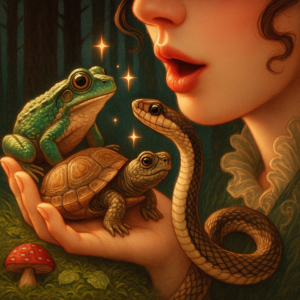
I walk through the family room, past an overstuffed sofa, and gecko-print-covered recliners. (No, I didn’t buy it. The cottage knew I was coming, just as it will know when you’re on your way.) The artwork changes each time I sleep. Today, a black and white photo of Terrible spans the sofa’s width. His mouth is open, showcasing his teeth. I open the door, and Mama drops the bronze salamander-shaped knocker. She’s incongruous in her pleated black slacks and cream blouse. Behind her, an Escalade sits on a freshly paved driveway that connects to a road. Last night, there was a dirt trail barely wide enough for my bike’s tires. My gaze skitters between the new features. Finally, I say, “There’s a road?” I barely catch the American toad, common garter snake, and snapping turtle that fall from my lips.
“In French,” Mama reminds me, shouldering past me into the cramped family room. “Really, sweetest, did you just wake up? You’ve wasted half the day.” She sets her alligator-skin purse on the coffee table, shifting aside my dogeared copy of Amphibians of North America, and directs a blinding smile my way. “Are you ready to get to work? I’ve made a list of all the best ones.”
Maybe she’ll leave if I ignore her. I walk into the dining room and open three of the empty terrariums sitting on the long table. I place an animal in each, add water and dried food, and return to the family room.
Mama is still there, now holding a green notebook. Her smile is gone. “Is this any way to treat your mama? You offer food to those pests before you offer me a glass of wine? What happened to the manners I taught you, Vivienne?”
“I don’t have wine,” I say in French.
“No matter,” she says, gesturing as though to wipe away the last ten minutes. “As I was saying, I know how to make us rich.”
“Aren’t you already rich?” I ask. “Don’t tell me you didn’t profit off Corinne’s gift.”
Mama glances away, widens her eyes at Terrible’s photo, before meeting my gaze. She takes a deep, yoga breath, exhales, and sits on the edge of the couch with her back to the photo. Hoop earrings shimmer like pearls. Nacre, or mother-of-pearl, the luminescent secretion mollusks use to coat errant grains of sand. Pearls are rare. Mother-of-pearl coats the inside of every mollusk shell. The earrings are cheap, considering.
She sighs, rests her face in her hands, rubs it gently. When she looks up, lipstick, liner, foundation, and powder are unmarred. “I made a mistake, mon ange. I went straight to your ex-fiancé and shared the news of Corinne’s gift. He married her, of course. He was no fool. After that day, he never left me alone with Corinne. Not until he left town for business. And then we barely got started before…”
She pauses, shakes her head as though to redirect her thoughts.
“But with you, I’ve learned. You were always the better daughter, sweet Vivienne. I’m so sorry I didn’t see your potential at once.” She opens the green notebook. There, in slender loops like mine, she has written a plan to monetize my curse, because if I used it the way she suggests, it would curse all who breathed life through my words. “Some of them aren’t pests, see? Some have purpose.”
I take the book, her earrings swaying as I pull it from her grasp. I glance away before she notices my tears. In French, I say, “Mama, why don’t you get yourself a glass of water while I read.”
I open the door, muttering “mother-fucking nacre” before I’m out of earshot. I catch a warty toad for the compound adjective and an unknown crocodilian. I set them on the picnic table, rubbing my finger across the crocodilian’s back. I’d forgotten nacre was identical in English and French. I’d research its species later. On the muddy banks of the river, I draw my knees to my chest and wait.
It isn’t long before Serpent joins me. “You heard?” I ask.
“I was under the couch. Slid out the snake door when your mother was in the kitchen.”
Terrible splashes up from the river, hoisting his front legs onto muddy land. I glance at my drenched sleep shorts and camisole, thankful I’d chosen black. The sun is at its zenith, drying the beads of water off my arm. I rest my head on my knees. “I don’t know what to do about her,” I say.
No one speaks. Terrible wasn’t there to hear Mama, but he knows the stories. They both do. Five years together. Worth more than my twenty with Mama.
“Did you hear what she said about Corinne?” Serpent finally says.
“What did that witch say?” Terrible asks. I’m surprised. He likes the witches in the stories I read to them. He says they have the best parts.
Serpent’s voice shifts to a high-pitched whine that sounds nothing like Mama. “’After that day, he never left me alone with Corinne. Not until he left town for business. And then we barely got started before…’” It takes me a moment to ignore the voice and process the words.
“You think…”
“I do.”
“What do you think?” I ask. I don’t even know what I think.
“That the witch killed your sister,” Terrible says. “That’s how it always goes.”
“I don’t know,” I say.
“Ask her,” Serpent says.
“And then?” I ask.
* * *
I move the picnic table closer to the water. I set the green notebook on top. Terrible’s bulbous eyes watch me. Serpent slithers across my shoulders, silent. I say, “Our plan is horrible.” I touch the green notebook, thinking of Mama, the crimes she’s proposed, and the one she may already have committed. “Maybe she didn’t do it.”
I return to the cottage to gather Mama. “Let’s sit in the sun to talk.”
She follows, grimacing at the muddy ground and weathered bench. She sits and disturbs the air with talk of alligator hides and import laws. “But don’t fret. I’ll handle logistics. You study your gift. Do you know which words link to each species? So often it’s nonsensical. You know what Corinne said for opal?” She whispers a crude word. I laugh, surprising us both.
“Mama, what happened to Corinne when Hugo left? I know something happened.” I pause, rest my hand on top of hers. “I won’t blame you.”
Her eyes glisten. She cried in just this way — a few tears that didn’t smudge her eyeliner — when she drove me to the desert five years ago. “Oh, Vivienne, mon bijou, it was tragic. We finally had time alone, our first since the wedding, and your sister refused to help. She just wanted to talk. In French! I gave her wine and a few pills, just to relax. She was so tense! I tucked her into bed like when you were girls.” She never did that. For either of us. “Left for a moment — to grab a glass of merlot and our notebook — and when I returned, she was still.”
“Why, Mama? Why was she still?”
“Her mouth, her throat.” She looked up at me and her face was wet, eyes smudged. “Filled with pearls.” She looked around, probably wishing for her purse and its tissues, before she rubbed her hands across her face and dried them on her pleated black slacks. “But that’s all in the past. Now I, we, can start over.”
“You’re right,” I say. “Stay here a moment, Mama. I’ll get your tissues for you.” I look to Terrible as I leave, all but his eyes beneath the water, invisible if you don’t know where to look.
I wrap myself in a robe before sitting on the gecko-patterned recliner. Even after an hour in the sun, my clothes are damp. I lean back and study Terrible’s photo. After the third sniff, I open Mama’s clutch and dig out the package of tissues.
I think about pearls. A common grain of sand inspires its creation; common words produce them. Before Mama left me in the desert, she punished Corinne for my curse. “You ruined your sister,” she said, as she held the painting Corinne had gifted her on Mothers’ Day over the kitchen sink and set it on fire. Corinne cried, “Mama, stop, mama, stop, mama, stop,” and black and white pearls bounced across the floor.
When I left my childhood house, I still believed Corinne was gifted. She’d leave, I thought, Mama would have nothing, and Corinne would have everything.
I almost died in the desert. Serpent saved me, led me to the cottage. Years later, when I made it out of the woods, I learned of her marriage. Hugo is an ass, I thought. But at least she’s away from Mama.
I should have known how much a person will do for a bit of sweetness, after a lifetime without. Delirious from a mix of alcohol and sedatives, Corinne pleaded with the woman who cried only crocodile tears. And she died, choking on pearls.
* * *
I shower and change into clean clothes before I go outside. Mama is gone. A hybrid pickup sits in the Escalade’s place on a drive that now curves toward the San Diego entrance. I lift the cover on the truck bed to find it filled with premium habitats. I sigh, not happy, exactly, but relieved that the cottage agrees with my choice.
Terrible lies beside the river, bulbous eyes closed. His back looks like a mountain range, burnished copper in the sun. Like Serpent, he is a living treasure. “Well?” I ask because I probably should.
He grunts.
“Indigestion,” Serpent says. The unknown crocodilian lies beside Serpent, sunbathing.
“Do you know the species?” I ask because I’ve given up predicting what Serpent knows.
“She hasn’t said.”
Terrible raises his head from the water and lets out a nauseating belch. I pinch my nose until the odor clears. I wipe the tears from my eyes and rest my palm on the ground beside the baby crocodilian. “You speak?” I stroke her baby-soft skin. Someday the nubs on her back will be craggy mountain ranges. Today, they look like strings of burnished pearls.
“I’m not mother-fucking nacre,” she snorts. “I’m mother-fucking Necrosis. Pleased to meet you. And especially you,” she says, turning her snout toward Terrible.
My laugh, when it comes, is more than a little hysterical. “Cell death? Terrible, her name means cell death.”
“She’s perfect,” he says, gently resting his snout on the riverbank so that the mate who just traversed my narrow esophagus can touch her nose to his.
I leave them to it. Inside, I gather Corinne’s journals and add them to our safe. They join the lexicons and diaries written by the women who have made it to our cottage. (There are gaps. Sometimes we do burn in the desert or freeze in the woods.) They belonged to ages when everyone witnessed the power of magic, or prayer, or science. None witnessed the power of dinosaurs. Perhaps you will.
* * *
 About the Author
Liz Levin lives near Chicago with one vociferous cat and the three other humans who cater to his needs. An alum of the Stonecoast MFA program and Clarion Science Fiction and Fantasy Workshop, her work is published or forthcoming at MetaStellar, Flash Fiction Online, and Metaphorosis.
Silver Bones
by Michael Steel
 “In another world, a simple rat like me might be the king of the world. Kings don’t need beautiful graves to be remembered.”
My ma always said if I was going to die, I ought to get a beautiful grave, with a nice tombstone and everything, so when I was long gone every rat that passed by would know I existed once. Graves, she said, are the only places that little rats like us can affect the world once we’re gone. Not that any of the bigfolk would notice it. They’re too busy with their bigfolk nonsense to even notice us when we’re scurrying underfoot. That’s better for us, though — anytime they do notice us, they stamp us out. But you’d know all about that, wouldn’t you?
Somehow, I don’t think my ma would call this a beautiful grave. A filthy subway tunnel in New York City, with only the rumble of the trains and the chatter of the bigfolk to keep me company. And you, of course. You’re always here, in the murky dark shadows. Watching, lurking, waiting for me.
I think the walls were beige once, but now they’re an awful, filthy gray. It stinks in here. Stinks like rotten banana peels and misery. I don’t want to die surrounded by the smell of misery. And I can’t stand bananas.
I was stupid today. You see that bigfolk over there? Yeah, that one, in the rags. The one who’s stinking the whole place up. He probably hasn’t cleaned himself since before I was born! He always hangs around here, but he never gets on a train like the other bigfolk. He just sits on that bench there, and sometimes he smokes. Today he had a sandwich. A sandwich sent from heaven. The smell was so good, you’d never believe it. I thought I was dreaming at first, but I knew it was real. I watched him for a while as he ate it. Watched him from my hidey-hole. I could feel my stomach screaming for the sandwich. I wanted to scream for it. It had bacon in it, you know. Bacon!
Finally, the dirty bigfolk put the sandwich back down onto the floor. I thought I’d just scurry over and snag a piece of bacon. Nothing big, nothing he’d miss. I got the bacon in my mouth, and oh boy it was the most beautiful thing I’d ever tasted. I couldn’t stop myself, I ate it right then and there. If only I had just run back to my little hole, the bigfolk would have never even noticed me. But he looked back down and saw me. His eyes, they were gray, such a dirty, dark gray. Like the water down in the sewers. They were furious, though, and sewer water never gets furious.
He yelled something at me, and before I could run there was a boot in my stomach that sent me flying and now I’m here, dying under the subway tracks and I’m just so tired, old friend. I’ve seen you so many times over the years, taking my ol’ ma, my brothers. Taking even bigfolk sometimes. And now that I’m the only one left, I guess you’re here for me.
I keep thinking, over and over, no! No, not yet. But it is my time now, isn’t it? Or else you wouldn’t be here. Old buddy. Old pal. You’ve been here as long as I remember, always following me around, floating over my shoulder. Only I never turned around to see you, even when you were everywhere. It’s only been a year. Hardly a year. I only ever saw one winter. Please, I don’t want to go yet. What about my beautiful grave?
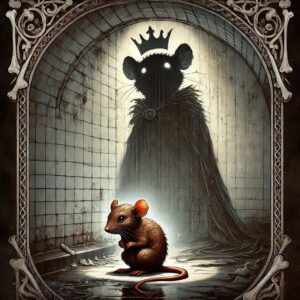
I had no say in any of this. Why aren’t I a bigfolk? Why did I have to be a rat, downtrodden and hated by everything? In another world, a simple rat like me might be the king of the world. Kings don’t need beautiful graves to be remembered. But here I search for food in rotten dumpsters, until some bigfolk notices me enough to end my life, without barely caring. How is that fair? They can kill us with a swift kick of a boot or a quick shake of a poison bottle and never think of us again. They end so many lives, every single day — and they don’t even care.
I guess I could appeal to the heavens, the rat gods, and the rulers of the real world, but I know they won’t listen. I’m just a little sewer rat drowning in the filth of the subway tunnels. Why should they care if I live or die?
The only thing left for me to do is run.
I can hear my life leaking out of me when I pant and wheeze. My claws hurt from running on the concrete. I’ve spent my whole life down here, and somehow only now I’m lost. The tunnel is so dark now, rushing by like the fleeting life of an unloved rat. I’m running as fast as I can, but you’ll always catch me. You’re in every shadow, every dark corner.
The tunnel’s getting bigger, I know it is. I’ll never find the exit now. Why are you doing this to me? I don’t want to die.
I don’t want to die alone. I could have been a world champion, if only somebody had cared. When I’m dead, I’ll be nothing more than just another mangled corpse, another dead rat out of thousands of dead rats. My dusty bones will lie in the mud for four centuries, slowly turning to silver in the darkness. And even in my silvery death, I’ll be beautiful, more beautiful than the foolish bigfolk who crushed my ribcage for a bacon sandwich. He will never be as pearly perfect as my cold, dead bones.
I will be my own beautiful grave. I hope my ma’s proud of me now. Maybe one day somebody will find my smooth white skull and they will hang it on their bracelet. Maybe then somebody will remember me.
I’m ready now. Take me home to Ma.
* * *
 About the Author
Michael Steel is a high school student currently living in Vancouver, British Columbia. He lives with his parents, brothers and ridiculously fluffy cat, Taco. His hobbies include fantasising about rats, writing about rats and playing Block Blast.
Queen of the Hungry, Queen of the Few
by Leo Oliveira
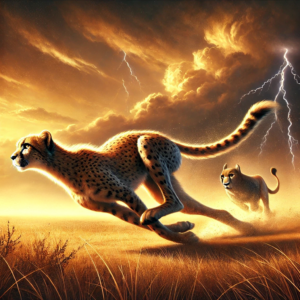 “Lions are no easier to fool than anyone else, but they were built to chase lightning wherever it strikes. That’s what thunder does.”
Before the lions came and ate our mother, she filled our nursling ears with tales of The One Who Races the World.
“Races the World was as quick on her feet as she was in her mind.
“She was a queen among cheetahs. A legend across the savanna.
“Impala frightened their cubs with invocations of her name. Hyenas did not steal her kills, for she was strong as well as fast, and she could drag the carcass of a water buffalo up a tree like a leopard, so that only the boldest of baboons would dare challenge her for it.”
Races the World was like a goddess to me. Countless silver nights curled up together in the long grass sheltering under a fallen acacia, begging our mother to tell us another, and another, and another. Of Races the World’s adventures, I could never get enough. I used to wish my mother had given me a proud name like hers, a bold name like hers, but I am only The One With Tiny Spots.
My brother is The One With A Dancing Tail and my sister is The One Who Sheds Black Tears. We had seen the rains come but once and we were three days and nights alone. Three days and nights as orphans. Several times that spent hungry, near starved. Our mother could not feed us anymore; not while she fed the fly-bitten bellies of lions.
Dancing Tail complained first of his empty stomach and how weary he’d grown of running, so I stopped him in the brush to chase down the fresh scent of a hare.
“I appreciate you,” Dancing Tail said, stretching out his long limbs beneath him. I considered giving him a warning not to grow too comfortable, but we’d not rested since before, and we were all tired and hungry. I didn’t have the heart to push him. Not even if our mother’s stories had taught us to be stronger.
Black Tears said nothing. She was the better hunter of us, what little practice we’d been given. But her eyes — measured, focused, and still — told me not to make a mistake. They said that she would not help me if I did.
* * *
I stalked the hare like our mother had taught us to stalk, patient and slow. “We are cheetahs, and we are not given second chances.” If I did not understand it before, I understood it then.
The hare was young and reeking of milk-scent. I followed her trail between brush stalks and golden swaying grass reeds until I spotted her ears. Somewhere out there was a litter of hare cubs, squirming and blind and useless. Possibly fur-less. All they had was their mother, and they would die quickly without her.
The first impala we ever ate was a young female our mother had brought down at the edge of the plains. She’d taught us between heaving breaths how to pull the skin free, how to split open the belly, how to fill our stomachs with the best parts of a carcass quickly, before hyenas or lions or painted wolves came to steal it.
I had never seen a dead impala before. I did not know the moist-slick mass, still blue with its fetal sack, was an unborn cub until our mother told us. I’d crunched through its soft skull, and I did not feel any guilt. I felt none for the hare now, but I twinged ever-so-slightly imagining her litter, tiny and helpless and so much like me and my siblings — my chest clenched with hurt.
Then I ran.
The One Who Raced First was born from a bolt of lightning that’d lanced down and struck the first of the First Cats. We are bolts from the black. We are energy incarnate. We burst to top speed from standing in three heartbeats flat.
Young and underdeveloped as my bones and muscles were, I closed in on the hare. It had not one hope of outstripping me. The ground became a blur. I stopped moving my legs for it was them that moved me. Inertia and instinct.
“If you think, you fall,” my mother had said to us. But that was why Black Tears caught more prey than I ever did.
A scent hit my nostrils through my next gulp of air, and I could not help myself. I slid to a halt. The hare’s fleeing footsteps faded in my ears, but I was not watching. I did not care.
We were born from lightning; lions came from the thunderclap after.
* * *
“The lions! The lions are here!” My fur trembled, feverish with race-rot — that sinking, heady feeling that follows a sprint to the edge, when the world swims before the eyes and the sun glares inside the skull.
Dancing Tail sprang to his feet. “What, where? Did you see them?”
Black Tears remained sitting. “I thought you left to catch a hare.”
“I called off the hunt because I smelled them. They’re close. I don’t know how close, but we must leave before they find us.”
“You smelled them, but you did not see them, and so you abandoned the hare.”
I have never wanted to kill my sister, but at that moment I came close. Her callousness dug into me like her tongue was tipped with poisoned spines. I hissed and spat in frustrated circles. I held my own tongue, but I held it barely.
“We don’t have to fight each other,” Dancing Tail said. “We’ve tricked them before.”
And indeed, he was right. The lions had not been content with our mother. This was not the first time their scents had drifted down to us on the breeze — they weren’t even hiding, that’s how we knew how little we meant to them — and we made use of the environment every time they came near. Switchbacks through the brush, false trails, looping paths that intersected with one another and shot out in different directions.
These had also been tricks our mother had taught us through the old tales of The One That Moves Shadows. If Races the World was like a goddess to me, Moves Shadows was like a goddess to Black Tears.
Black Tears gaped her jaws wide in a tongue-curling yawn. I forced my twitching tail to lie still.
“Let’s get it over with,” Black Tears said. “Hopefully you didn’t scare all the prey off with your yowling.”
“Only the ones slow enough to be caught by you,” I said.
“All of them, I see.”
I glared at my sister. She gave me a blank glance back. Then she turned away from us.
I sighed and pawed at the parched orange dirt. I wished she didn’t follow so closely to Moves Shadows’ favourite lessons, the ones our mother had so often repeated:
“The strong cheetah she is; she hunts alone.”
* * *
It took us until the first high heat of the day to finish our rounds. By then we had no appetite for hunting. Fear is one of the great constrictors, and we had spent so very long afraid. But we couldn’t risk standing still, either. While cheetahs sleep at night, lions are wide awake. To stop was to die. We needed to take every opportunity we had to make distance.
So, we started off and did not stop until tingling exhaustion forced us to. I sank onto my side, soaking in the cool dry earth. Dancing Tail curled up beside me. I shed heat through my open mouth, and each inhalation raked in great lungfuls of evening scent.
The musky tang of distant zebras and wildebeest skipped across the breeze to me. Dust, pressure, and the coming rains. Beetles and bugs and moisture in the air. My sister, my brother, and—
Lions.
I scrabbled upright, huffing, filtering through the scents for new and old, strong and weak, predator and prey. I had not been mistaken.
The lion scent had not gone away. If anything, it had grown stronger.
“Wake up,” I said, nudging Dancing Tail and Black Tears in the ribs. “The lions are coming.”
I could tell right away that they did not want to believe me. But the chance of ignoring a serious threat for a few fleeting moments of ignorance was not worth the trade, so they parted their jaws and confirmed my findings for truth.
“That’s impossible. How did they find us so fast?” Dancing Tail shivered. He was already the smallest of us, and he seemed to shrink further.
“They learned what we were doing.” Black Tears’ tail tip flicked up as if batting off flies. “That’s what we get for doing the same things over and over again. And whose idea was that?”
“Don’t hiss at him,” I said.
“Then you better hope you have a plan.”
I hesitated. This was not for lack of an idea, but for the nature of the idea I had. But both my littermates were staring at me, waiting, and I lowered my eyes as I said, “There’s always the Wall.”
The Wall was a dangerous place. A deadly place. Our mother had warned us in thrice as many words: humans with loud sticks and dogs, rock beasts on baking black paths, fields upon fields where nothing grows. The whole world changed on the other side of the Wall, but what other choice did we have?
“Maybe the lions won’t follow us past,” I continued. “Nobody crosses the Wall. And we can’t be far from it by now. See the baobab splitting the rocks? It’s the vulture skull stones.”
Our mother had brought us to the edge of that baobab once to tell us it was the edge of her territory. When we’d asked her why she didn’t go further, that’s when she told us about the Wall.
Neither of them liked my plan; I could tell this too. But nor did they see any other option.
“All right,” said Black Tears. “To the Wall.”
* * *
The lions stalked us throughout the night.
Several times we swerved off to the side and attempted to bed down, but the lion scent strengthened in half a cooling cycle or less without fail. They kept on coming. We had no recourse but to forget about sleep. Forget about resting. Move and move and move some more.
Cheetahs were not made for the night. We were born of lightning and nursed by daylight. Divots and grooves appeared beneath our paws, and any misstep into darkness could lead down gulleys or dry streams or crocodile-infested rivers. We had no way of knowing. We’d never been there before, and we could barely see.
At the point when the moon had begun to arch its descent, Dancing Tail took the lead. It was his turn to sweep the earth and guide us through the treacherous landscape. I kept my nose to his tail-tip, ignoring how it made me itch and sneeze. It was about the only way to keep together, our scents mingled and muddied as they were.
Then my brother disappeared.
“Dancing Tail?” I called out as he yelped — a sound that grew dimmer beneath a shatter of small stones down below.
Black Tears crouched beside me. Her ears flattened. “He must’ve fallen.”
Wordlessly, cautiously, we picked our way down the slope. It stretched near vertical from where Dancing Tail had stepped right off, and I had more than a couple close calls tempting a similar fate.
When we reached the bottom, Dancing Tail was hissing in pain, but alive.
I let relief brush through me before I saw his front right paw. It was twisted. Almost backwards. Broken.
“It hurts,” he said.
“Tiny Spots….”
“I know it hurts, but we must keep moving. Do you need help up?”
“Tiny Spots….”
“Come on, just lean on my shoulder. You can stand.”
“Tiny Spots!”
“I know what you want,” I hissed back at Black Tears. “It isn’t happening.”
Black Tears was no more than a pale outline in the deep grey gloom behind me. Still, I thought I could see the disapproval in her twitching whiskers. But by some miracle, she protested no more — not when we lifted Dancing Tail up on either side, not when we slowed our pace to a creep carrying him between us, and not when the lion scent began to overpower the scents of strange rock and dead wood closing in from the distance. Not one of us said anything as dawn came overhead. Not until we saw the Wall.
Black Tears stopped first, her eyes open wide.
I could not help but do the same.
The Wall stood as tall as a full-grown cheetah on her hind legs. Impenetrable. Thin bones of glittering rock crisscrossed each other, all strung together so as not to allow even a mouse to slip through the cracks. The very top was tipped in thorns.
“We’re trapped,” Dancing Tail wailed.
Neither Black Tears nor I responded, because we both saw it to be true.
“There must be a way around,” Black Tears said after a moment. “How else would stories get in?”
And then I glimpsed it: a break in the glimmering mass, a hole farther down the Wall the size one of us might squeeze through. “There, quickly!”
We pushed ahead as swift as we were able. It wasn’t fast enough.
The grasses behind us crunched under confident paws. Growls understood without a word to accompany them. The markers of killing intent. It wasn’t long before we saw their golden fur, too, along with their golden eyes.
The lions.
“We won’t make it,” Dancing Tail cried.
He was right. The lions spread out around us, carving the shape of a crescent moon. They would spot the gap; they would run us down. This I knew as I knew my own spots. So, I did what only someone as brave and brilliant as Races the World would do.
“Keep moving to the gap in the Wall,” I said. “I’ll lead them away.”
“Don’t you dare!” Black Tears said, but I was already running.
Lions are no easier to fool than anyone else, but they were built to chase lightning wherever it strikes. That’s what thunder does.
Where my littermates went to one side, I veered to the other. Taunting, close, like prey bolting out of instinct. Fear. The lions caught on like flame, and suddenly the grasses burst alive with giants.
This is also true about lions: they are much larger than even a full-grown cheetah. Our heads fit right in their mouths. I have seen this with my own eyes. My mother’s shoulders fit, too.
My courage wilted in a blink.
There were a dozen lions now — all leaping and lunging out at me, their paws bigger than my head, their claws thicker than my spine. They could kill me in a moment. I tensed my tired limbs and ran.
What started as a distraction turned on a fang-tip to survival. I raced without a thought for where my littermates were, or why I was running, or where I was leading the lions to. I didn’t think about why, or how to slow down to ensure the lions kept up, or what I would do once Black Tears and Dancing Tail escaped. I felt hot breath against my fur. I felt death closing in. I felt my heart beat faster, faster, faster, until I was sure it stood moments from giving out of race-rot.
Then Black Tears caterwauled. Loud and insistent. It was a dying wail, a fear wail, and it drew the lions up short to stare.
I am ashamed to admit it, but it’s true: I did not look twice. I did not glance around. I did not take in what had happened or where my brother and sister were. I flung myself through the gap in the Wall and I did not slow down until I tripped and rolled under a dry bush beyond.
It was only afterwards that I searched the grass for my littermates. Black Tears padded to my side, head bowed.
Alone.
“Where is Dancing Tail?” I asked. I already knew. I had to have known.
Black Tears lifted her eyes to mine. There was a defiant gleam in them. Defensive. “He wouldn’t have survived.”
I don’t remember if I did or said anything right after this. I only remember moving, and then Black Tears saying, “You don’t want to see.”
I didn’t listen.
When the lions ate our mother, we could not bear to watch. I could not bear this time any better, but just as strongly I could not make myself turn away.
Dancing Tail was already dead. I am glad that he was. Had he still been suffocating in a lion’s jaws, had I crouched in the long grass watching, I might have thrown myself back into the pride’s claws out of guilt.
I watched the lions finish eating what they wanted of him. I watched them purr and hum and groom each other. I watched the vultures descend. I watched the lions stand up, stretch, and leave.
“They were going to catch you, Tiny Spots,” Black Tears said. “You know they were. If I hadn’t brought the lions over, it would be both of your skeletons in the grass. I saved your life. And even if we’d saved him… He died quickly now; he would have died slow and alone much later.”
There is one more part to the legend of The One Who Races the World, and that is how she died. The story had always upset me — pouting and mewling for days after I’d heard it, but our mother would groom my ears and tell me it was important to listen. There were things that even Races the World could not outpace. Age, the rising heat, and the selfishness of our own kind. As she lay down, old and dying and mere paces from water, seven cheetahs passed her. Not one stopped to help. She died like that, a goddess to me, nothing and no one to anyone of her time.
I did not look again at my sister. I watched the vultures pick our brother clean.
“Please don’t hate me,” she said.
“This is the way things are,” she said.
“Cheetahs hunt alone,” she said.
She must have left soon after, for she didn’t say anything else. Eventually I fell asleep where I sat. My dreams were filled with storms, and every cloud pierced a hill with blue lightning, but lightning does not last forever. Lightning lives for a blink. A moment. A speck of time in the skies above the grasslands: beautiful and striking and gone much too soon.
* * *
 About the Author
Leo Oliveira is a queer writer from Ontario, Canada, where he harbours a soft spot for rats, pre-history, and flawed queer characters. His work has appeared or is forthcoming in Radon Journal, Fusion Fragment, and Port Crow Press, and has been nominated for the PEN/Robert J. Dau Short Story Prize for Emerging Writers, Brave New Weird, and Best Horror of the Year.
Herdhunters
by Mike Robinson
 “Instinct told her to turn back, but what possessed her was not normal instinct. It was herdwind, maybe even greater, too, the winds of many herds well beyond her own, fanning a deathbringing fire.”
Southern Africa
3 Million Years Ago
1.
They never believed her until she described the screams. She knew why. Recalling the brain-goring terror of those sounds, from the high squeals to the deep, resigned rumblings, broke open all the realness of that night through her, and her telling of it.
Sweetfoot liked surprising others, especially youngkind. Bigcats threatened the young, some might say, but that threat was finite, and the calves were safe within the thick forest of the herd’s legs and trunks and the canopy of their tusks. In general, the bigcats knew not to even try.
But that was why she told them of the Five Waters: the only place with bigcats bold enough to take down grownkind. They would come at night, lurking on the edges of the grounds, letting themselves be sensed at choice moments. It was artful spooking, a slow build-up of panic. Consisting mostly of females, the bigcats would circle closer, scouting, floating in and out until they’d managed to isolate a young unattached bull, one usually wedged in mud.
At the time, Sweetfoot was only a few seasons old. She couldn’t see much, as it was dark and her clan had quickly enveloped her. Her Clan Mother had insisted they leave the Five Waters. But through the surrounding bodies, she caught glimpses of what was happening: the bigcats perching themselves on different ends of the young bull, one clutching the trunk while others held the legs and all digging in like parasites with tooth and claw. Still more awaited their role of taking out the eyes, which would unleash the worst of the screams.
Today, as a Clan Mother herself, Sweetfoot told that story mostly through those screams, so that the youngkind might always be vigilant. Particularly her own male child, Two-Step, a season-cycle old and a clumsy walker since birth.
Every newborn, it was told, was delivered from the Windrealm, and so had trouble steadying themselves. Yet Two-Step’s struggles were unique, his legs misshapen, maladroit — it had taken many tries just to stand him erect for longer than a blink. Using mostly his front legs, he had, with effort, begun pulling himself forward. He staggered. Hopped. Eventually, over many days, with the supervision of Sweetfoot and the clan’s other mothers, he found his strength and his balance. Because of all this, his Name had come swiftly.
Still, Two-Step had proven the most spirited of her offspring. He played as much as he could, squeal-crying his frustration when he could no longer keep up with siblings or playmates of other clans. Periodically, Sweetfoot would have to right him. It made her anxious, seeing his Windblown spirit struggling against glaring weakness.
Hearing of the bigcats at the Five Waters, Two-Step wondered aloud when he might be much bigger than the biggest of all bigcats. Impatient, Sweetfoot replied that it would take many seasons. As demonstrated by her story, not even a young bull could guarantee escape from the interest of bigcats.
Were there bigcats so big, Two-Step asked, that could swallow whole clans — or herds? His cousin Springtrunk had remarked on herdhunters: great rare roving beasts that outmatched even the mightiest kin.
Always, it came to this: the morbid wonder of the young. There was thrill in grand unknowing, in imagining the many beings that might populate the savannah, its trees and waters, its rocks and burrows.
But no, Sweetfoot told him, the notion of “herdhunters” was not true. Unlike her account at Five Waters, it was a fanciful idea, passed from clan to clan, herd to herd, mainly to titillate the young and not a few of those grown who still enjoyed such stories. But nothing encountered by any of their kind — not the bigcats, spotted or otherwise, the toothy water-dwellers or the hook-beaked birds — would ever presume to destroy an entire herd. Nothing walked that might threaten whole groups of grownkind.
2.
Sweetfoot’s own Name had been given late. In those early days, through the Five Waters era and for seasons beyond, she was among two in her clan simply called Littlewind, a common placeholder for those who had not yet earned the distinction of a Name.
Earning a Name meant you had been delivered here in full, in this world, in this body. One could not fully control when that happened, though — it was up to the winds, perennially unpredictable.
One night, as Clan Mother, Sweetfoot slept and crossed into the Windrealm, where memories blew together to make dreams. She felt young again. She was small and restless, back with her old clan in the northerly territories.
Her Clan Mother had brought them to the tree of the dizzyfruit. Higher in the branches, two smaller dark forms stirred, clearly agitated with the clan’s approach. Their vocalizations were hesitant, cautious. Their smell was unique, too, layered and ripe.
Tree-dwellers, they were called. Light-furred and walking mostly on two legs. Trees were their refuge, though not so much from the larger spotted bigcats. Yet much like her kind, tree-dwellers appeared to find strength in family bonds. They coalesced against threats.
Locking her tusks on the heftier branches, Clan Mother wrestled the tree, and the dizzyfruit rained about, where others sniffed for them, trunks curling and whipping overground.
She wasn’t sure why, but in a burst of impishness, Sweetfoot began stomping the dizzyfruit, smooshing their innards all over the bottom of her feet. She found it fun. Cathartic. Until the disapproving honk from Clan Mother, forcing her own mother to step in and halt her play.
Soon after, when she’d eaten enough dizzyfruit, and the world tilted and spun and she laid down, she felt the tickle of other trunks on her feet, and realized other youngkind were scraping off her what they could while she lay there. It was all so silly, a pleasant memory they would all keep.
And so it was, decreed Clan Mother, that she had fully entered this world as Sweetfoot.
Somehow, though, right now, Two-Step was here, among those eating pieces of dizzyfruit off her. In the body of her younger self, she saw him less as a child than a peer. His curiosity was palpable, too, heated like a presence.
She wanted to ask him: why are you here?
But then, in a blink, she awoke. Newday sun glowed dimly on the horizon. She rose to her feet and grazed a little, feeling groggy and oddly disoriented.
Moments later, Two-Step awoke, too. To her astonishment, he recounted what he had seen during the night. Her old clan. The tree-dwellers. That he knew now why she was called Sweetfoot. How he had enjoyed the taste of the dizzyfruit.
Sweetfoot was confused. Had the Windrealm played some sort of trick on her? Or was she still dreaming? No. The sun was rising, the savannah taking steady form around her.
No doubt: she had awakened. Returned.
How, then, did Two-Step know of her dream?
Two-Step himself seemed not to think much of the strangeness. He was happy they had shared an intimate, unexpected moment. He liked seeing her so young, closer to his age.
She considered he might be special, in ways she couldn’t comprehend. Yes, he had been given a name. In all manner of body, he was here. But perhaps some portion of his spirit remained elsewhere, in the shadows of the Windrealm.
*
The season was warming, the sun higher and lingering and driving moisture into the earth. Once eight members strong, Sweetfoot’s clan had come to include several other families, bolstering their herd to over thirty which she now led as they trekked for water, swaying in a loose line of dusty backs lined with dried mud.
Several days in, Sweetfoot heard a cry. Far away, but she was fairly certain—a tree-dweller.
She knew they did not tend to travel far in droughts, which could mean, potentially, that there was a water source near them. As the herd walked, she and several of the younger mothers also picked up scent traces of water on the wind, coming from a northeasterly direction.
Two-Step was now three season-cycles old. Though he managed to keep general pace with the herd, his gait remained awkward, slower. As always, there was a mismatch between his body and his spirit, the latter of which (perhaps because he didn’t move as fast) seeking to pry and to poke at things unwelcoming of his touch: the ground-dwellers in their burrows, or the limbless slithers in the tall grasses. Occasionally, when they were grazing, he would wander, as if in search of some other, unknown food. Angry horn-heads had once charged him away from their herd of hundreds. For this, he had received taunting tremors from even younger males.
One day later, they reached the water source — a murky pool, too small for a water-dweller. A skinny bigcat crouched at the edge, lapping away before sauntering off.
There were tree-dwellers near, too, little more than dark lumps dozing in the branches. Sweetfoot had smelled them well before. Their odor was unique, and could ride the wind — likely what made them vulnerable, and why they remained mostly treebound.
The herd gathered round and drank what they could. At some point, Sweetfoot lost track of Two-Step. Smelling the air and surveying, she found him maybe fifty paces away, standing in grass halfway between the water and the place of the tree-dwellers. She called to him, but he didn’t respond — he was spraying dust on himself in curt, playful snorts.
She went to him.
A sudden, extra plume of dust rose from the grass. As Sweetfoot drew closer, ears perked, she spotted a young tree-dweller. A female, by the smell. Very young. She made soft chirpy noises as she scooped up dust with her limbs and tossed it all over herself. She coughed — a little puff. Her eyes projected light. It was impossible not to see her playfulness. Like she was imitating Two-Step, and enjoying it.
But when Sweetfoot came close enough, the young tree-dweller grew alarmed and scampered back to the tree, where her elders received her. They issued minor yelps, which might have been challenges, or scoldings. Either way, they didn’t concern her.
She told Two-Step to rejoin the herd, thinking distantly, shapelessly, how amusing it was that the winds of play reached every young form — and spirit — of the world.
3.
It was multiple seasons since Two-Step left the clan when Sweetfoot, for the first time in her life, knew the intimate brutality of an attack.
Once part of a larger herd, her new clan had broken off and now numbered about fourteen. She led them west, where grazing promised to be more robust. This was also the general direction of the Five Waters, though of course they would not be going there.
At first, she thought maybe the memory of those screams was the cause of the sudden, terrible unease which had descended on her, and which slowed her movement. The rest of the clan slowed with her. Some issued curious grumbles and tremors.
But she kept to herself, which appeared to make them that much more anxious. They wanted to know what was wrong. Yet Sweetfoot could hardly respond for the weight that had struck her out of nowhere — not in body, but in spirit. A Wind harsh upon her. A dream, ambushing under the waking bright of the day.
There was sharp bigcat smell. A dreadful sense of being pulled down. There was twisting. Wrenching. Biting. Ripping. More: the wailing, the anguished cry which seemed to have carried over from her memory of Five Waters, but which she knew belonged to another, younger male, one she could not see, nor smell, nor see — not in body, not now — but who in the throes of death had reached out to her, in his special way, across the Windrealm.
Without any contact with him, she knew, in that moment, that somewhere Two-Step had fallen.
Sweetfoot stood still. Terrified. She had not encouraged him too strongly to leave the clan. She had left it up to him, and he had chosen to go. It was not surprising, considering his restlessness. He might have joined a clan of young males, though that was unlikely. He had set out alone, and probably stayed alone, traversing the savannah with his strange, clumsy walk, not fully grown. Small enough for the larger, more determined bigcats.
Chaotic as the vision had been, she sensed that Two-Step’s attackers were large young males, well-maned and maybe siblings, traveling together.
A flame of Threat sprang up inside her. The feeling of omen. This portended bad things—a growing Threat from the biggest of bigcats, who, generation by generation, might just be growing big and bold enough to take on more grownkind.
She would warn the other mothers in her clan. They would seek other clans and become a herd again. Perhaps, together, they ought to concoct further stories to frighten and instruct the young — tales of enormous, tree-sized bigcats that could circle whole clans with their patient pawing stride and death-lit eyes, that might just be big enough, vicious enough, to become true herdhunters.
*
The vision of Two-Step’s death haunted her, across miles and nights and even a whole season. It was the way of males of a certain age to leave a clan, to wander and seek out similar-aged males and female otherkind. The risks to them were clear, but necessary. Her other male, Moonback, had left well before Two-Step, yet she had not thought much about him.
She had, however, thought quite a bit about Two-Step. Through the seasons, he had kept close to her in spirit, if not body. Part of her imagined the winds would guide them together again.
Cold season was coming, the insects fewer and water more plentiful since the recent rains, which had lasted days and which still blurred the horizon in great pilings of clouds. Leading her clan to better grazing, she tried to downplay the distress, but could feel inquisitive tremors about her, and knew they wondered.
They passed a tree full of tree-dwellers, sleeping and clumped together for warmth. Did their males leave, too? She never saw them alone.
Along the way, she led them to the site of a fallen youngkind, a place she remembered from her early days as a mother, before becoming Clan Mother. It had been another solitary male. No one had known how he had died, yet no one thought it had been the bigcats — even as they, and other sharptooths, had taken swift advantage.
Only scattered bones were left now, including a partially buried skull. One whole tusk jutted from the earth. Sweetfoot caressed it with her trunk, issued perplexed, agitated murmurings. She had never known this male’s Name, nor his former clan. But he was their kind, part of a much greater herd: all those who had come from the Windrealm, and those who had gone back to it.
Anger rose in her, which she released in low, ominous grumblings. Had she spotted a bigcat just then, or even something that looked like one, she might have broken all chains of obligation to her clan to chase it down and destroy it.
The rest of the clan gathered close, unsure as to the nature of this visit, or this deadkind. Yet they maintained quiet respect, even as they especially did not understand why she referred to these bones as Two-Step.
4.
Half a season-cycle later, she dreamed — finding herself in the Windrealm.
Darkness pressed palpably at her eyes. She heard only the soft hurried chatter of the wind and, more alarmingly, smelled only decay. Death colonized her whole trunk, creeping up and filling her skull with its own nightmarish herd.
She also detected ash.
Gradually, the darkness broke into discernable shapes. There were hills and trees and grass, much like the world she knew, but all of it felt different — sinister, like a creature waiting in camouflage. Her trunk grasped about for anything. It made its way upon bone, familiar in its contours and sockets and dimensions. And there were more, forming out of the earth and shining dully not by any moon above but by an eerie negative light.
The ground was littered with the skulls of otherkind. None of them felt right, though, because something was missing.
Their tusks. None of them had tusks.
A slow, subtle terror rose in her. This was new. It represented some unknown, terribly unprecedented Threat. Tusks were marvels, artful in display, useful in defense, a feature unique to their kind.
She felt tremors underfoot — rumblings — and knew instantly who was speaking to her. She smelled him, too.
She turned and faced Two-Step, now standing aways from her. He was much more grown, and seemed to walk without difficulty. Any happiness at seeing him, however, was tarnished by the memory of what she’d felt of his death.
And, it seemed, whatever he was trying to convey.
A warning, she thought, frightened.
He came closer, enough that she could see him more clearly. Half his face was gone, the exposed skull dully aglow like the other bones here and the flesh of his trunk and remaining ear hanging in bat-like strands. He was his own cloud of deathsmell. His tusks, however, remained intact.
Sweetfoot sent her own tremors: a jumbled conveyance of her guilt and confusion and fear. She couldn’t think or vocalize straight, and it frustrated her. But then, maybe she wasn’t supposed to talk — maybe her words were just dusting over what Two-Step had come to tell her.
Finally, in a bolt of clarity, Two-Step’s voice reached her:
They will be coming.
Who? Another herd? Clan?
Herdhunters.
She was puzzled. Herdhunters were not real. But there was only one creature that could fit the role.
Sweetfoot answered: Bigcat.
He just stood still. Then, after a moment:
No.
He undid his trunk, unleashed a cry. His ears perked. He backed up a step, trembling such that dark chunks rained down off his frame. Sweetfoot turned to see what he was reacting to and startled at the large object that had suddenly sprouted there.
It was a tree, or something like it. It glowed like the bones and the skulls around her but that was because, she realized, it was made of tusks. Like they were at once the branches and the thorns, arranged as frozen white flames against the night.
But it wasn’t this tree of tusks that ultimately commanded her attention. It was the eyes among them, peering out at her like stars. She stepped closer, raised her trunk and smelled the wind and knew instantly that odor, layered and ripe. Distinct. The eyes moved and the shadows came alive and there were sharp cries, too, which she’d heard many times and considered almost precious.
Tree-dwellers.
Her bewilderment only grew. As did, it seemed, Two-Step’s agitation. He stomped, kicked up dust and ash, ear-flapped like any fight-ready young male.
The tree-dwellers moved in a way she’d not seen before. They seemed to pour down from between the tusks, mobilizing with a strange, headstrong confidence, unlike those she knew who often took anxious refuge in the trees, and who tended to avoid high grass.
Reaching the ground, they split off one another, eyes still staring ahead. Then, remarkably, their shape and their smell began to change. They rose — standing straighter and taller. Their hues and textures varied, too. They carried strange objects.
Threat overwhelmed her, as did unexplainable anger. They were dark spirits, these new tree-dwellers, long gestated in the silly bodies she knew. When they would shed their current forms for these taller, stranger ones, Sweetfoot did not know. But it was, somehow, inevitable.
One of these new tree-dwellers raised a stick-like object (their own trunk? she wondered for a second) and suddenly there were short, resounding thunder-bursts and a series of bright flashes and pop-whiffs of smoke.
A thing struck her — or bit her, she couldn’t tell. More bursts and there was thumping pain which grew worse. Threat crashed down upon her like it never had —these tree-dwellers wielded thunder, had somehow ripped it down from the sky.
She trumpeted and charged, driven less by her own intuition than by forces unseen, as if, in these Windrealms, the spirits of many otherkind had found her, and filled her limbs.
The tree-dwellers broke away. Their definitions blurred into the gloom of the grass. More thunder around her, though she couldn’t sense the source. Two-Step was gone, a lingering deathsmell. Sweetfoot cried out for him, and there was an answer but it wasn’t him — it was Many, a storm of tremors underfoot, great echoes of desperate calls from her kind issued down countless seasons she would in fact never see but which, dimly, she understood would darken with the blood of every generation as the tree-dwellers came with their thunder, surrounding her and surrounding them, all of them, the way bigcats might wounded prey yet these stranger tree-dwellers circled not just one of them or even a clan but a whole herd, and not even just one herd but—
She awoke. A singular sensation had overtaken her: a greater drive, Windblown into her limbs.
By the time she was even half-aware of what she was doing, Sweetfoot was moving, climbing to her feet and hurrying away from the clan. She sent out tremors, letting them know she would return. They sent back baffled cries and vocalizations. A young mother named Tornear almost trumpeted. But she had to go. Two-Step had sought her across the Windrealm in order to warn her.
Sweetfoot made her way across the land. Instinct told her to turn back, but what possessed her was not normal instinct. It was herdwind, maybe even greater, too, the winds of many herds well beyond her own, fanning a deathbringing fire.
Nor far away, other creatures watched with dull interest as she passed—horn-noses, and some of the smaller, more graceful ones that could outrun the spotted bigcats. With a flyflick of the ear, the horn-noses returned to grazing.
She had seen tree-dwellers impaled on those horns, when they drew too close. She had seen tree-dwellers hopelessly mauled by every manner of bigcat. Surely some had been lost to the jaws of the water-dwellers, those that sat like logs before hunger-whipping their prey.
How, then, could tree-dwellers pose a threat to their kind? Or, more astonishingly, to herds? Herdhunters were a thing of myth.
Soon, she found herself facing the tree they’d passed, across a long stretch of grass. She could make out no movement, but with her trunk she knew that ripe unique smell. Her reaction to it had changed suddenly, bringing with it darkness and decay.
Sweetfoot strode forward. The smell was curiously strong. As if—
Then, there was movement — close. A dark figure hopping in the grass. Definitely a tree-dweller. Anger flared in her.
She stepped closer. The odor clarified. It was a breedready male, and he appeared to be chasing something. She caught whiffs of a small ground-dweller.
Closer and closer, she stepped. The creature didn’t even seem to notice her as he jumped about violently. This was strange. It was unlike them to spend much time in high grass.
As Sweetfoot edged toward him, there was a squeal as he raised his arm and slammed it down over and over. He was holding something, too — a stone, which increasingly smelled of blood.
He was killing, over and over. Then he lifted the battered body of the ground-dweller and when Sweetfoot saw and smelled this in full she broke out in terrible aches, as though she and the ground-dweller were the same.
In one explosive moment, she charged this creature.
The tree-dweller screamed and tried to run, dropping his prey and bolting, arms swinging but managing only a few paces before she overtook him and jousted with her tusks, bucking him forward where he sprawled limply, screeching for the rest of his clan who’d now come alive in the tree thrashing and crying.
There was no way to stop her, though, as she stained her soles with the blood of this dweller, felt the pathetic ease with which his whole body broke under her power.
At some point she could no longer distinguish the ground from the body. The smell and the cries only enflamed her resolve, and she turned her back toward the tree and charged, trunk raised higher. The tree-dwellers jumped and screamed and clambered, dark shadows in the dark of the canopy.
She circled the tree, wide-eared, bellowing sharp, raspy trumpets. Several dwellers climbed higher. Others hurled things at her, mostly fruit and feces.
In the excited panoply of smells, Sweetfoot picked up one she knew better than others: a female. Younger. Familiar.
Yet that broke nothing of her temper. The image of Two-Step — face ripped, skull aglow like all those lying tuskless at her feet — burned deeper into her. She charged the tree and the tree-dwellers scrambled higher, and Sweetfoot rose on her hindlegs and sent her trunk curling up and grasping the branches and she ripped one down, catching an older male tree-dweller who plummeted shrieking to the ground. On her feet she mixed the other male’s blood with his, bones pop-snapping and the screeching cut short and the rest of the tree exploding in screams and crazed across the canopy. She grabbed at what branches she could and tore them down, and she leaned her bulk on the tree for leverage but the furry creatures were all unreachable and then they started dropping down the other side of the tree and hurrying away in erratic trails through the grass. Sweetfoot ran after them, catching an older female and shattering her lower half before seeking another, training on the smell and the wayward paths and the shrieks echoing over the savannah.
In the storm of this moment, new sensations bombarded her, making her feel both ill and empowered. Not unlike the effect of too much dizzyfruit.
The grass grew higher. Wind picked up. The tree-dwellers fanned out, but with her height and her trunk full of wind and odor Sweetfoot could still follow them. Another of the older slower ones fell easily. She now had generations of tree-dweller blood on her feet. She turned, trumpeted, charged again, acuity sharpening with every kill.
She paused, took in the air. Their smell-trails had lowered. Picking up one stronger, steadier odor, she followed it across the field.
When the grass parted, she halted for the sudden drop-off, steep and muddy down to a body of water connected by a thin ravine to a larger body of shallowing water.
Crouched just under her was a female tree-dweller. Her foot was twisted, and she was crying out. Sweetfoot recognized her. It was, indeed, the young, playful female who, several season cycles ago, had imitated Two-Step by tossing dust on herself.
Except she was older now, clearly breedready, as indicated not only by the menstrual smell but the whimpering child, now clinging to her fur.
The tree-dweller struggled a few paces between Sweetfoot and the water, injured, terrified. Sweetfoot huffed and stepped to the side, the tempest in her calming. Slowly, the empowered feeling left her, leaving only the illness.
Here, below her, was mother and child. Here, below her, was the tree-dweller who had interacted with Two-Step as if, briefly, she were of their kind.
In the water, soft ripples appeared. A pointed shape drew closer.
The tree-dweller clutched her infant as she limped — or tried to — up the slippery mudslope. Her utterances grew higher, more erratic as she kept glaring back and forth at Sweetfoot and the edge of the water.
Much as with her anger, Sweetfoot could not comprehend that which now spread through her. It was like sunlight, warming away cold. She vocalized, but not in a challenging way. It was a surge of alarm for the pathetic broken creature and her child strewn just under her.
She set her front feet down on the incline, then reached out her trunk. The water-dwellers were of their own world — an alien one, with which Sweetfoot could find no sympathy. But there was a distant spark with the tree-dwellers. Even a kinship, one which had nothing to do with body but which dwelled, perhaps, on the Wind. At some level, a gust out of their eyes could reach her.
Her trunk hung there. She curled and flipped it, hoping the tree-dweller might somehow understand. She sent reassuring tremors — futile.
The water bubbled slightly. Sweetfoot acted, lunging and slipping her trunk around the shoulder of the tree-dweller just as the water exploded with teeth, and she pulled up, mother and baby yelping and drag-kicking a deep groove in the mud quickly covered by the girth of the water-dweller.
Sweetfoot released the tree-dweller atop the ridge. The baby fell helplessly but the mother scrambled and hastily scooped it up. With a brief, harried look at Sweetfoot, she raced away into the grass which swayed with her path, until her motions became the wind’s.
She stood there a moment, sniffing after them, rumbling to nowhere, no one.
Dazed, Sweetfoot made her way down to the water’s edge. The water-dweller had returned to the murk. It wouldn’t bother her. She waded into the shallow end and drew up a volume which she drank, desperately. Her pulse slowed. Then she sprayed her back, cooling her body. Rinsing the dust which felt like ash on her.
* * *
 About the Author
Born and raised in Los Angeles, Mike Robinson is the award-winning author of multiple novels and dozens of short stories, most of them speculative fiction. His work has appeared in Clarkesworld, American Gothic Fantasy, Storyteller, Cirsova, ClonePod, December Tales II, Underland Arcana, Thirteen Podcast and many more, and has received honours from Writers of the Future, the Next Generation Indie Book Awards, Maxy Awards, The BookFest, Kindle Book Awards and others. His novel Walking the Dusk was a semifinalist in Publishers Weekly’s BookLife Prize.
As an editor, he has worked with hundreds of authors, including National Book Award finalists, and is the red pen behind J.P. Barnett’s bestselling “Lorestalker” series. A book coach and senior editor with Wordsmith Writing Coaches, he also co-created the New Author Plunge, a workshop for beginning writers, and is on the advisory board of GLAWS, the Greater LA Writers Society, He is also an illustrator, and the screenwriter of the film Blood Corral, which recently hit the international festival circuit.
Migration Mismanagement
by Dana Wall
 “Oh, and one more thing – the flock has requested that you install TikTok. Something about documenting the journey for their followers.”
“Your Projected Migration Efficiency Rating has dropped to 62%,” the sparrow from HR chirped, adjusting her tiny glasses with one wing. “That’s well below the industry standard of 85%, Ms. Honksworth.”
Gloria Honksworth, Senior Migration Consultant at Wingways Solutions LLC, fought the urge to roll her eyes. Twenty years of guiding geese across continents, and now she was being lectured by a bird who’d never flown further than the office park.
“With all due respect,” Gloria said, straightening her neck feathers, “traditional metrics don’t account for the current situation. The warm fronts are arriving three weeks early, the cool fronts are stalling out over the Great Lakes, and half our usual rest stops have been converted into parking lots.”
The sparrow – Ms. Twitterton, according to her name tag – consulted her tablet. “Nevertheless, your last three migration groups have all deviated significantly from their approved flight plans. The Canadian contingent ended up in Miami instead of Mexico City. The Atlantic seaboard flock somehow got lost over Kansas. And let’s not even discuss the incident with the Hudson Bay formation and that squadron of fighter jets.”
“That was a scheduling error! How was I supposed to know the Air Force would be running drills in our airspace?”
“By filing the proper flight path documentation,” Ms. Twitterton replied primly. “Which you haven’t done correctly since last spring.”
Gloria’s neck feathers ruffled in indignation. “The standard forms don’t have checkboxes for ‘freak thunderstorm’ or ‘entire lake dried up’ or ‘wind patterns completely reversed from historical data.’ I’m having to rewrite the whole playbook here!”
“That’s not protocol–”
“Protocol?” Gloria spread her wings, knocking over a stack of migration maps. “I started flying these routes before you were an egg! Back then, we had reliable seasons, predictable weather patterns, actual wetlands to land in. Now? I’ve got elderly geese getting heatstroke in October, goslings who’ve never seen snow asking why we bother migrating at all, and don’t get me started on the mess with the GPS signals…”
Ms. Twitterton made a note on her tablet. “Speaking of GPS, your requisition for new tracking devices has been denied. The budget committee feels the current equipment is adequate.”
“Adequate? Half of them still think magnetic north is where it was in 1990!”
“Ms. Honksworth.” The sparrow’s voice took on a warning tone. “Your attitude isn’t helping. Now, we’ve assigned you a new group for next week’s migration. They’re a young flock, very tech-savvy, very modern. They’ve requested a more… contemporary approach to navigation.”
Gloria’s heart sank. “Please tell me they’re not the ones with the smartphone app.”
“MigrateGr8 is a perfectly valid navigation tool–”
“It’s designed for human road trips! It doesn’t account for wind speed, wing fatigue, or the fact that we can’t just pull into a Motel 6!”
The sparrow sighed and pulled out a final form. “This is your last chance, Ms. Honksworth. Get this flock to their destination on schedule, on route, and within budget, or we’ll have to discuss early retirement options. Do you understand?”
Gloria stared out the office window at the autumn sky. The wind was all wrong for the season – warm and southerly when it should be a crisp northerly blast. Just like last year, and the year before that. But nobody in management wanted to hear about climate change or habitat loss. They just wanted their neat little reports and their efficiency metrics.
“Fine,” she said finally. “I’ll do it. But I want it noted that I’m flying under protest.”
“Noted.” Ms. Twitterton gathered her papers. “Oh, and one more thing – the flock has requested that you install TikTok. Something about documenting the journey for their followers.”
After the sparrow left, Gloria slumped at her desk, surrounded by outdated maps and useless weather reports. On her computer, another email popped up: “10 Hot Tips for Modern Migration Management! You Won’t Believe #7!”
She closed it without reading. Instead, she pulled up the satellite imagery for next week’s route. The weather models were a mess, showing three possible storm systems and unprecedented temperature variations. The rest stops she’d used for decades were mostly gone – drained, paved, or dried up. And now she had to guide a flock of influencer geese who probably thought “ground effect” was a photo filter.
But as she studied the maps, a plan began to form. The official route was impossible – but there, cutting across an unexpected urban heat island, and there, following a new wind pattern she’d noticed last season… It wouldn’t be pretty, it wouldn’t be protocol, but it might just work.
She opened a new document and began to type: “Alternate Migration Strategy: Adapting to Modern Realities.”
Let the HR sparrows chirp about protocol. Gloria had a job to do, and she’d do it the way she always had – one wing beat at a time, adjusting to whatever the changing world threw at her. Even if it meant learning TikTok.
She just hoped the younger geese knew how to fly in formation while taking selfies.
* * *
 About the Author
Dana Wall traded balance sheets for prose sheets after years of keeping Hollywood’s agents and lawyers in perfect order. Armed with a Psychology degree that finally proved useful when creating complex characters and an MBA/CPA that helps her track plot points with spreadsheet precision, she ventured into the haunted halls of Goddard College’s MFA program. Her work which has appeared or will appear in Intrepidus Ink, 96th of October, Fabula Argentea, Summerset, 34 Orchard, Eunoia Review, The Shore Poetry, Dreams and Nightmares, Bright Flash Literary Review and Sykroniciti confirms that words are more reliable than numbers, though occasionally harder to balance.
The Passing of Lore
by Anne Larsen
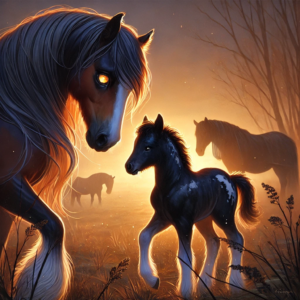 “My dam’s eyes do not glow. Why do you smell like her? Where is she?”
My dam remembered when Lore was a sorrel mare with a bad hock. By the time I was foaled, Lore was a dun mare faded by sun and salt water, her muzzle going grey and her eyes — well, Lore’s eyes are what they are: green and gold, like no other horse in our herd’s heritage.
“Can she really see the wind, mama?” my third foal asked.
“My dam said she could, but how can we know?”
“Did you ever talk to her?”
“Only the lead mares speak to her. Sometimes the old aunties graze by her and listen. She tells them the stories they must tell the weanlings.”
“What stories?”
“Soon enough, you’ll know, won’t you?”
He leaned into me then, lipped my udder enough to show that he appreciated my milk, though he didn’t drink much these days. His foal fuzz came away in patches revealing his bright bay coat, a gift from his sire. By late summer my colt would be off with the others of his year learning all the things a horse needs to know to live among his kind on this harsh place: how to see patches of sucking sands, how to brace side-by-side with cousins, rumps to the storm wind and heads low in the lee of their shoulders, how to run and spar in the bachelor band where friend and rival are the same thing because they both strengthen you. But for now he stayed close, bending his knees to graze in the shelter of my body when the wind off the water blew cold.
As my foal would soon do, I had learned Lore’s stories grazing among the senior mares who no longer bore foals but guarded and guided the weanlings into maturity. She remembered sweet grass in marshes far back before men, when only the wind’s hands had touched us and we carried no burdens. She remembered generations when ice locked the land and when it had weakened, she had led her people north to new pastures fed by the waters of its retreat. She remembered the hot, golden hills we had run before we came here, packed in the dark bellies of wooden ships that crossed the saltwater.
One evening, in the dusk after sunset, with the offshore wind fading and the herons settled on their high nests, Lore called us all to Gather. She had never called a Gather in this land before now, but we all recognized the summons as it lived in our bones and blood. The lead mares sent the bachelors up and down the island, leeward and windward, to bring every horse to hear her. Last to come were those on the far side of the fence that humans had stretched from inner sea to outer sea, nonsense dividing the sand. Those horses skirted it by swimming around the sunken end. Rumor said they had left a great pile of manure banked against the sun-warped planks.
By moonrise we were with her in our hundreds, mare and foal, weanling, bachelor, and herd sire. We surrounded her, the lead mares at the center and the rest of us around them, circle around circle, silent but for tail-swish and hoof-stomp when flies bit. The Gather Truce prevailed, so none of the young stallions challenged their elders or one another for mares. They knew the penalty for disturbance was exile, as good as death, for no horse can live alone.
Into our minds she came, silent as snowfall, showing us what we needed to know and what we had to do. “Far over the gray ocean in the direction of morning,” Lore said, “lies an island with a fiery heart. That heart swells and will soon break, shattering the island above it. Most of its body will fall into the sea, making a great wave rise and run. In less than a day it will travel from there to here. When it arrives, it will shrug the ocean over this island and roll far inland across the channels, washing everything before it, then drag the shattered mess back out to deep water. The flood will run faster than we can, so we must leave now to be far away and safe when it comes.
Lore’s plan was to take us across the channel to the smaller sister island, through the town there, across the second channel, then over fields and into a forest we had never seen. She knew some of that country from the times she had been caught in the high summer penning-day, when many of us were driven across the water and into the town to be looked over by humans, with some youngsters taken while the rest of us returned. Because they were her kindred, Lore could touch the minds of those horses carried away to new pastures, so she knew roads and open land none of us did. She selected our destination inland from what she had learned from these distant lives.
The vision of tall, dense trees startled us, for we were creatures of this windswept, watery place, living on seagrass between sand and sky. But for horses, the sense of home is the same as the sense of safe, not tied to a bit of ground, but to a feeling of peace, where a watchful eye is all we need to keep our foals and families from harm.
Lore sent urgency rippling through our spiraled herd, and the outermost bands peeled away, trotting toward the channel crossing. The senior mares led; their stallions took the rear guard, guiding the youngsters between them. As the great mass of us moved out, I felt the other lives of the island stirring. The white tips of fox tails flickered through the scrub, and I heard the light footfalls of deer shadowing us.
The wading birds, who have their own ways of knowing, lifted from the shore in skiffs and swirls, strangely silent. I had never seen herons leave their rookery so close together, one after another, long legs behind them and their wide wings scooping the night air, the lines of them long strands like a tail swept back in the wind. The egrets, large and small, were easier to see, their whiteness gathering the scant moonlight. By the time the first horses entered the channel, the air above was filled with birds, the differing rhythms of each kind’s flight blurring together into a whoosh like rushing water.
When I plunged into the channel my foal pressed close to my shoulders. He’d splashed in the ocean shallows with me before to escape the black flies but this was his first real swim. It was low tide, so there was little current in the narrow stretch of water. His brave muzzle never wavered as he swam, ears swiveling to listen to huffing breaths around him and the murmur of crossing wakes as our band pressed forward. The moment his hooves found the far shore he bounded onto the beach, soaked tail high with pride. He nuzzled his year-mates as they checked one another, affirming that all were here.
Whitetail and sika deer had blended into our great herd, but sifted themselves apart as soon as they landed, bounding away across the yards and gravel roads toward the leeward beach. Foxes and raccoons arrived in our wake, staggering on the trampled sand as they shook water from their pelts before disappearing with the deer.
Lore came in the middle group, but all the bands waited for her to take the lead in the next part of our journey. She led us past the wooden houses and yards of short, thin grass, sending her peace outward to soothe dogs startled awake by our footfalls. We walked so the foals and eldest could rest and so the muffled rumble of our hundreds passing would wake no human sleepers. The island’s captive horses heard us, though, and some called to Lore. She quieted them, but I believe she gave them the message because several of them ran their fence lines and rattled the gates that kept them from joining our numbers.
“Will they die here?” my foal asked.
“I don’t know. I think the humans will leave the island and take their animals with them in a few hours.”
Our great herd bunched together on the leeward shore as Lore assessed the condition of our weakest and then considered the best crossing. Marshy sand spits littered the inner channel, some of them standing proud at low tide and others merely clots of reeds trapping muck that gave no rest or purchase to a tired horse. Lore’s light touch in our minds asked us to attend her again.
“It will be a long swim, maybe hours to reach the far shore. Some will be lost to the water.” The lead mares nodded, their ears twisting with fret. “But there is another way. We take the narrow road above the water that goes straight across. We could trot and canter that distance, reaching the far shore with enough night left to hide us as we run inland.” The adults raised their heads to study the distant ribbon of stone and steel. Ever reckless, the bachelors nudged one another, their feet shifting in anticipation.
“We might meet with humans crossing. We would have to share the road with their machines as there is no way to leave it once we have begun. Are you willing?” Mares and herd sires pressed together, necks arched and muzzles close, seeking reassurance from one another. Shifting along the shore road, the herd shuddered as each family band made its choice. One by one the lead mares sighed their assent and the entire herd stood still, waiting.
“Together then,” Lore said. She led us up the island, the stallions keeping our long herd clustered on the road. Past houses and cars and buildings we walked through the silent town. Most of the adults had walked through the town on penning day, so the shapes were familiar. The waning moon was high now. Lore turned onto the wide, white road that ran over the water. Lead mares and stallions kept us bunched close on the shallow rise to the road. It was wide enough for us to travel several abreast, the mares with foals at heel. My colt and I trotted near the front. We could see Lore’s pale coat glint in the moonlight, her dark tail held half-high, signaling her concern. From the well of my heart through every muscle and sinew I knew she would keep us safe.
Lore kept our trot steady, a cadence to cover distance without exhausting our youngest and eldest. The bachelors longed to break and run, but lead mares pinned their ears and drove the males back into line with nips and glares. My colt’s boldness pleased me as he matched my pace. I raised him with that courage. In a different band I would be a lead mare, but my older sister guides us, the strength of her spirit rare and worthy, so I am content to follow. Perhaps one day she will leave our band to go with her chosen mate when he is displaced by a younger stallion, and I will step into her place. Until then I trust and obey her and insure all my foals do as well.
The road crossed reed beds that hissed in the sea breeze, the long stems rippling like water above the water. Now and then we heard deer splashing over the sand spits, traveling in pairs and severals with few fawns among them. I doubted that fawns could survive the long swim, so many does had not started this part of the journey. By now all the birds had vanished inland so the sky above us was deep and calm, though on the far shore lights from another town tainted the dark horizon and smothered the stars. The rhythm of our two-beat pace blurred into a low thunder on the hard road.
We had reached the place where the road crosses the deepest, widest water when the truck came, heading toward the island. I had seen one of these at rest in the town last penning day. It was huge, three times our height, and its face lights flashed as it roared toward us.
“Move over!” Lore commanded, and the whole herd flowed sideways to the upwind side of the road, crowding many horses against the low metal fence. The truck made so many different sounds that it seemed to be more than one creature. I heard thumps like a woodpecker on a hollow tree, though there never was so huge a bird. I pinned my ears against its mind-piercing squeal.
The horses in the front bunch balked and those behind them piled into one another, screaming. Some that were crushed against the low rail leapt off the bridge, and I heard their bodies hit the water below. A filly panicked, breaking out of the herd and running blind toward the beast, screaming for her dam. Lore spun and leapt, shoving her back into the stumbling mass of us. The filly found her dam but Lore could not escape the truck’s path. It hit her broadside, throwing her several lengths down the road.
She lay still.
The truck halted, its eye-lights glaring at the heap of her golden body.
The mass of plunging, panicked horses milled on the road. My colt squealed and the lead mares cried out, frantic to contain their bands and push them past the rumbling truck. It was not moving anymore, but clouds of smoke billowed around its feet, its eye-lights shattered our night vision, and a human had climbed down off of its side. He yelled at us and waved his hands but the horses at the front ignored him. Beside his deadly, reeking beast, he was no threat at all. The leading band had tangled in rage and fear, stomping on their own youngsters and not even the stallion could shift them by driving from the rear of the group.
“Lead them. They need you now. Get them across the water.” Lore’s voice steadied me, directed my attention away from the press of legs and the roiling sea of necks, manes, and haunches. “Go on. This is who you are. They are all, every one, yours to lead.”
“I am not a lead mare,” I answered. I could not keep my feet still. Terror had streaked my shoulders and flanks with foamy sweat.
“You are far more. Now you are Lore. Call your people together and they will follow you.”
“How can they hear me?”
“The same way you hear me now. Believe with your whole heart — know with your whole mind — that they are your people. Then speak.”
I turned away from the empty body on the road to look at the shuddering line of horses stretching far back toward the island we had fled. My night vision returned and I saw them, each one, knew their names, their lineages, their strengths and sorrows. White feet, blazes, stars, patches, and tails gleamed under the waning moon. Scents of fear-sweat and mare’s milk whipped past me on the landward wind. My colt found me, ducked under my neck and pressed himself against my chest, his voice quavering in time with his skittering feet. I bowed my neck over his back and laid my cheek against his face.
“Shall we leave, beloved?”
He bleated in answer.
“Follow me, stay close.”
I turned my mind inward, stroking the memory of every horse I knew here, discovering that somehow I knew them all, even the bands from the north whom I had never met.
“My people, my family, follow. We move forward now.”
I stepped around the dead mare and passed the hot body of the truck, pausing only to bare my teeth and strike at the human so he would step back. I arrived at the front of the line, nibbled my colt’s curly foal-mane to reassure him, and spoke again with my whole body, a strong trot ringing on the hard road as I stepped into the darkness beyond the horror.
“Follow, follow,” my two-beat gait sent a tempo through the herd. The confusion at the front dissolved into order, the simplicity of the trot, and with motion came clarity and calm.
All down the herd the lead mares matched my call, walking until the ripple of forward movement opened space for them to trot. I directed one of the old bachelors to keep the human pinned against his truck until we were all past that narrow place. I knew, somehow, when the last horse was on the open, empty road, and I pulled the whole herd into a canter.
On the road we crossed the main channel, then the marsh islands and the smaller channels. A knowing, rather like a scent, came to me that the horses who had leapt into the sea were making good time. All were strong adults who could smell the mainland.
“We will wait for you on shore,” I told them. “We will rest until you join us.” There was no lead mare in the water with them, so they could not answer me, but I felt them take heart and stroke onward.
I cantered above the last marsh island. The road was level with the land again and swung left a short way onto the shore. It lay beside the ocean’s edge for as far as I could see, short grass and white sand on either side. I saw a fence glint in the darkness, but there was enough space on our side of it for all of us to gather. I walked onto the grass, my colt walking beside me, his body trembling with exhaustion.
“We will rest here and wait for the swimmers,” I told the arriving bands. “The foals need to feed and sleep. Come close to the fence, away from the road. Our band, led by my sister, stayed near me. We claimed a space and I dropped to my knees, then to my side, rolling to rid myself of the sweat and distress of that crossing. I stood and shook, then invited my colt to nurse. He drank all I carried, and was asleep, flat on the grass but for his round belly. I felt the last of our herd, mud-caked and staggering, rise from the channels and marshland and rejoin us. They found their bands and lay down, their need to rest greater even than their desperate thirst. I also sensed does and fawns on the bridge, their hard, tiny hooves tapping as they followed our lead, foxes and other small animals scampering among them, pulled far from their home ranges by their terror of being left behind.
“Ask the aunties to watch for a time so you can sleep,” I told the lead mares. More tired than I had ever been in my life, I lay down beside my foal and slept.
In my dreams, Lore’s power and knowing flowed into me, blending my own life’s experience with that of all the generations of our people who came before, like a tributary stream joining a great river. I was still myself, a dark paint mare of six summers and three foals, but now I also carried in myself so much more. I wandered the memories of these horses, of their sires and dams going back to a place I had never seen. Hot, stony mountains and hard land, sparse grass, black cattle. Men on tall horses used long poles to drive us and the cattle to high meadows season on season. I dreamt of the wooden ships that bore us over the water, not to our island but to a place far to the south, hot and wet. We carried humans, pulled wagons and plows, walked beside sheep and cattle, and plunged into the noise and stink of battle, steel spurs sharp against our sides, urging us into the blood and hurt and press of angry, frightened bodies. Horses came north, dispersed across forest lands and grass lands. So many places, so many seasons, and yet we were one people under a clear and fair justice meted out by the lead mares. At the edge of my awareness, further than eye can see or ear can hear, bands of horses ran under the setting sun with their own Lore among them, as all horses across the broad face of the world, mountain to desert, grassland to island, have a Lore among them who keeps them safe.
I dreamed each member of this herd: the white-faced foal born deaf, the exiled stallion going blind, the fierce, wild minds of the young bachelors, the foals like marsh lights, faint glimmers at birth but burning bright and steady by weaning. The lead mares bound together all other mares connected by blood and friendship, the strands among them gleamed like a dew-touched spider web on a clear morning. Now I stood at the center of them all, promised to them and promising them, bearing in my body all we are and will be. This is how it has always been, Lore passing from one mare to another, shifted by deaths sudden or slow, always a shock to the anointed one. I would never be our band’s lead mare. I would not bear another foal. I no longer belonged only to myself, but to all of us, and I loved each quick-footed foal and senior stallion, each vigilant dam and cocky bachelor, and every one of the brave lead mares. I loved them all with a fierce, determined, sheltering understanding of who we had been and who we will be.
I woke, rose, and snatched at the short, tough grass, frantic and ravenous. While I grazed, I sought out the memories Lore had left to me of the way from here to safety. My awareness drifted inland, following the tendrils of memory from other island horses who had lived here for generations and guided by the minds of those who lived here still. The living horses showed me that fences closed off the most direct path to a forest. They also shared the knowledge of ponds and creeks where we could drink.
The light grew brighter long before the sun lifted above the water. My colt stirred, blinking and groggy. He rolled onto his belly, braced his forelegs wide and shoved himself up, shaking himself from nose to tail tip. I lipped his forelock and invited him to nurse. He looked up at me and scrambled backwards, legs splayed and the whites of his eyes bright against his dark face. He fell into a frightened heap, struggling to rise.
“Who are you?” he bleated.
“You know me, beloved,” I said, sending my breath to comfort him.
“My dam’s eyes do not glow. Why do you smell like her? Where is she?”
“My eyes glow? I did not know that. I am who I have always been for you, though now I am also more.”
He sorted his legs out, rose, and bolted toward our lead mare. My heart twisted in pain to see him so afraid. My sister met him, curling her piebald neck over his and nibbling his withers to calm him. When his trembling eased, she shouldered him back toward me.
“She is your dam, child, always,” my sister said. “Close your eyes, take in her scent, and you will recognize her.”
I closed my own eyes and held myself still, but I could hear the panic in his feet as he scrambled beside my sister.
“What happened?” he snuffled against her flank.
“On the bridge, Lore passed from the mare where she had been into your dam. She is now Lore, keeper of all the stories, guide and watcher, the wisdom of all horses living among us.”
My foal made a soft sound of fear and loss and only the steady presence of my sister kept him from bolting. Grief rose in me then, a stain in my tributary as it entered Lore’s ancient river. I knew now that every mare who has ever been Lore had felt this loss, though knowing I was not alone in this did not comfort me.
“I will look away so you can feed,” I said. But my colt would come no closer, and did not ask to nurse again. My sister released him to join the other weanlings in our band. She shared her breath with me, taking in some of my sorrow at this loss. We groomed one another for a time while my heart ached.
A few cars passed us on the road, going out to the island. They slowed or stopped to look at us before driving on. The ground beneath me felt wrong, not the way that sucking-sands do, but dangerous and unfamiliar. Refreshed by sleep and light grazing, my people’s thirst made them restless. I chose to follow this road to its end, then turn into the farmed fields and travel over them to the nearest woodland.
“Rise now,” I said to the herd, “I know you are hungry and thirsty, but we must move away from here. We are not yet safe.” The bands stirred, mares nosing foals up for a quick meal, stallions circling their charges to bunch them together.
“Follow me. We will go to water first, and then take shelter from what is coming.” Speaking to all of them this way disoriented me as I gathered glimpses through the eyes of each horse as my mind touched theirs. I shook off my confusion and set out in a slow trot that would carry us miles though we were still tired.
We stayed off the road when we could, trampling the grass alongside it rather than bruising our feet on that hard surface. Each time my hooves touched the earth, it felt wrong, as though the ground should not be trusted. I wanted to move us faster but forced myself to keep to this easier pace.
Not long after sunrise the earth moved. The tremor swept past us from seaward to landward, a shiver like flanks beset by biting flies. Horses squealed and bucked, scattering. Several foals went down hard and their dams stood over them to fend off the trampling, panicked hooves. Then, as suddenly as it shifted, the earth quieted. None of us trusted that stillness now. Inland and from the islands, we heard the wail of human alarms.
“Follow, follow,” I called and we set out again, the lead mares hard put to keep their bands from tangling in the confusion. The few cars on the road had stopped, their humans out and walking, gesturing to one another. They had had no warning. They stopped talking as we swept by them in our hundreds. The road turned away from the ocean and headed straight inland. I stepped into a canter. We had so little time before the humans would swarm. Now they knew what was coming and we must be out of the way of their rush.
I learned from the horses living nearby that the road went straight from here, and soon we would reach open land. An old gelding paced us along the fence of his pasture, telling me where to find the creek on the far side of the long field. The sun was well up and more cars appeared, so I was relieved when we arrived at the place where we could leave the road. I sent my sister and her band on toward the water and waited while the herd flowed past me. The bachelors, unfettered by mare rules, bolted into the wide field, their hooves flinging up clots of mud and small plants as they tore away, tails flagged high and eyes wild. I joined the last band to leave the road, stepping between them and a group of humans approaching on foot, yelling and waving their arms. We left them their road, and they did not follow us.
I joined my sister at the creek. My son clung to her flank and would not look at me even when I nickered at him. I turned away from the pain in my heart, keeping my attention on the stragglers far across the field. Horses arranged themselves along both banks, upstream and downstream. They dipped their muzzles into the chilly water and drank, lifting their heads in turn to keep watch while the water settled in their bellies. Then others paused and took the watch so the first could drink again. The foals pranced into the creek up to their knees so they did not have to strain past the length of their legs to reach the water. As horses soothed their thirst they stepped away, allowing the latecomers access. There was no grazing for us here, just scrub and a small patch of trees. But there were also no humans here, so sighs of relief rippled through the herd. No one relaxed, as we were in unknown territory, but we were not threatened. The earth beneath was still for now, but I thought it might move again. It was the coming shift in the ocean that threatened us, though, and we had to be further inland before that happened.
When I set out in the lead this time, I kept us at a walk. Even the younger horses kept this pace, as the terrors of the night and morning had drained them. Each band kept its members close, but the bands themselves drifted apart in this open space. It was bigger than any flat, empty ground these horses had ever seen, and it spoke to their blood and bone as good land for horses. We could see any danger coming from far away, and there was ample room for all of us to move if we had to flee.
It took much of the morning for all of us to cross that ground. It was all as flat as our island, which is why we had to go so far away from the shoreline to escape the coming water. We saw only one human far away, a man on a machine that stirred the sandy dirt. He stopped his machine and stood on it so he could watch us pass. I looked back and saw him turn his machine and leave the field.
At noon we reached a place with patchy scrub and some grazing, so we stripped it bare. The foals nursed and slept, and the elders lay down in the cool shade. I stood apart, listening to the minds of horses far from here. Those native to this place showed me that their humans hurried, moving their families and animals inland. I found some of the horses on the small island and saw through their eyes the fear and haste as they, too, prepared to leave with their humans. A filly in a trailer on the long bridge shared her eyes with me, and I saw there was no open road, only a stretch of cars and trucks creeping toward the far shore. I breathed gratitude into the afternoon breeze that Lore had Gathered us when she had.
Late in the afternoon I called, “Follow, follow me.” We left the scrubland and walked another long field, always heading inland. Human alarms blared in the distance. I pushed the herd through fine pastures though many wanted to stop and graze. Even so far from the ocean, I could feel the wrongness in the turning tide, though I could not convey this to my people. They trusted me when I moved them on at a brisk trot. We stopped just once for water.
That evening we reached the forest I recognized from Lore’s memory. She had meant for us to go among the trees, as they held this land fast with their bodies and no great wave or storm surge had ever shifted them. We needed only to spend a night and a day in their shelter; then we could return to open country. The herd bunched against the borders of the forest, unwilling to step into the dimness under the dense branches. Born and bred under wide sky and constant wind, the trees felt confining, and to us, that meant dangerous.
“Come in, my people, come under these trees,” I coaxed. “This is where we will wait. The water is coming, and in a day or two it will retreat. Then we graze under the sky again. In time, we can return home.” The lead mares coaxed their bands from the sunlight into the deep shadows. The bachelors were the last to enter, skittish and resistant to the lead mares’ instructions. I directed seven of the senior stallions to drive the reluctant young males, with teeth if necessary, into the forest. When the entire herd settled at last in this strange shelter, I spoke to the Gathering, my mind touching each of them.
“Come close around me,” I said. “I will tell you stories through this time we must spend far from our island.” The wind in the trees sounded like surf. “We will be safe here.” Away to the east, I sensed the ocean arrive and the world we had left snapped and splintered under the running wave. My breath caught as horses and humans trapped on the road, and those who had not yet left the island were swept under. Sweat formed on my flanks and neck and dripped off my shoulders while those around me stayed dry and calm. I took a deep breath and released a long sigh. I forced my attention back to the shuffling of hooves in leaf litter and the call notes of tiny birds astonished by our arrival. I decided to tell my herd about the golden mountains and the black cattle. “Long ago and far away,” I began, “we lived in a different land and ran with another people.” Even the bachelors stood still to listen.
* * *
 About the Author
Anne Larsen writes in a bio-diverse household that includes mammals, birds, and plants, in particular a gang of Venus flytraps that rule a dangerous neighbourhood on one windowsill. In addition to direct guidance from her animal family, Larsen draws on biology, history, mythology, and religious studies in her magical realism.
Issue 25
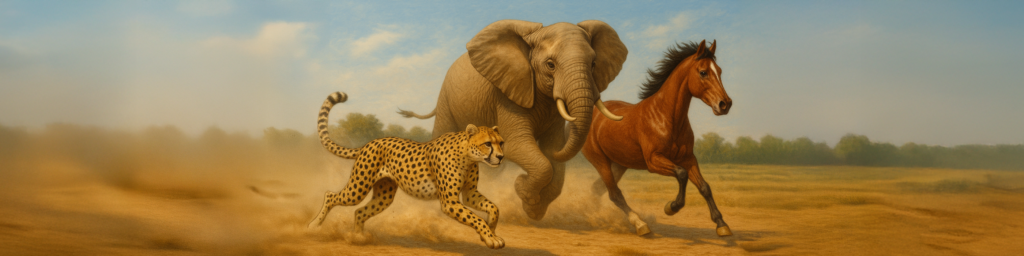
Welcome to Issue 25: Migration and Survival
The world changes, and creatures great and small, wise and simple, old and young — all of us — must move on to survive. Gallop with horses, feast on festering fruits with elephants, and fight for your very life with cheetahs, rats, and practically extinct reptiles. But as you do, keep an eye to the future and the path you’ll have to follow to arrive there. The animals certainly do.
* * *
The Passing of Lore by Anne Larsen
Migration Mismanagement by Dana Wall
Herdhunters by Mike Robinson
Queen of the Hungry, Queen of the Few by Leo Oliveira
Silver Bones by Michael Steel
Unmaking Extinction by Liz Levin
The Last Breath by Liam Hogan
* * *
Zooscape will be re-opening to submissions on February 1st, 2026! We will stay open for at least a month, and announce our closing date with at least one week of notice. However, the exact length of our open period will depend on the volume of submissions we receive. You can learn more on our guidelines page. If this open period proves as successful as the last one, we hope to go back up to releasing issues four times a year.
As always, if you want to support Zooscape, check out our Patreon. Also, you can pick up e-book or paperback volumes of our earlier issues, complete with an illustration for every story. The e-book of the sixth volume just released today, and the paperback for it will be coming soon!
Issue 24
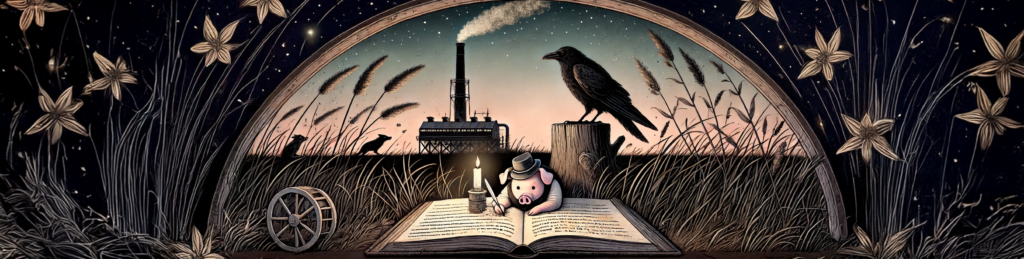
Welcome to Issue 24: Pigs, Rats, and Anti-Capitalism
The wonderful thing about stories is that we can fight our battles in them — process grief, fight capitalism, and imagine paths past our current woes. Maybe you’re not quite ready to throw it all away and run into the forest without even a sunhat for protection, but in a story, the brave hero can do it for you. Mice can overthrow corporations; pigs can fight against the company town; and you can follow vicariously in their hoof and paw prints, learning how it feels when the shackles finally break away… perhaps inspiring you to keep fighting too.
* * *
Nine Lives Later by Alyza Taguilaso
The Crows Do Not Know Me by Lynn Gazis
Gifting Salt and Sorrow by Melanie Mulrooney
Jot, Flowerwerks, and the Missing Mice by Lara Hussain
Sunflowers and Spring Steel by H. Robert Barland
Rat Race by Larry Hodges
Capitalist Pigs by David Aronlee
* * *
As always, if you want to support Zooscape, check out our Patreon. Also, you can pick up e-book or paperback volumes of our first 16 issues bundled into five anthologies, complete with an illustration for every story.
Capitalist Pigs
by David Aronlee
 “Without my pay going to those silly log cabins, I am saving so much, it would make your snout drop.”
Posted Hogtown Post Office, January 2
Dearest Priscilla,
I miss you the way the daisy misses the sun. I have wonderful news. I got a job! I’m a truffle sorter at the truffle factory. Not bad for a hog from the country. I had my first day yesterday and my boss already says I have potential. I could be a shift leader within a year or maybe even a truffle hunter someday! My friend Fred says that’s where you can make it big: with the commission from finding a big truffle cluster.
Fred’s a city pig. He grew up here in Hogtown and is showing me the ropes. I get the feeling he’s got money; he said something about doing this job just to get his parents off his piggyback. He’s got a beautiful brick house right in the middle of town. He’s a good oinker though, even if he’s got a bit of a wild side to him. Showing me the watering holes, making sure I don’t put a hoof wrong at work (or at least not when the boss can see).
I better get to sleep soon. Back to the factory early tomorrow. I miss you dearly.
All my love,
Patrick Pig
* * *
Posted Hogtown Post Office, January 20
Dearest Priscilla,
I miss you the way the river misses the sea. I cannot wait for the day I can build that little brick house we always dreamed of living in together. I received my first paycheck. It was a little disappointing. Apparently, most of our paycheck goes into our company lodging. Many of us live in bunks in these quaint wood cabins just by the factory. It’s an easy commute, but so much of the pay gets gobbled up, I’m thinking about moving. I talked to a few of the other young hogs around. Apparently, there is a place called the Straw Sheds you can move in for dirt cheap over on the edge of town. The straw keeps you warm and for pennies a day you can actually save. This is all I ever wanted in the world: to save up to build a beautiful little brick house and find that future we always dreamed of.
All my love,
Patrick Pig
* * *
Posted Hogtown Post Office, February 6
Dearest Priscilla,
I miss you the way the sky misses the dawn. I got my second paycheck today, and I think I can move the plans up! Without my pay going to those silly log cabins, I am saving so much, it would make your snout drop. To think: the son of a long line of muck-rollers and scrap-eaters might someday own a brick house. And the Straw Sheds aren’t half bad. After growing up in a drafty barn, they are positively cozy, and I can afford my own little private shed.
This old boar in our cabin, Barry, gave our whole group a warning before we all moved to the Straw Sheds. He’s the only old porker among us, looks he just sort of got stuck snuffling for pennies and plowing it all back so he can live there. A few of the other younger pigs decided to stay after he said his piece, but when we pressed him for specifics, he just told us about this family that moved out into the woods and built themselves a little log cabin. I guess in the middle of winter some wolves got to them. A whole bloody mess. But please don’t worry. They built their cabin way out in the forest, down by the river. Here in the Straw Sheds we are just on the edge of the town meadow, and I’m surrounded by sturdy hogs. Safe as a pig in a blanket! Sounds like he is just wallowing in his ways. And besides, after hearing so much about the Straw Sheds, well I was curious!
I went down to the Piggybank after work today to open an account. They treated me like pig royalty! (I joked that I came into the city from Animal Farm. They didn’t laugh. I don’t think they got the reference or read as much as we do, even if they like to pretend they are polished city pigs compared to those of us from the country.) They did say if I wanted to take a mortgage on a brick house like Fred’s, they need at least 6-months’ proof-of-income. But I ran the math, and if I’m careful I think I can save the down-payment they require in that time. To think that it may be less than a year until the brick house we always wanted makes me snort. And that should be plenty of time for me to fully explore the mysteries of Hogtown for you.
All my love,
Patrick Pig
P.S. Pardon my crossing out. Paper is too dear in this town to throw away and we have a house to save for!
* * *
Posted Hogtown Post Office, February 24
Dearest Priscilla,
I miss you the way the garden misses the rose. I think I need to see less of Fred. After a few pints the other night he suggested we take some of the truffle oil from the back room. He said all that was left in there was waste, and no one would miss it. Apparently, it gives you a heck of a buzz, so on Friday we snuck in and took a quart or two. Well, dearest, they caught us. And Fred hadn’t been quite right: they very much did care. They had us strung up in front of the Head Hog quicker than you can snort. I thought I was bacon, but then my Uncle Jimmy stopped in.
Have I ever told you about Uncle Jimmy? I may not have. Our family doesn’t talk about him much. He has a connection to the cartels. I’ve heard a rumor he makes the bodies disappear. I won’t tell you how. Anyway, as we were being run up to Head Hog, I saw him. He must have spotted us because no sooner had we been deposited in front of the snorting boar than he stepped in, apologized on my behalf, promised to see I was punished, and when the Head Hog agreed, which clearly Uncle Jimmy very much took as a foregone conclusion, he hustled me out of there. He gave me a talking to alright, told me to get the hell out, leave the factory and Hogtown and go home. But I can’t do that. We have sacrificed too much for me to leave now. And when I asked him what he was doing there he ignored the question, gave me a good tail bite, and left.
I saw Fred that Monday back on the factory floor, none the worse for wear. I’m not sure how he got out of it, but he was snorting along and smiling. He’s a bad influence. That may be an understatement. I must say I am curious just why they are so protective of the truffle oil. Another mystery. I dream of you every night.
All my love,
Patrick Pig
* * *
Posted Hogtown Post Office, April 20
Dearest Priscilla,
I miss you like the wave misses the beach. A strange thing happened yesterday: one of our Straw Shed sows, Pansy, is gone one of our cutters, Pansy, didn’t show up for work. It was most unlike her — she had never missed a day — but we checked the Straw Sheds and there was no sign of any foul play. I asked Fred if he had seen her downtown, and he said he hadn’t. We all heard some wolves howling off in the woods, but when we told the constabulary, or the Porky Patrol as they call it here, the squealer at the station said it was coyotes and huffed about country bumpkins. Didn’t sound like any coyote we have around our place.
We didn’t see anything amiss at her house, so everyone seems to think she just gave up and went home. I don’t believe that for a second. She seemed to me like she was working whole-hog. She mentioned something about her sister just having a farrow and the boar running off with the spoon, so I think she was sending money home…
The other strange thing was that Head Hog didn’t seem all that surprised. Oh, he said all the right things, but there was a strange air of expectation. There isn’t much we can do, not like we have that much free time between truffle sorting and bed, and the matter was referred to the Porky Patrol. They just want to let sleeping hogs lie. But all the same, it is a mystery and you know how I hate mysteries. Only two more months until I can go back to the bank and our dream can begin. I wish I could ask you to write to me of home, I could use a loving reminder.
All my love,
Patrick Pig
* * *
Posted Hogtown Post Office, June 30
Dearest Priscilla,
I miss you like the winter branch misses the leaf. And that is how I feel right now: bare. Indeed quite low although I am not one to wallow usually. I have received terrible news.
I went back to the Piggy Bank, six months of pay stubs in hoof, full of excitement, and was told that the 6-month pay stub only applies if you have some collateral. Well, I do not have a house and needless to say my Straw Shed doesn’t count. Otherwise, I must wait a whole year. I am bereft to learn that it will be another six months before I begin to finally build our house, but alas it must be so. No more trips to the watering hole for me. If I must wait another six months, I shall be saving full-boar and use my time wisely. I will find out what happened to Pansy — I can feel it in my tail curl that it is important.
At least our bonus vests after a year. Apparently, they hold back about 10% of our pay at the factory and after we’ve been there for a year we get it as a lump sum plus a little extra. Encourages retention. I’m not sure about the legal specifics but HR (Hog Resources) says it’s a very sound system. So at least I’ll get a nice bonus to speed us on our way.
It may be my disquiet from the bank, but I received another piece of strange news. Barry is gone. No one has seen that old grunter for weeks, apparently since the day we all moved to the Straw Sheds. Now that I think of it, that was the day after he warned us about the move. I daren’t bring it up to the Head Hog. He heard me talking about it with Fred, who had nothing to add, by the way, and told me to get back to my truffles. Less grunting, more sorting. Something rotten seems to be going on. I heard the howling the last few nights too. It keeps me up sometimes.
I haven’t seen much of Fred since Pansy disappeared. He seems to be keeping his distance outside of work, which is just as well if I am to save all my pennies for our future. I wish I could write to you to come this second. Alas, it is impossible. Besides, with fall approaching the Straw Sheds would be no place for such a beautiful gem anyway. I am well.
All my love.
Patrick Pig
* * *
Posted Hogtown Post Office, August 3
My Dearest Priscilla,
I miss you the way the alpine lake misses the mountain stream. I have amazing news! I have been promoted to shift supervisor! I guess that is what you get when you keep your snout to the grindstone. It’s not much, a little bit more job responsibility, and a few more pennies an hour, but it could mean a whole extra room or two in our little home. Maybe even a second floor. I am all aflutter, drawing up new plans as I drift off to sleep, staring at the shadows on the hay roof. I think of such domestic things: where we will put the ice box and the garden in the yard. I can’t decide if the garden should go in the front or the back (we don’t want any squealers stealing our mushrooms!). But I am getting ahead of myself. There are five months yet, but I feel now like our dream might finally be within my grasp. The oinkers are taking me out for a drink to celebrate, so I must trot. I cannot wait, heart’s flower.
All my love,
Patrick Pig
P.S. Not to mention, as shift supervisor, I have better access to the factory records!
* * *
Posted Hogtown Post Office, September 5
My Dearest Priscilla,
I miss you like the night sky misses the moon. I am so worried. Another of our cutters, Sam, didn’t show up to work. Sam lives a couple sheds down from me in the Straw Sheds. The first day he skived off we figured he had just had a few too many pints at the bar with Fred. Since I’ve withdrawn from Fred’s company, I noticed Sam and Fred have become thick as thieves and it wouldn’t be totally unlike him to be sleeping off the piss recovering from overindulging the night before. But then he missed a second, and then a third day. He has certainly never done that before.
As shift supervisor, it was my duty to report his absence to Head Hog. Head Hog just politely thanked me for the information and trotted off. An employee absence and he just trots away like nothing has happened: this from a pig that squealed so loud when Sam knocked over a sack of truffles last week we thought someone had skinned the bacon from his back. This from a grunter that chomped so hard he almost broke a molar when I showed up to work three minutes late. (It was that first week after Fred talked me into going into the cidery and we ended up with rooster hats.) (Sorry my love, I don’t think I ever told you that story; I’ll have to fill you in the next time I see you.) THIS FROM A SQUEALER Head Hog didn’t seem at all surprised by Pansy’s disappearance either. I commented to Head Hog that the “coyotes” are getting louder and louder, but he just said they get like that this time of fall. Something is amiss, like a moldy truffle hiding at the bottom of the sack. Never fear my dear; I shall get to the bottom of this.
All my love,
Patrick Pig
* * *
Posted Hogtown Post Office, October 18
My Dearest Priscilla,
I miss you like the evening shadow misses the far horizon. The plot thickens. Head Hog invited me over for a poker night at his sty. A couple of the execs were there too, really heavy hitters, along with a few other shift supervisors (all boars; not a single sow among them), and to my surprise, Fred. Fred and I were the only first-year-factory-oinkers there. I promise dearest, I was not there to gamble away the savings. It was simply too good of an opportunity to chew the fat with upper management and see if I could sniff anything out. And believe it or not, I was doing quite well at the game too, or at least holding my own, until I had two shocks.
Fred had just gone bust and tried to buy back in for the third time (who goes all in on a pair of deuces?), when one of the execs told him, “That’s enough cob-roller, you get on home now.” Fred just rolled his eyes and ambled out. I leaned over and whispered to another supervisor who had been there a year longer than I and asked, “What was that all about?” And do you know what he told me?? That was the CEP (Chief Executive Pig) of the whole factory and none other than Fred’s old shoat! It all came together for me: how Fred “owns” a brick house in the middle of town; how he got out of trouble after that truffle oil incident. I lost the next hand. But what really set me back happened a couple hours later in the night.
Head Hog had been passing around brandy and the snorts and shouts were getting louder as it got later. One of the other shift supervisors burst out laughing at some joke and shouted back that he’d “call the wolves early this year.” I don’t yet know what that meant, but the room got real quiet for a moment: like a piglet learning about bacon for the first time. Well, that reference to wolves threw me off something terrible. You remember that’s how Auntie Edna went. I stayed quiet the next few rounds to try to listen to the snorts around me, but with my concentration split I was quickly drained of chips, which raised the volume considerably. Priscilla, I do not know what that comment meant, but it meant something. That evening was worth it. I will write to you as soon as I can.
All my love,
Patrick Pig
* * *
Posted Hogtown Post Office, November 7
Dearest Priscilla,
I miss you the way the desert cactus misses the rain cloud. I think I am finally making progress. I am doing my best snuffling up to Head Hog. I have become a veritable tyrant to my crew and I fear they are not taking it well. I dare not tell them what I am up to, but I am in Head Hog’s good books. He has me coming in late to do the scheduling. I would normally not stand for it, since I do not even get paid overtime, but coming in late seems the perfect opportunity to do some rooting around. We will find our answers soon, I can smell it.
All my love,
Patrick Pig
* * *
Posted Hogtown Post Office, November 25
Dearest Priscilla,
I miss you the way the spider misses the web. I found some things. I shall try to lay things out more clearly in my next letter. I don’t think anything terrible should happen, but if you do not hear from me, know that I have copied this letter to Uncle Jimmy so nothing should be lost with me. Straw Shed 4. Mud under the bed.
All my love,
Patrick Pig.
* * *
Posted Fairytale Post Office, December 4
Dearest Priscilla,
I miss you the way rabbit misses the burrow. I do not know if you can tell, but this letter was not posted from Hogtown. I gave it to a traveler, she said her name was Red Riding Hood. Strange name these humans come up with. Anyway, she was heading out of town and said there was a post office up by her grandmother’s house in Fairytale Village and she would post it there for me, so there is no chance of this falling into the wrong hooves.
I found the ear of corn in the mud. Head Hog sent me to the CEP’s office the other day to drop off the truffle-loss forms. While I was there, I poked around his desk since he was out for the evening. There was a latch under the bottom drawer, and a secret compartment; you remember how we used to play around with those with your Uncle Peter? Anyway. I found contracts. It’s all there.
The CEP has been paying off wolves. I cannot believe it, but it all fits. They make the new hires disappear so they can re-hire a new crop every year and pay them peanuts instead of paying each experienced crew the wage they deserve. It’s somehow cheaper for them to hire assassins than pay a reasonable wage? Should I be surprised?? I saw so angry my tail straightened right out and I nearly barked.
Do not fear for me my dearest. I snuck out the way I had come. And they seem to keep the shift leaders; at least, I am the only new one this year so I assume so. I think I am safe. It is Thursday. I’m going to take this information to the Hall of Justice and constabulary on Monday. Too many people are off on Fridays and I’m afraid of this falling into the wrong pettitoes. I shall talk to the other oinkers and we shall march in numbers.
I cannot imagine you in this cesspit, so perhaps I shall return to you soon, but we shall see on Monday. I will write to you as soon as I can.
All my love,
Patrick Pig
P.S. I just realized this is why they keep back 10% of our pay. It’s not for retention. It’s to pay for this dastardly scheme! We have been paying for our own demise!
* * *
Posted Hogtown Post Office, December 8
My Dearest Priscilla,
I miss you like the falling rain misses the soil below. I am despondent. I know you have been expecting a letter from me for days, but I could not bring myself to put pen to paper. I am in jail. It all went wrong. They will no doubt read this, but I do not care anymore. If they use this against me, so be it. I do not believe they will give me a fair trial, so I must tell my story to someone.
I did it. On Sunday I gathered the trotters from the Straw Sheds, and some few left in the wood cabins at the factory, and told them what I had learned. And on Monday we marched in force down to the Hall of Justice. I made my report to the Porky Patrol while my fellow brave oinkers marched outside with signs and chants. I gave Officer Parker the documents I had found, with the promise that they would get before a judge ASAP. I trusted him. I’d seen Officer Parker around town a few times, he seemed the professional, if a little lazy, type of hog, but he’d always been friendly. More fool me.
I thought things were going well, they held me in a room with one window, but Officer Parker porked his snout in to say they would be bringing the CEP down straight-away to get to the bottom of this. My heart rose for a few minutes. I saw the CEP come in with a couple other officers. Then I heard the laughter in the other room and my heart sank. Then I heard shouts and squeals from outdoors and the sound of breaking logs, and then it got quiet, and my disquiet grew. Then the CEP left, rubbing snouts with the officers, with a sheaf of documents — my documents — in his hooves.
Officer Parker came back in and explained that it was all a big misunderstanding: those were security documents for the factory that I must have misinterpreted. I was, after all, “just a pig from the country, haha.” I rose to go and it got worse.
Officer Parker then explained, almost in tones of regret, that unfortunately I was going to be held. There was the small matter of inciting a riot. Of slander of an important individual. And of course: thievery of corporate documents. I was caught, bound hoof and hoof, metaphorically and literally.
Here I sit, wondering when I shall see the light. I am awaiting trial but I have little doubt what the outcome of that will be. I trusted in the justice of this place, I do not know how I could have made such a mistake, and now we shall not get our closure. I miss you all the more my dearest. It pains me to think how I have ruined the whole point of my trip here.
Patrick Pig
* * *
Posted Hogtown Post Office, December 10
Dearest Priscilla,
I am out! Fred posted bail. I guess he felt bad about everything. Not bad enough to help me — he didn’t hear me when I tried to explain about the wolves — but bad about how everything went down. He urged me, near tears, to just leave town and be safe.
You know why I cannot just give up now. But I have a new plan. The wolves are due in two days and there won’t be a floor-level factory cutter left alive after that if I leave. Most of them are young and clueless and after marching with me are just wandering aimlessly around the Straw Sheds. Some have even gone back to work. They don’t know what to do. I will not leave them to those vulgar fascist pigs and their murderous wolves.
I know this would give you anxiety my dearest. I am so sorry. If all goes well this will put an end to things in this reeking sty of a town and I shall return to you post-haste.
All my love,
Patrick Pig
* * *
Posted Hogtown Post Office, December 20
Prissila,
That dirty squealer. He led the wolves right to them! And to think I bailed him out of jail. I’ll never forgive myself. Patrick asked me to write to you, and I wouldn’t have bothered getting my hooves dirty, but his family needs to know what kind of rotten squealer they raised. Holy hog. I hope his last moments were agony.
The wolves came, just like he kept grunting about. Patrick kept squealing that my old shoat was mixed up in it — that uptight old trotter — and now we’ll never know.
I was at home, wallowing with this pretty petite oinker named Patty, when I heard an insane high-pitched squealing that rattled the windows. I saw a couple trotters tear past and then some wolves, howling and drooling, pelted by in a flash heading towards the factory. One of them banged into my door, so we boarded things up tight — fortunately the brick walls are sturdy and they couldn’t get in. I followed them as soon as things quieted down and Patty trotted after me.
Well, it was mayhem up there. There were a few of the Porky Patrol and about half the town milling about outside. I saw Officer Parker rolling out some tape and cornered him. Patty was with me so I reminded Officer Parker who my father was and he spilled what he knew.
Apparently, there was some sort of hostage situation led by some radicals and Patrick. That crazy grunter. Then a pack of wolves came busting through, chewing up anyone who got in their way and smashed their way into the factory, which was on fire for some reason.
They got my old shoat! The Porky Patrol found him chewed up like bacon along with Head Hog. Those sick beasts. And it was Patrick’s fault.
Oh. And I guess some of the wolves then took off after Patrick and his crew. The Patrol found a few ripped up snouts and gobs of blood and guts by a back exit, so it looks like they didn’t get that far.
Good riddance.
Fred
* * *
Posted from Fairytale Village Post, January 2
Dearest Priscilla,
I miss you the way the willow seed misses the wind. And the wind is finally blowing me to you. I am coming home. I fear we shall never have our brick house in town, but we already knew that.
I hope Fred wrote to you to let you know I made it out. I assume he was not pleased. But we did it. Vengeance. For all of us.
I gathered all the young factory oinkers in the Straw Sheds the night before the wolves were supposed to arrive, I remembered the date from the contracts. And it was obvious where the wolves would go first: the Straw Sheds. We took our things into the woods and hid out, but left a few notes for those vicious beasts. We stayed there until the shadows were getting long the next day but before the rest of the factory cutters headed home.
Then, we quietly crept around town and broke into the factory! We overpowered the security guards and tied up all upper management. Any snout who had been there less than a year or was just a worker we let go, but every shift supervisor, Head Hog, all the executives, and of course the CEP, we kept. A couple shift supervisors escaped, but that didn’t bother me.
Then we barricaded the doors to the factory and started chanting, “no justice, no peace,” and “hog heads will roll,” just to stir them up. Sure enough, the shift supervisors had gone straight to the Porky Patrol and those corrupt porkers showed up just as the sun was setting. We had hostages though, so they just set up a perimeter and ordered us to roll over, which we naturally ignored.
I and a few others made some final arrangements as the night deepened. And just as the Porky Patrol was getting ready to burst in blazing — we had the CEP and all the richest pigs in town of course; they were getting quite anxious — the wolves showed up. Right on time. Slavering jaws, hanging tongues, any Porky Patrol that got in their way was quickly shown the way to hog heaven.
And the rest of us just slipped out the back door and into the woods.
See, we had left notes for the wolves, that the hog management had decided that the deal was off, and so they were going to burn some of the truffle oil they usually paid the wolves in, and then smuggle the bulk of it out and pretend it had been lost in the fire. The wolves, when they found those notes but no tender pigs in the Sheds, came storming up to the factory. Where we happened to have all upper management neatly trussed up for them. And we had poured all the truffle oil into the big vat on the factory floor and set fire to it just as we slipped out.
The wolves broke down the door, saw the fire, just as we had said, and were enraged. Apparently, half the wolves took their displeasure out on the drove of upper management before them, and the other half ran in and tried to put out the fire as the place burned down around them. But a few came after us right quick and nearly caught us. It was touch and go my dear, but we had an insurance. We brought the CEP and a couple of his right-hoof snouts like Head Hog, and, this may seem cold blooded, but we cut them loose just as the wolves came up behind us. Well, such carnage you have never seen, but it gave us the time we needed to escape.
I cannot say I feel bad about the death of those porkers. When I think of the scheme they ran and the blood of so many innocent trotters on their hooves. Sam. Pansy. So many, many years of young dead pigs. They deserved what was coming. And of course…
I am bringing some of the trotters home with me. We are going to start our own truffle collective, away from the corruption and depravity of Hog Town. I know it’s not the brick house in town we imagined, but all these oinkers, sows and hogs, are brave, loyal, true, and kind. It is something. I shall see you soon my dearest.
All my love,
Patrick Pig
* * *
Posted From Truffle Commune, May 5
Dearest Priscilla,
We have started our truffle commune far to the east of Hogtown, past the Billy Goat’s bridge. I cannot tell you how I wish you were here with me, but I find solace in knowing that this letter will find you as all the others have.
I hope you know I visited you on my way here. The other cutters helped me plant a few peonies and daffodils, but the roses and hydrangeas around your headstone were already in full bloom. It looked so beautiful it broke my heart.
Please know that you are and have always been my inspiration for this. I don’t know if this is closure. I will probably never find that true joy again, not since the day you left me to try your pettitoes at the factory in Hogtown. I will never forget the day they sent me that note and a little box with your ashes. Not even a year after you had left.
Revenge doesn’t heal, but putting an end to that monstrosity does, just a little. Know that you inspired me; a hog who never wanted to leave the sty in the first place — inspired a change that will hopefully last for generations. The world is a bleaker place without you, but you were the spark in my heart and always will be.
We have our first few farrows here in our commune, and the birds are singing, and the grass is green, and I see you in all of it. That is about as close to peace as I can get.
I shall miss you forever.
All my love,
Patrick
* * *
 About the Author
David Aronlee lives in California with his family. He loves his family (including his goofy golden Lucy), dragons and volleyball, and is a lawyer, but would dearly love to be a fantasy writer when he grows up. He has been previously published in Spaceports and Spidersilk.
Rat Race
by Larry Hodges
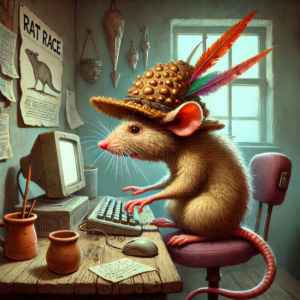 “Spreading such misinformation went against all her scientific training, and it killed her to do so, but what choice was there?”
Zuk stared out the open window above her cubicle desk at the poor, hatless rats chattering and scampering about outside, digging through heaps of garbage for scraps of rotting food. She wrinkled her nose; even from here the stench was like a tail smashing into her face. Pathetic. It should be illegal to have that much fun when you’re homeless.
That’s what happens when you don’t get an education! she wanted to scream, but instead just slapped her tail against the sawdust floor. Saying that would be rude. She herself had a doctorate in ratropology, but often wondered if she’d made a huge career mistake. Aerospace engineering, physics, astronomy, computer science — those were the cool, high-paying careers, and rats with those jobs weren’t stuck working in office buildings next to heaps of smelly garbage and the homeless. Soon they would land the first rat on the Moon, and they’d be heroes, while she’d be stuck at her desk writing stories for tabloids. With her academic skills, she could have breezed her way through astronaut school. She could have been the first rat to scamper on the Moon.
She could have been famous.
“Where’s that article?”
Zuk almost fell off her hard wooden stool. It was the boss, his head thrust through her cubicle’s circular opening behind her, his vantablack moleskin cap askew, as always. How did he always sneak up so silently? Was he part cat? His ragged fur was already graying, almost silver. Hers was light brown, almost blonde, and meticulously combed, every strand in place.
“Almost done,” she said through gritted teeth. She was not a good liar. “Give me a couple of hours.”
“One. Or you know what happens,” he said, feigning a tail yank with his paw before withdrawing, leaving behind the usual nauseous smell of rose perfume.
She sighed. Her tailbone still hurt from yesterday. Forget prancing about on the Moon — she was stuck in a tiny cubicle, typing away like a mindless mouse for a mindless, tail-yanking boss, surrounded by tokens of her trade.
A framed poster hung on the gray cubicle wall to the left of her desk of the Ludy fossil skeleton, two hundred thousand years old. It was considered the first modern rat, with fully opposable thumbs that could rotate freely. An inset showed an artist’s rendition, with the beginning of a brain bulge. Zuk often stared into his eyes. What was Ludy like? Did he have thoughts and feelings like modern rats? She envied the simple life they’d led.
On her desk sat a fifty-thousand-year-old spearhead from their ancient ancestors, now a paperweight. She’d dug it up herself. She often imagined some ancient ancestor spending countless hours rummaging through human ruins to find the perfectly shaped piece of glass for a spearpoint, lashing it to a bamboo stick, and taking down huge, ferocious beasts like rabbits, chihuahuas, and maybe, heroically, a pre-domesticated cat, before they were tamed by those brave catadores. They knew it happened — they’d dug up cat fossils with embedded spearheads. Wow.
Taped to the wall on the right was her top treasure, an actual eagleskin feathered cap once worn by Ambra the Aviator, the first rat to fly around the globe, one hundred years ago. Zuk would never have adventures like that. In her excavations they’d mostly dug up old pottery shards, not exactly something to get excited about. Stop the presses, I have a bit of pottery!
Smiling, she took a sip of sassafras juice from a clay cup, and imagined its shards being dug up someday by some futuristic ratropologist. Maybe it would end up in a museum. How boring.
At least she had her cute toadskin cap, warts and all. It had cost her a week’s pay. She carefully readjusted it over her head.
“Why aren’t you typing?”
This time Zuk did fall out of her stool. The boss snorted.
“Sorry, was planning the big climax.” She jumped back on her stool and attacked the keyboard with a frenzy.
“Hurry up. Words are money.” He withdrew.
As bosses go, he wasn’t totally terrible, as long as Zuk made her deadlines. When she missed one… well, tail-yanking wasn’t so bad once you got used to it. There simply weren’t that many jobs in ratropology, so she had to take what she could get. That’s why she’d joined Emca Writers, a writing mill that churned out sensationalist articles for the tabloids. She was chair of the Ratropology Department.
Or rather, she was the Ratropology Department. Sighing, she took another sip of sassafras.
Ratty Magazine had solicited another article on ancient rats and humans. Why the recent fascination with this long-dead species of huge bipeds? Recent research indicated that early rat began its million-year ascent during the age of humans. The two had lived in harmonic symbiosis for much of their joint history, with humans the alpha partner.
The details were sketchy, extrapolated from the few crumbling human and rat fossils and artifacts that had survived the periodic purges. Modern rats simply did not like the idea that their prehistoric ancestors were primitive creatures that lived off the scraps of humans, but that’s what the evidence showed, no matter what the populist leaders screamed from their pulpits. So, of course, they got rid of the evidence.
Zuk glanced out the window at the homeless, hatless creatures outside that lived off the scraps of society. Little had changed.
Humans had done what rats were only now attempting — they’d gone to the Moon. It was hard to believe that something like that could have been accomplished a million years ago by those huge, buffoonish apes, but that was the only explanation for photos taken of the Moon’s surface by robot explorers. Amidst the mysterious objects found at locations around the Moon were the unmistakable footprints of human shoes, preserved on the unchanging surface.
She needed to finish the article but was tired. Time to get energized. She hopped off her stool. There was no room to really turn in her cramped cubicle so she stood on her hind legs and spun about, and then squeezed out the cubicle door. Had the cubicle been designed for dwarf mice? She scampered to the end of the hallway outside to the office lounge and jumped on the squeaky exercise wheel against the wall. A few minutes of frantic running woke her up. Ideas for the article popped into her head as she ran, including the perfect title: “Humans on Trial: Guilty!” That would grab readers’ attention. With the public all abuzz about the idea of humans on the Moon, she would write about how humans tested their space machines by sending primitive rats into space as test subjects, doomed to die. Those monsters!
That would be the gist of the article, and there were no humans around to rebut her theory. No one really knew what happened to them, but their demise had been fortunate as rats then evolved, scurrying to the top of the intellectual food chain.
She stopped at the bathroom. There were so many droppings on the floor that she had to hold her nose and tiptoe about — how long had it been since they’d changed the newspapers on the floor? She checked and saw that it was dated from last week. Yuck.
Then she stopped by the office water bottle, where the writers liked to congregate until the boss kicked them back to their cubicles. To rationalize her visit she took a few drops from the water tube.
“The boss gave me two stories to write!” exclaimed the albino Jik with the usual big grin. The journalist wore a red rabbitskin hat with a hawk feather stuck in it. “The Bigtail sightings up in the mountains, and guard shrews that turn on their masters.”
“At least you get to use your degree,” said the black-furred Mab, the haggard-looking accountant with a green crabshell hat. “I’ve got a PhD in theoretical math. My dissertation on the equivalency of mass and energy won the Remy Prize for math, for cat’s sake. And the boss has me doing time allocations, product optimization, and calculating bathroom newspaper overhead — can you believe it? All with the wonderful powers of arithmetic.” He snorted. “I’m bookkeeping for a boss who thinks the Unified Field Theory means buying up the local sports fields for furryball.”
“He has me writing about how the stars and planets predict career success,” said Axax, the resident astrology writer. The brown with white splatches rat wore a chipmunkskin turban with an embedded black coal over the forehead. “The stars told me that since Jupiter and Saturn were in the same quadrant, I should take this job.” Axax spat on the ground. “The stars lied to me. Don’t tell my readers.”
Zuk was about to share her gripes as well, but just then the janitor scurried into the room, with a hat made from folded newspaper. It was a bit torn but had been repaired with tape. At least Zuk and the other writers weren’t at the bottom of the tail-yanking hierarchy!
“Hey, janitor,” Zuk said. “Could you put fresh newspaper in the bathroom? It’s really bad in there.”
The janitor stared at Zuk, which made her uncomfortable. She looked away.
“What’s my name?” the janitor finally asked in his strange Eastern accent.
“Um,” was all Zuk could squeak. The other writers averted their eyes. One of them coughed.
“Anyone?” the janitor roared. “I didn’t think so. I have a PhD in marine biology and you want me to change bathroom newspaper?”
“Sorry,” Zuk said. “If you’re a marine biologist, why are you working here?”
“If you are ratropologist, why are you working here?” The janitor kicked the wall, leaving a dent, then turned and left.
“I guess we’re all in the same bottom burrow of the world,” said Mab the accountant.
Zuk was about to respond when she realized Jik the Journalist was sobbing, the big smile long gone.
“I went to my college reunion yesterday,” Jik said, sobbing louder. “They’d all read my story last week on wererats… and they laughed at me!”
“I’m sure they—” began Axax.
“GET BACK TO WORK!” roared the Boss. He gave Jik a tail yank.
They scurried back to their cubicles, sawdust flying. The boss was definitely part cat.
Zuk hopped back on her stool and prepared to type. The stench from outside was as bad as that in the bathroom, but she was used to it, and once you got used to it, it was better than the stale office air. She took a deep breath and glanced outside.
One of the poor homeless, an aged one, stared at her while gnawing on a slice of moldy bread, balding head exposed for all. There should be some sort of community decency standard! The rat looked away and another’s bare head popped out of a hole in the piles of garbage, holding its prize in its mouth—a chunk of gristly meat, probably soaked in the spit of some higher-class rat who’d spat it out. The two chattered back and forth with the cheerfulness of the clueless, their disheveled, filthy fur blowing about in a breeze. Could the Ludy of two hundred thousand years ago have been that primitive? How could anyone live like that? Zuk quivered her whiskers. What type of life was that? At least put a hat on. Jeezers.
Shaking her head, she took another sip of sassafras and went back to typing.
Soon the first draft was done. She stared at the computer screen. Now it was time to embellish. Spreading such misinformation went against all her scientific training, and it killed her to do so, but what choice was there? It was the difference between a page-turner and an eye-glazer, between selling and rejection, between a successful lower middle-class life… and living outside in the garbage.
No way. She slapped her tail against the floor.
“Where is it?” the boss squeaked from the entrance, jarring Zuk from her thoughts. Even a cat couldn’t sneak up that quietly.
“I’ll have it in an hour,” Zuk said.
“Half an hour,” the boss said. With a hairy nose wiggle — did he even own a comb? — he turned and left, tail sweeping side to side.
But… half an hour? Time to buckle down.
She tapped away, about humans ejecting rats into space to see how long they could survive a vacuum, lowering oxygen levels to see when they’d black out and suffocate. Testing how many G-forces it took to kill them. She described the poor rats as their eyes bulged, their faces turned blue, their bodies squeezed thin and bleeding, their bones breaking. She had the poor rats stare lovingly into each other’s eyes as they died. And she gave them exotic striped racoonskin spacehats. Of course, pre-civilized rats went bareheaded, but what’s wrong with a little literary license?
Her tail drooped. But readers would eat it up. Maybe she’d get a raise.
If those stupid rats outside would just stop chattering, maybe she could focus and get the article done on time. She glanced out the window. How come they got to run around doing whatever they wanted, while she was stuck in a cubicle? She was the one with an education! She’d earned what they had.
Even the angry janitor was above the homeless. So why were they so happy?
As the sun sank outside, the homeless rats — there were three of them now — shared a pizza crust, that ancient treat that Zuk so loved. She preferred it in its most basic form, flattened bread covered by coagulated cat milk, mashed tomatoes, and spices. Were those the very crusts she’d discarded at lunch the day before, after eating the tasty cheesy parts? Stale, leftover pizza crusts. She wondered if they were chewy or crunchy.
“WELL?” the boss roared from the cubicle entrance, flexing his fingers. “You want a yanking?”
“Give me twenty minutes,” Zuk said, though she barely heard him as she gulped down the last of her sassafras juice. That stench from outside — if you really parsed it, you could make out the individual yucky flavors. The outside rats didn’t seem to mind it. Perhaps it was an acquired taste.
“Ten,” said the boss. He glanced at the Ludy poster for a moment. “Lovely picture.” His rose scent now drowned out the outside smell.
“And I have another job for you tomorrow,” he said, “about primitive humans living on the moon who’ll eat our astronauts. Some nut job’s been posting all sorts of claims about this online, says they’re fifty feet tall with big, razor teeth, and they’ve evolved so they can breathe vacuum. Lots of quotes you can use — make up the rest, as usual. Remember, you make your deadlines, and this job is yours… forever.”
She stared after him as he left, thinking about what he’d said.
* * *
You can’t go easy on these writers, the boss thought. Gotta keep on them to make product, even if that means yanking a few tails. Tough love was good for them.
He knew that his employees mocked his overuse of rose perfume. His wife had worn rose perfume right up to her death, and he liked the constant reminder of her. But now his employees were his family. But like his wife, why did they keep leaving him? He gave them everything! He sighed, knowing his sacrifices would never be appreciated. Perhaps he should work them harder.
After ten minutes he tiptoed back to Zuk’s cubicle. He didn’t like going there, as she had a habit of leaving the window open, letting in that unbearable stench from outside that no amount of rose perfume could suppress. It was worse than the office bathroom, but he, of course, had a private executive bathroom that was kept spotless. And that poster over her desk of old rat bones was downright creepy.
But he loved scaring her with his sudden, silent entrances.
“Well?” he exclaimed as he scampered in.
The cubicle was empty. Had she gone home early? He’d fire her! But no, he needed her more than she needed him — thank the great cats she didn’t know that. But she’d get a tail-yanking.
Was the article done? Why was her desk covered with the shattered shards of her cup? And was that her cheap toadskin cap sitting on top of her computer? He slapped his tail against the cubicle wall, tearing off a corner of the Ludy poster. Writers are so temperamental.
The boss looked at the computer screen, where there had been a draft of the article.
It said, “File deleted.”
“What!” He frantically pulled up the trash folder, but it had been emptied.
Then the boss heard a familiar voice through the open window. His jaw dropped, and his prized moleskin cap fell to the floor.
Outside, Zuk and three rats, all hatless, chattered back and forth gleefully as they shared a pizza crust.
* * *
 About the Author
Larry Hodges, of Germantown, MD, has over 220 short story sales and four SF novels. “Rat Race” is his second sale to Zooscape. (The other was “Philosopher Rex.”) He’s a graduate of the Odyssey and Taos Toolbox Writers Workshops, a member of Codexwriters, and a ping-pong aficionado. As a professional writer, he has 22 books and over 2,300 published articles in over 200 different publications. He’s also a member of the US Table Tennis Hall of Fame, and claims to be the best table tennis player in Science Fiction & Fantasy Writers Association, and the best science fiction writer in USA Table Tennis!!! He’s also had quite a few pets, including (cumulatively) 3 dogs, 1 cat, 50+ gerbils, 30+ snakes, zillions of fish (including sea horses and sea anemones with accompanying clownfish), a few hamsters, box turtles, toads, and crayfish, and a parrot, chinchilla, snapping turtle, iguana, and a tegu . . . but never a rat (so far!). Visit him at www.larryhodges.com.
Sunflowers and Spring Steel
by H. Robert Barland
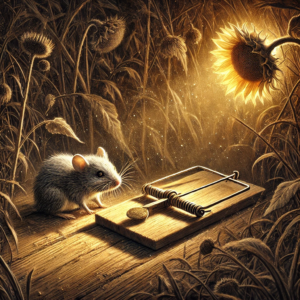 “Adventure drew her forth, a siren’s song that sang a melody of new places, new things, new experiences. She drew me with her.”
Her scent was that of the warm grass of summer. And sunflowers. I still smell her now, I think, but the scent dwindles as does the image of her in my mind. I try to hold onto it, pull her grey furred shape into focus, but the more I try, the more she slips away. The ghost of her memory wafts through my paws liked winter fog. I wince. Concentrating… it makes my head ache.
To keep her from disappearing altogether, I direct my focus elsewhere, to the machine, the Contraption. It sits a tail-length beyond the safety of my hide. The gleaming steel bar is poised to strike. Today it is baited with a fat pumpkin seed. It’s a trick. I see through its false promise. I turn back into my hide, to await the day when the Contraption works its magic again, when it transforms from a machine of pain to one of wonder.
Oh, I know they think me mad, my fur matted, my teeth grown so long. They think the blow to my head — that split open my furred scalp to the bone and cracked the same — shook something loose. They are wrong. They don’t know the Contraption’s promise. The secret that took her from me.
For now.
I remember her. And that day. A frolicker, that’s how I’d describe her. She loved to frolic. The mediocrity of walking wasn’t for her. Whenever we went anywhere, it was always at a run. And she’d jump. She was fearless and lean. She soared when she leapt, laughing all the while. I couldn’t help but laugh, too.
It had been her idea to sneak into the human’s house that day. Adventure drew her forth, a siren’s song that sang a melody of new places, new things, new experiences. She drew me with her. I loved her and her frolics. How could I not?
We widened the gap in the wall of the human’s house. In front of us lay the device I would come to call the Contraption. I wasn’t fearless like her. I was wary and remained in the wall, always the shadow to her light, but she tumbled thought the hole and ran to investigate the machine. I could smell newly-sawn wood and oiled metal. Such smells worried me, but not her. Under those alien smells, was that of sunflower seeds. She loved sunflower seeds, her namesake. I remember the way she’d looked back at me hidden in the wall; the way her whiskers twitched with delight, as she poked her head under the raised arm of the Contraption and began to nibble at the seed on the plate.
That moment is lost in the fog of my head. I remember the snap, or at least, I think I do. I remember being startled and falling. When I awoke, dried blood matted the fur on my head, and she was gone.
The Contraption remained, its arm raised again. A crumb of fragrant cheese now replaced the sunflower seeds. Pain filled my heart. I could still smell her scent mixed with that of the Contraption. I’d sagged to the ground and fell into a shuddering, fevered sleep. It was then the Contraption spoke to me, offering a dark promise of reunion.
* * *
The snap wakes me. Some idiot pup, barely out of the nest, has tried to take the seed. I hear the Contraption being bashed against the wall. I poke my head out of my hide. The steel arm has caught the pup across the back and his hind legs are limp. Though diminutive, he had the strength of youth. His struggles have flipped the Contraption over. His chest rises and falls, his breathing laboured. His bulging eyes catch mine, pleading and I see that strength fading with each breath.
I do nothing. I will do nothing. He does not comprehend the importance of the Contraption. I turn away before the rise and fall of his chest ceases.
He has been judged, and he is unworthy.
* * *
The Contraption snaps again. This time I do not look. Crouching in the dark, I turn in circles. My claws have shredded the surface of the beam. The wood looks like fur. Her fur. My stomach issues a complaint, and I am forced to obey. I nose my way out of my hole. Pain lances through my skull as the weeping wound on my head brushes the edge. I suck in a hiss and wait for the pain to recede, a throbbing that undulates in time with the beating of my heart.
By the time I reach her, the doe is already dead. She was old, exhausted. She would have died soon anyway. Blood trickles from her snout, seeping into the coarsely sawn wood of the Contraption.
The metallic scent of the blood obscures that of my Sunflower. Anger flares within me. How dare this doe allow her filthy blood to contaminate Sunflower’s memory? I rip bread out of the dead doe’s mouth, plunging the soft morsel into my maw. It is wet. I grimace at the sensation and remove it. It is stained red. I hadn’t tasted the blood, or if I had, I hadn’t cared enough for it to register. The blood glistens, crimson in the dark light.
My stomach complains again. I retreat to my hide. I eat, thinking of my mate. Sunflower had been chosen, chosen to go wherever the Contraption sent the worthy. It had to be a special place. She deserved that and it couldn’t be anything less.
I must be patient, to wait for that wondrous day, when the sunflower seeds appear again and when the Contraption will sing its song to me. A siren song of sunflower seeds and spring steel. I will go to it and be judged worthy.
And I will see her again.
* * *
About the Author
H. Robert Barland is a teacher, Viking re-enactor and black-belt martial artist. A former climber, film extra, and resident of the UK, he has now returned to Newcastle, Australia where he lives with his wife and two boys. He considers himself well adapted for life on land and can be followed on BlueSky (@hrobertbarland.bsky.social), Instagram (@h.robertbarland) and X (@hrobertbarland).
Jot, Flowerwerks, and the Mystery of the Missing Mice
by Lara Hussain
 “Flowerwerks employees stopped to watch her work, awed by her skill and intensity.”
Jot knew exactly what had happened to Iota: Flowerwerks had eaten him alive. Or rather, he had worked himself to death. Mice were prone to it: working to grinding exhaustion, from those who squeaked commands all day to the lowliest directors of fertilizer distribution, and even the earthworm and bee wranglers. But it was unlike Iota to disappear. He had a quiet intensity, certainly, but he would never leave something unfinished, or depart without saying goodbye.
Jot’s best friend, Dottie, was wringing her paws. They were raw and pink from all the kneading, which started when she realized her partner was missing. Iota wasn’t the first mouse of Subporchia to go missing. Jot put her own paws on top of Dottie’s and looked up at her. Dottie was taller and had a lovely coat of fine winter grass-colored fur, with a single spot of white spread across her chest.
“When did ya last see him, Dottie?” Jot asked. Her voice had a thick New York accent, lyrical and caring, but with a no-nonsense tone.
Dottie found Jot’s self-assured voice comforting.
“Oh, oh. I saw him when he left for work yesterday,” Dottie panted in her high-pitched breathless waver. “He left early… said he’s working on some big project ,and they’re behind on deadline with a second planting. That they’re expecting rain. As if anyone could predict the weather. Well, you know, the big mice think they can. But you know what I think? I don’t think they have a clue! They’re just working everyone to death, all so they can get fatter! It’s not fair, Jot!” Dottie squeaked angrily. This wasn’t the first time they had discussed the unjustness of Flowerwerks.
Dottie pulled her paws back and began wringing them again. “To be honest,” Dottie continued, “He’s been working long hours for a while now. Flowerwerks just isn’t producing like it used to. There are fewer flowers than ever. But he’s working his tail off. I’ve never seen him so thin…” A sob snuck up on her. “Jot, do you think he’s okay?” she squeaked.
Tears were wet on Dottie’s sweet face. Jot offered open arms to embrace her.
“We’ll find him,” Jot said as she squeezed Dottie. “I start that new job today, you know, at the Flowerwerks entrance. I’ll nose around and see what I can find out.”
Jot was a carver, a talented artist who worked with roots and wood. After the success of her community roots projects — a tangle of wondrous flowers that she delicately carved in the thickest roots that ran through common areas in the burrow — she had been commissioned by Flowerwerks to carve the tall redwood columns at the entrance to the company. The thick square columns sprang from the ground and held up the canopy that covered all of Subporchia, from the burrow to Flowerwerks. No one had considered carving the columns before, not even Jot. But she thought it was a very good idea. The carved wood would bring beauty — and she hoped joy — to the start and end of the work day. And so she had agreed.
The early summer sun was already peeking through the narrow slits in the canopy by the time Dottie left. Tiddle, Jot’s partner, offered to accompany Jot on her first day to her new job, before he continued on to his work at the Scout Corps headquarters, the security outpost for Subporchia. It was also time for Flowerwerks’ town hall, something everyone listened in on, even if they didn’t work there. That’s because Flowerwerks ran the garden, of course, the whole east side of Subporchia, and beyond.
Jot and Tiddle nimbly crossed the long stretch of rocky flats outside the burrow and joined the commute of other mice, embarking on their work day. As the throngs neared the Flowerwerks entrance, the rocks gave way to soft soil. A large crowd had already gathered there, eager to hear from the leaders of Flowerwerks.
“This is the dawning of the earth’s fertility!” Mr. Cheeseman said, the bulge of his expansive furry belly bouncing with his enthusiasm.
Tiddle rolled his eyes. “I’m pretty sure the earth was growing plants just fine before Flowerwerks,” he whispered to Jot. “The real question is if anyone there has figured out that you can’t take from the Earth forever, that you have to give back and care for it, too?”
Jot, ever the optimist, squeaked back, “Well, maybe investing in public art is a good start. I mean, maybe it’ll help them see things differently.”
Tiddle sighed. “It’s the same thing every time. Big words and no real change. If they just gave the soil a break and put more earthworms to work, the flowers would come back… it’s simple…”
“Shhhh! Jot hissed. “Listen!”
“More flowers means more cheese bonuses. We’re expecting great things from you. Now get back out there!”
There was a smattering of applause and small cheers that could be construed as quiet groaning, and the crowd quickly dispersed. Jot and Tiddle scurried to the first set of columns at Flowerwerks’ entrance.
“Who needs more cheese?” Tiddle huffed as he patted the side of a column. “Honestly, at some point, Mr. Cheeseman is going to explode from all the cheese.”
Jot elbowed him. “Well, this job is helping pay for our cheese for now. It’s worth a try, ya know, to put some good in the world. It just might change things,” she said. Jot looked thoughtful, and then added more as a pep talk for herself, “I haveta at least try!”
“Oh, Ms. Jot! You’re here!” It was Mr. Cheeseman’s assistant. He was all nervous energy and jiggly in his rotundness, though he wasn’t nearly as large as Mr. Cheeseman himself.
Tiddle gave Jot a kiss on her cheek. “Be the change you want to see, darling,” he whispered in her ear, and whisked away toward the Scout Corps.
After Jot’s first day, her fingers were covered in chalk and ached from sketching. She would sketch for a few days still, outlining her plan for the carving. Then, Mr. Cheeseman himself would review the plan before she cut away at the wood.
“So, how did it go?” Tiddle asked.
“Oh fine. Everyone was very nice. They even provided lunch. Can you believe it? I haven’t even done anything yet!”
“Oh, that’s not true!” Tiddle replied. “You’ve been preparing for this for weeks, before you even got started. I bet you already had ideas before you put chalk to wood.”
Tiddle was correct, of course, even if Jot didn’t admit it. She returned to Flowerwerks the next day and the day after that. After two weeks, she noticed a new plumpness in her belly and roundness in her cheeks from all the free food.
“Oh, it will be very fine to have this extra fat in the winter, don’t you think, Tiddle?” Jot asked, pinching her own cheeks.
Tiddle harrumphed. “We’ve always been fine without it. The burrow is plenty warm with all the grass we harvest in the fall.” Tiddle cocked his head, as if a thought had occurred to him.
“How is Dottie?” he asked. “Let’s have her over, love. I don’t think we’ve seen her but once since you started your project at Flowerwerks.”
Jot looked down at her toes and nodded. She had been so busy at Flowerwerks that she hadn’t made time to help her distraught friend. Iota still hadn’t turned up, and she knew Dottie was frantic. The possibility that Iota might return was less likely with each passing day. Jot had nosed around, stealthily, as she promised, but hadn’t turned up any clues on his whereabouts.
Tiddle, a leader in the Scout Corps, which alerted all of Subporchia to any approaching danger — of the cat or weather ilk — was baffled. His team had investigated Iota’s disappearance.
“I just don’t understand,” Tiddle said, for what must’ve been the hundred and first time. “There were no cats in the area the day he went missing, nor the day after. And there were no signs of struggle. We just don’t know where he went!”
Tears brimmed in Jot’s eyes. She realized with heavy sadness that no one knew what had happened to Iota, and it was possible they never would.
The next day, back at Flowerwerks, Mr. Cheeseman stopped by and surveyed Jot’s sketches.
“This is masterful,” he said, and Jot blushed beneath her calico fur. In the same breath, he continued, “But don’t you think there should be more flowers and less soil? I mean, that’s what we all want, isn’t it?” he chuckled, and his belly bobbed ominously with the exertion.
“Yes, but we need soil. And it’s so lovely, too,” she said, fingering the swirls she had outlined for the soil portions of the carving. “Flowers cannot grow without it!”
“Not true!” Mr. Cheeseman replied with a nasty grin. “We’ve come up with a new way. Soil’s not needed. Heck, neither are the pollinators. Just don’t tell the worms and bees I said so,” he said and laughed.
He stepped closer to Jot and scraped his fingernail across the soil pattern. “More flowers, less soil. Get it done,” he hissed quietly. Then he stepped back and announced loudly, “This is going to be beautiful. A real testament to the power of Flowerwerks. Everyone will want to work here!”
Back in the burrow, Jot cried when Tiddle asked her about her day.
“He’s a horrible mouse. How can anyone be so blind and greedy?” Jot wailed, still upset that he had asked her to change the design, the true message of her work.
Tiddle frowned. “I think his greediness makes him blind,” he said. “And I’m sorry he doesn’t see the beauty of what you shared.”
Tiddle wiped at the tears on her furry, tri-colored cheeks and sniffed.
“Do you plan to finish it?” Tiddle asked tentatively.
Jot sat up straight, and her eyes cleared. She inhaled deeply, considering the question. She nodded, slowly at first, and then confidently. “Yeah. Yeah, I’ll finish, so long as I can!”
The next day, after early morning cups of warm honeysuckle with Dottie, Jot returned to Flowerwerks and began carving. She changed the design, embellishing it with bees and winding worms deeper in the wood, intent on showing all the essential elements that worked together to create a healthy garden. Flowerwerks employees stopped to watch her work, awed by her skill and intensity. They marveled over the emerging images and left paw imprints in the discarded dust and woodchips as they walked past.
That night, Jot’s teeth were sore from the many hours she had been carving, long after everyone else had gone home. She was still there when blinking fireflies and slivers of moon were the only light to work by. Tiddle retrieved her, and they talked on the slow scurry back to the burrow.
“Don’t let what happened to Iota happen to you,” he pleaded. “You need to take care of yourself, so you can continue this work. I don’t want to lose you, too, Jot! It’s not worth it. Nothing is.”
Jot started to disagree. The carvings could change minds, she was sure of it! But Tiddle was right. If she wasn’t well, it wouldn’t matter, because she wouldn’t be able to finish.
Jot took a refreshing spit bath, rubbing away dust and splinters of wood from her work. Then she sat down for dinner with Tiddle, berries and sunflower seeds drizzled in honeysuckle. Jot slept deeply that night and awoke, feeling more like herself.
When she showed up at Flowerwerks in the morning, Jot had to wade through a crowd to get to the column she had been working on the day before. Dottie was in the center, touching the curved backside of one of the carved bees.
“Oh my,” Dottie breathed. “This is beautiful. This is how I always imagined Flowerwerks would be. Should be,” she said. There were bobbing ears all around, and the crowd murmured in agreement.
“Jot, may I help you?” Dottie asked. “Please. I just think it would be…healing. Just tell me what to do.”
Jot startled. She had never considered such a thing. But partnering with Dottie would make the work easier, especially for such a big project. The wood was so dense, and she hadn’t even started on the second column. Plus her teeth were still sore from all the carving the day before. Dottie, a burrow architect, would bring her own skills and flair to the work. Best of all, it would be time they could spend together.
“I’m sorry I didn’t even think to ask ya, Dottie! And yeah, I would love to have your help. Here, I’ll show you how to follow the outline. Carving is the easy part, once you get the hang of it.”
And so, Jot trained Dottie, and while Dottie carved, Jot began sketching out a new design on the second column.
The next day, the crowd was even bigger. There were more volunteers, some were even Flowerwerks employees, willing to use their meager vacation time to help with the endeavor. Jot welcomed them all, trained them, and set them loose.
Mr. Cheeseman was not happy. Jot had not precisely followed his instructions. Mr. Cheeseman expected nothing but unquestioning, faithful followers, just as he was a loyal, compliant follower of his leader. But seeing how enthusiastic employees were about the carvings, he knew he could not change what had been done, not now.
Instead, Mr. Cheeseman turned his attention to the business of business. Employees were expected to work longer hours. The pressure to grow more flowers intensified. Purple and white buds unfurled and covered the lands surrounding Subporchia like a thick carpet. Though they were in greater quantity, Jot noticed they were smaller, with withered leaves and weak roots. Quietly, more mice went missing. The cat alarm was sounded more frequently.
One evening, Tiddle returned home upset. “Mr. Cheeseman called the outpost and actually asked us to stop sounding the alarm so much. Can you believe it? He said it was causing unnecessary panic. As if getting eaten is not something to panic about,” Tiddle said. “The fact is, that cat is coming around more often. How can Mr. Cheeseman not be worried about that?”
“What did you tell him?” Jot asked, her heart beating with fear.
“I told him we’re going to do whatever it takes to protect the burrow. Every life is worth saving,” he said. “Mr. Cheeseman actually laughed and told me I was a ‘ridiculous idealist’.”
Something clicked in Jot, then. She realized that Mr. Cheeseman did not seem to think that every life was worth saving, except his own. He wasn’t looking out for his employees. He was only looking out for himself. He’d destroy every mouse and the whole garden in pursuit of more cheese, more cheese than he would ever need.
“Oh, Jot. I know that look,” Tiddle said, watching Jot’s changing expression. “What are you cooking up?”
She smiled, a small fire in her eyes. “Well, it’s time we did something about it. Something big.” She shared her plan with Tiddle who nervously squeaked his support. If anyone could pull it off, he knew Jot could.
The next day, Jot bravely confronted Mr. Cheeseman.
“Mr. Cheeseman. We’ll finish the second column today. You’ve seen how the mice have reacted. Everyone is so excited. It was truly your brilliant idea to beautify the columns that brought everyone together. I imagine productivity is up…”
“Indeed it is,” Mr. Cheeseman boasted, inflated by Jot’s compliment.
“What if… what if we had a day of service where everyone came together and carved the columns deep within Flowerwerks. Imagine what it would be like if everyone collaborated, across the organization, to carve designs into more columns. It could transform Flowerwerks, inside and out! I mean, this is your idea after all.”
Mr. Cheeseman nodded and sat up a little straighter. His fur puffed out a bit with pride. “Ah, yes. Happy employees means more flowers. I will call a day of service. But the design MUST be within my specifications.”
“Oh sure. More flowers, less soil, yeah?”
“Yes, and giant flowers, too, please.”
“No problem, Mr. Cheeseman. No problem at all.”
It was settled. The day of service was announced, with plenty of time to prepare. Jot worked with Dottie on plans, leaning heavily on Dottie’s architectural expertise. Then, Jot turned to sketching new designs on columns deep within Flowerwerks, the whole far east side of Subporchia.
On the day of service, Jot gathered all the volunteers. Her eyes went misty over their joy and eagerness. Nearly all of Subporchia was there, it seemed, even a couple of Flowerwerks’ leaders. Mr. Cheeseman, of course, was absent, as Jot presumed he would be.
“I’m verklempt!” Jot said, overcome, and she waved at the hot tears of relief and joy that wet her face. “Thank you all for coming for this special day!”
Jot never imagined mice would turn up in such numbers for anything but cheese. But here they were, eager to work together for something better. Jot took a deep breath and began with carefully explaining her vision and purpose for the project. Those who disagreed were given an opportunity to leave. There was respectful silence and stillness, as everyone considered her plan. Jot nervously tapped her foot. Some mice closed their eyes. Others folded their arms, resolute. In the end, not one mouse put a paw in another direction. All were ready to chew.
In a single, very long day, the mice carved more than any had imagined possible. All were covered in sawdust. Splinters and wood chips were piled at their feet. Every designated column was given new life. They marveled over the power of their collective work, sure that they had made change, for now and for the future. Just after the first slivers of moon shone down, they scurried home to their burrows, their teeth sore, their hearts big.
That night, after a cat alarm sounded, when all were safe in their underground homes, there was a large crack. Followed by another crack. And then there was a splitting, a splintering and the ground shook as weight heaved to the earth. The mice heard the cat screaming then. They waited in their burrow, fearful and excited. They waited for the sun.
By the time the mice emerged the next morning, the cat cries had stopped. When all had gathered at the entrance of what used to be Flowerwerks, it was easy to see that Jot’s and Dottie’s careful planning had worked. The canopy over Flowerwerks headquarters had collapsed. The entire east side of Subporchia was rubble on the ground. The mice stood at the new edge of Subporchia, admiring the sunlight and splintered wood, awed by what they had achieved.
The mice’s strategic carving, a whittling away of the support structures deep within the company, had weakened the columns just enough to cause the entire roof to collapse. It was the collective power of the mice and their vision for a better future, for all of the garden and its many creatures, that brought down all of Flowerwerks overnight.
Far under the rubble, the mice heard a faint, desperate squeak. They raced after the sound and cleared surrounding debris, frantic to save any souls who had somehow been in Flowerwerks when the canopy caved in. It was Mr. Cheeseman. He was trapped next to the cat. And the cat was dead.
“It was the cat’s idea,” Mr. Cheeseman confessed, after he was rescued. He shook dirt out of his filthy coat and continued. “He was the one who wanted to control the garden. We did whatever he wanted because he gave us the cheese. All the cheese we could eat and more.”
“Waita minute,” Jot said, her hand on her hip. “Are you tellin’ us that the CAT was in charge of Flowerwerks? ALL this time, we were working for the CAT? Tell me I’m wrong.”
Mr. Cheeseman hung his head and shook it. The mice collectively gasped and squeaked with disbelief.
“But WHY?” Jot screamed above the cacophony.
“The cat wanted control,” Mr. Cheeseman said, still looking down at his ample belly. “The cat wanted to run the garden so it could grow as much catnip as possible.”
All at once, the mice erupted into shouts and shook their tiny paws at Mr. Cheeseman. Instinctively, the Scouts gathered around the large mouse, to make sure he didn’t try to escape.
There was a long, pitiful wail then. Jot ran toward it. Deep in the splinters of what was once Flowerwerks and what appeared to be the cat’s lair, Dottie was holding a mouse tail.
“Oh no, no!” she said. “It was the cat all along. He ate Iota and the others. Jot, there are so many tails here.” Dottie hugged the tail to the white fur of her chest and rocked back and forth. “Iota, my poor, poor Iota. You deserved so much better.”
Mr. Cheeseman was marched out of Subporchia and banned from the garden after that. No one ever saw or spoke of him again. The tails of the cat’s victims were delicately buried and marked in a corner of the garden where the lavender grew the thickest.
In time, the mice returned to doing what they always did best: working together in harmony with the garden and all of its inhabitants. The next spring, the garden never looked so beautiful. The flowers grew larger, the honeysuckle tasted sweeter, and there was always enough to share.
* * *
 About the Author
Lara Hussain is a former environmental journalist who spent many years in the corporate arena, making good trouble. Today, she teaches literacy and writes fiction in Denver, Colorado, where she lives with a menagerie of human, furry, and scaly family members. In her youth, she spent summers creating Lego villages for pet mice until the mice learned to chew through the windows to escape. Her stories of the underdog rising up have appeared in The Literary Hatchet, Scapegoat Review, and The Last Girls Club, among others.
Gifting Salt and Sorrow
by Melanie Mulrooney
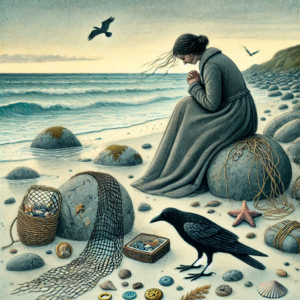 “When he dropped the small sea pebble, she drowned it in salty tears, cawing about Ty’s eyes, blue like glass.”
Crow circled above as the sad one trudged through wet sand, scrambling to perch on the highest rock. She visited every day — huddling against the frigid wind, pleading with the ocean, leaking her salt into the vastness.
Crow sang to her sometimes, when he was bored. She didn’t answer, but she also didn’t yell for him to leave. So he stayed close; they often dropped food, if he waited long enough.
Receding waves carried her calls to the deep: Ty, come home.
* * *
One day she piled peanuts high on a rock before climbing to roost. Crow swooped in again and again to collect his bounty, then flew off to find the perfect gift in return.
When he dropped the small sea pebble, she drowned it in salty tears, cawing about Ty’s eyes, blue like glass.
* * *
She brought many peanuts and Crow grew fat and happy. In exchange, he tried to cheer her with presents from the sea: abandoned shells, strands of netting, shiny buttons found among the rocks. Each piece was rewarded with Ty-words: Ty collects seashells in pretty jars, Ty works too long on a boat, Ty’s favourite sweater has silver buttons like these.
All gifts led to Ty, and more stormy sadness.
* * *
The winds warmed and the light grew long, and Crow caught an extra-special gift delivered from the ocean. She pushed her finger through the shiny gold circle and wailed: no no no. Her cries crashed like the waves again and again, until she had no words left.
Crow was determined to make her happier with his next offering.
* * *
The sad one stopped living on the rock and feeding Crow treats by the sea. He searched for her along the shore for many moons, followed the wind for her familiar lament. His caws were met with silence.
Crow waited a cycle of seasons, but she remained lost. He missed her Ty-words — maybe even more than the peanuts.
* * *
 About the Author
Melanie Mulrooney lives in Nova Scotia with her husband and a gaggle of kids. Her work has been published with Elegant Literature, Metastellar, TL;DR Press, and others, and she has won multiple writing competitions and been nominated for the Pushcart Prize. When not writing or child-wrangling, she can be found reading, volunteering in her community, or strolling through the woods — usually with a cup of tea in hand, and always wearing clothing suitable for napping. Her favourite days are when the fog rolls in so thick you can barely see, and everything smells like the ocean. Find her at melmulrooney.com.
The Crows Do Not Know Me
by Lynn Gazis
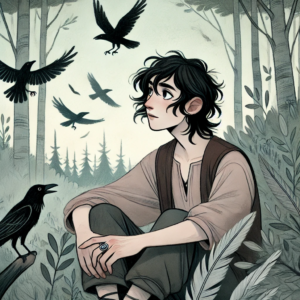 “Each day I woke, hoping again to have my wings and to take to the air. Each day I rose forlorn, bereft of feathers.”
The crows do not know me. Trapped in the wrong body now, I have no way to tell them, “I am one of you.”
Once, with them, I flew and roosted, foraged and played. Together we used sticks to pry insects from holes, sledded down roofs of houses on flat circles of metal that humans had left where we could grab them, and traded information about where food could be scavenged. When we needed to, we joined forces to chase off hawks.
Now the crows do not know me. When I tried to approach, to find some way to signal, hey, I’m still me, I was the threat and the one mobbed.
It’s all the fault of that old sorceress. She left a small, shiny circle on her windowsill. I always loved shiny things. I flew to the window and grabbed the shiny circle. But she saw me and cursed me.
I fell to the ground. When I tried to rise, I was bigger and less graceful. When I tried to cry out, I heard not my beautiful crow voice, but an ugly human voice. My naked body had no trace of feathers. Most of all, I had no wings!
I clutched the shiny circle and put it on one finger for safekeeping, because if I was going to be punished for taking it, I had damn well earned the right to keep the object for which she had cursed me. Then I rose on my overly long legs and staggered away. So slow and awkward were my steps that I was sure the sorceress would chase and grab me. Instead, she watched and laughed, that grating, scary laughter that humans have.
Once I had walked over a hill and past a grove of trees, safely out of sight of the sorceress, I dropped and crawled on all fours. I felt strange, as if I was dragging my wings in the dirt, but I also felt more stable crawling than standing on such long legs. A human family found me crawling along the road and helped me to their small hut. They gave me clothes — how odd it felt to wrap my body in cloth, rather than having it covered with my very own feathers! They let me sleep on a blanket on their floor. In front of their hut, I dared to walk again, balancing precariously on my new legs.
The witch’s curse contained a small mercy. With my human form, I gained a knowledge of the human language. Scratch that. I learned one of the human languages. It turned out that they had many. Unlike my fellow crows, who could speak to crows from anywhere, traveling humans struggled to make themselves understood. Perhaps this difficulty in human communication was a good thing. Think what a threat humans could be to crows if they all understood each other! Still, stuck in my human body, I knew I could not venture beyond the land where humans spoke the one language that I knew.
Each day I woke, hoping again to have my wings and to take to the air. Each day I rose forlorn, bereft of feathers. The humans gave me food, a strange mush each morning from which I picked the bits of fruit and nuts, and only occasionally meat. The first morning I slipped outside, once I had finished my fruits and nuts, and found an anthill, where I enjoyed some tasty insects. But the humans stared and exclaimed so that I had to learn to enjoy my insect treats when they weren’t looking.
I learned over time to eat and enjoy more and more of their food, my new favorites being a rice dish with bits of fish and a serving of mostly lettuce with bits of other vegetables. The family was patient with my slow efforts to learn to walk, and only when I was steady on my feet did they ask me to help them on their farm. I agreed. What else could I do, stranded without wings?
The farmers gave me a spade, dull gray to the eye and hard to the touch.
“Dig here,” he said, “and put these seeds in the ground.”
I wanted to scratch the ground with my nails, but human nails aren’t good for much, so I settled for the spade. Next they set me the task of milking the cow — such an odd sensation, to grasp the cow with these things called hands, so soft and tender! Then came the day when I helped the woman of the house, carrying baskets of vegetables with her to the market in town, to sell. There I saw the shop of the town silversmith. Shiny things!
I wandered into the shop. I watched the silversmith rub a stick against a shiny thing, until he looked up.
“Can I help you?” said the silversmith.
“Just looking,” I said.
He grunted as if he had hoped for something more from me, I wasn’t sure what. But he let me look.
Soon I spent every spare moment I had, when done with my work on the farm, at the silversmith shop. If I could not have my crow body, at least I could be close to shiny things all day. I started to fetch and carry, to please the silversmith and be closer to his shiny things. He had fascinating tools. Some had blades to cut the shiny things, others held shiny things still so that they could be cut, and odd sticks with rough edges could be run over those shiny surfaces to smooth them the way the silversmith wanted. I learned the names of each, and where to find them. My favorite, though, was the cloth that could be used to bring out the shine.
In time, the silversmith paid the farmers who had rescued me, to buy out my contract and take me on as an apprentice. I had not known I had a contract, but if I did, well, I was happy to have it purchased, so I could spend all my days with silver. I took up with enthusiasm the first job the silversmith gave me, shining tarnished silver.
One evening, after my work was done, I wandered to the blacksmith’s shop a few houses over. The metal at the blacksmith’s shop did not shine as the things at the silversmith’s shop did, but it glowed bright when the smith put it in the fire. As I watched the glow of the fire, the blacksmith’s daughter approached.
“Aren’t you the new silversmith apprentice?” she said. “Where are you from?”
“Down the road, past the trees, and over the hill,” I said, “as the crows fly.”
She laughed, though I couldn’t see why.
“Ah, but which trees?” she asked.
I am a crow. I can talk all day about trees.
“There’s the big old stump,” I said, “where termites live. And the young tree with silvery bark and leaves shaped like this.”
I sketched the shape of a leaf with my hand.
The blacksmith’s daughter listened to me more intently than anyone else had, since I left the crows behind. For a human, she was lovely, nearly as dark as a crow, her skin a lustrous dark brown and her hair tightly curled. When she smiled, the white of her teeth drew my eye. And she looked at my ugly human form at times as if I still had a crow’s beauty. Most of all, she listened.
After that day, I came back often, in the evening after work, to talk with the blacksmith’s daughter and find the comfort of a listening friend. Sometimes I was tempted to confide in her about the curse. Each time I was tempted, I thought better of it. Safer to keep the friend I had, and not risk the friendship by sharing things she might not understand.
As my visits became more frequent, the blacksmith muttered odd things about wanting to know my intentions. How could I tell him that my intention was to become a crow again, as soon as I could figure out how? Each time he muttered, I returned to the silversmith’s shop and busied myself with shiny things.
In time, the silversmith judged me ready to do other work with silver. As a silversmith in training, I learned that awkward as human legs could be, human hands had a certain grace and finesse. The day that I hammered my first dish, I stood amazed at the result. Never, as a crow, could I have done the work with silver that I could now do!
Yes, human hands had their uses. But they could never reconcile me to being trapped in a human body. One day, I stumbled on a trail and twisted my ankle, and it ached for weeks afterwards. Often, my back ached. Walking on legs could not compare with flying. Most of all, the body was not mine. I felt wrong in this body, as I felt right in my old crow’s body. And in this body, the crows do not know me.
It’s this essential wrongness of my new body that led me, finally, to leave behind my beloved shiny work as an apprentice silversmith. The shop where I worked did not just make new shiny things. It restored and repaired old ones, and, for those rich enough to pay for the service, even did routine cleaning and polishing of silver. The silversmith left most of the routine polishing to me, his least experienced assistant. In this way, I came to be the one to be sent to pick up some silver for polishing, from a local magician. Silver bowls are important for making magical mixes of all kinds, and they must be clean, for the potions to be pure and work true.
A magician! If I could find work with him, I might learn the trick that changed my form, and what could change my form back. I hurried to his shop as quickly as my awkward human legs would take me.
The magician’s shop stood at the edge of town, a small house of stone with a thatched roof. As I stepped inside, I saw the magician at work mixing something in one of his silver bowls. On the table lay mint leaves and parsley and basil.
“What are you making?” I asked.
The magician glared at me. “Who are you and why are you in my shop?”
The name the humans gave me always felt awkward on my lips, so I skipped it. “I’m the apprentice from the silversmith shop, here to collect your silver to shine.”
“Do that, then,” said the magician, and handed me a bundle of silver.
I took the pieces away and shined them to a fine gleam. When I brought them back, I asked the magician directly, “Do you need an apprentice.”
“Certainly not,” said the magician, “and if I did, I wouldn’t want one so eager to skip out on his contract.”
I wasn’t ready to be give up, though. I made it my business to win him over. I shined his silver with extra promptness and care. I gave him small presents — finding out from other villagers what herbs he liked to purchase and getting good quality rosemary and thyme. He started asking me to run errands on the side. Finally, I found my way where I wanted to be, working by his side in his shop, fetching and cleaning and passing and, most importantly, watching and listening.
It paid off when I learned why he never let his wand out of sight, waking, and slept with it under his pillow.
“Get hold of a magician’s wand,” he said once, “and you can unravel his spells. I’m not about to let that happen to mine.”
I didn’t dare ask how — I didn’t want him to think I had my eyes on his wand. I didn’t, after all — I wanted only the wand that had made me human. I listened and waited for other hints.
Hints like the time I took one of his silver bowls back from the silversmith to his house and stopped at the blacksmith’s shop on the way. The blacksmith’s daughter welcomed me back — it has been so long since we spoke! She thought I had forgotten her! Her father let me know that I would hear from him if I forgot her again. I dallied there all afternoon, talking with the blacksmith’s daughter. I thought, when the magician frowned on my return, that he was angry because I had taken too long, stopping to chat for as long as I had. No, he had other reasons.
“I smell iron,” said the magician.
In my shock, I forgot to conceal my crow nature.
“People can smell iron?” I asked.
As a crow I could smell food, blood, and even fear, but never metal. My human body didn’t quite perceive things the way my real crow body did. Colors were missing. But it never occurred to me that humans might smell things that crows didn’t. Had I missed this new sense all this time? Perhaps it was harder to process since I hadn’t grown up with it.
The magician laughed, but then set his mouth again in a firm line.
“I can smell far more than you know,” he said, “Don’t bring my silver to the blacksmith shop. It’s bad for magic.”
If I can bring iron to the witch’s wand, I thought, can I break her magic?
It seemed unwise to ask such a question of a magician. I would watch, and wait, and look for magic’s vulnerable points. Iron might not be the only one.
I watched, and I learned. Iron could weaken silver’s magic for days, but burning the right herbs hastened the recovery of magical properties. When the magician gave me a list of which herbs to bring, I made up a little poem to remember them, for these herbs were the very herbs I’d want to remove from the witch’s house, if I wanted to break her wand.
I watched, and I learned, as the magician gave me instructions on polishing his silver. Wands, like bowls, must be made of silver. Clean silver worked better magic than tarnished silver.
I listened, and remembered, as the magician spoke his spells. Words must be carefully spoken. And a wand, I learned, carried a record of all the magic it had ever worked.
I did not, however, learn to work any magic of my own. Perhaps magic could not even be worked by a crow trapped in the wrong body. In any case, I could see that there were secrets the magician would not share. Some of them he had recorded in marks on paper, but such marks were unintelligible to me.
Each day I woke and saw the wrong face in the mirror. Each day I moved awkwardly on the wrong legs. Some days my back ached. Each day, I looked to the sky and could not rise. Most of all, whenever I saw my old friends, I was reminded: The crows do not know me.
After one heartbreaking morning glimpse of crows in the magician’s yard, none of them seeing my crow nature, I could bear it no more. I told the magician that I needed to stretch my stiff back, and I set out for the blacksmith’s shop, to find my best human friend. I stood with her on the porch, her father’s sharp eye watching my every move, and the two of us spoke, in voices too low for him to hear. My voice trembled as my whole story tumbled out, how the sorceress had cursed me, exiled me, hidden me from my family. My whole story? Well, not quite my whole story. I left out the part about being a crow. I wanted her to believe in the curse. I wanted her to help. Perhaps the part about being a crow would be too much for her to believe.
The blacksmith’s daughter did not disappoint me.
“We’ll lift the curse together,” she said, “tell me all the herbs you know that a sorceress would use for potions. And meet me at my window tomorrow night.”
How slowly the hours passed till the night when I could meet her! But I looked in the magician’s mirror at my pink fleshy nose and imagined the fine beak I would soon have. Good things are worth the wait.
I threw a pebble at the window of the blacksmith’s daughter, as she had told me to do. It bounced from her closed shutters, and she flung them open, and tossed two bags down to me. Then she clambered out onto the branch of a tree and climbed down to meet me.
“My father will kill me,” she said, “if I don’t return with your ring.”
“No” was on the tip of my tongue. Give up my one shiny thing? But I reminded myself that she was my best human friend, and that soon I would have my true body back. Surely that was worth a ring.
“Yes,” I promised, “You shall have my ring.”
I doubted her father would kill her if I failed in my promise. Would he kill me? Of that I was less sure.
The two of us set out for my old roost site. On foot and with no cart, it took days to make the trip. At night, the blacksmith’s daughter pulled out an iron poker and laid it between us, as I laid down to sleep.
“Until I have my ring,” she said.
Smart of her to bring the iron, I thought. It could be useful, once the two of us got hold of the wand.
When we reached a grove of trees near the house of the sorceress, we buried the iron poker, and set up camp for a few days, so that the blacksmith’s daughter could lose the smell of iron before she scouted out the sorceress and her house. In place of the poker, she placed a large stick between the two of us, when we laid down to sleep. During the day she sang to me, and I told her stories of the places I had been, still leaving out the angle from which I had seen them.
One morning she set out to see the sorceress, a small basket of herbs in hand. I paced as I waited for her return. After some time, she burst through the grove, running toward me.
“Good news!” she said, “She needs more herbs tomorrow,” and she paused for emphasis, “because she’s leaving to see her sister the next day.”
“But she’ll take her wand with her,” I said, “that means we need to grab it by tomorrow night. And she’ll recognize me.”
“No,” said the blacksmith’s daughter, “It’s a day trip, and it’s a day trip to Mondavir. I know that town. They don’t allow wands within their walls.”
Hope clouded my thinking. Surely if anyone could charm secrets out of the sorceress, it was my friend, the blacksmith’s daughter. I believed that I had only to show up, the day after tomorrow, and the wand would be mine for the taking, and the curse undone.
The day came, and, while I dug up the iron poker, the blacksmith’s daughter kept watch from the side of the grove that looked on the sorceress’s house. She fetched me once the sorceress had ridden her horse out of sight.
The two of us approached the door of the house, and a three headed dog charged out, and jumped on the blacksmith’s daughter, biting her arm.
I had attacked before, but always in a mob with my fellow crows. Now I stood alone, frozen in fear, for long moments. Then I remembered the poker and charged, stabbing it at the dog.
The dog let go of the blacksmith’s daughter to dodge me. She landed a kick while I missed it with the poker. On the third try, I managed to stab the poker into its side. The dog collapsed and dwindled into a whimpering one-headed toy poodle. Iron combats magic.
The blacksmith’s daughter bandaged the dog, while I ransacked the house looking for the wand. I found it. The sorceress had not, after all, lied about traveling to Mondavir, the town where wands are forbidden.
I returned to the blacksmith’s daughter.
“It will live,” she said of the dog, “I think. But it will do better if we take it back with us.”
“Take it,” I said. I knew the blacksmith’s daughter to be kind to a crow, so why not a dog?
I lifted the poker to the wand. Would it dwindle, like the three-headed dog? It did not. Instead, it sprouted bright lines. A web of spells, kind, cruel, and petty, spread out before me. I saw the babies the witch healed, the extra bit of flavor she added to her zucchini, the pratfall she forced on a woman who had been mean to her when both were teens.
I did not see any lines leading to me. Where was my curse? Only my ring, my bright, shiny ring, stood linked to the wand by a slender line.
I dropped the iron poker and the wand.
“Are you alright?” asked the blacksmith’s daughter.
“I need you to take this ring,” I told her.
“Yes,” said the blacksmith’s daughter. “Yes. A hundred times yes.”
I took the silver ring off my pinky finger and placed it on her ring finger. She gazed at it and grinned.
Then she looked up at my face and screamed, as she saw me begin to sprout feathers.
As I took to the sky — free at last! — my joy at returning to my beloved murder of crows mingled with pity for the human best friend whom I left weeping on the ground.
* * *
 About the Author
Lynn Gazis (she/they), being one of nine children, grew up in a small town in New York surrounded by cats, dogs, mice, gerbils, turtles, snakes, and an invisible goldfish. As a child, she played “For All the Saints” on the piano at a funeral for a mouse. She now lives in Southern California with her husband and cats. She works in IT and is active in her Quaker meeting. She has stories published by Cathedral Canyon Review, Air and Nothingness Press, JayHenge Publishing, Persimmon Tree Magazine, and Friends Journal. The cats, though, want you to know that her most important function is scratching them right where they want it and placing items on the table for them to knock down.
Nine Lives Later
by Alyza Taguilaso
 “At this point I was no longer sure of the things around me. I vaguely sensed the presence of other cats. Wisps of them, all faint…”
When this began, I was there in my cage lying cozy as cats are wont to do. Anticipating catnips and fish bits for the afternoon. I wasn’t the type to explore. Even if my humans let me out in the hopes of getting me to lose weight I’d only curl up in a corner and sleep some more. I like to stay where I ought to be: in safe, soft places. Sometimes there is a cage, sometimes a box. Better the comfort of thin metal and the warmth of newspaper than the cold streets where I once used to scavenge not so long ago.
This story is not about me. It’s about Mister Icarus.
Mister Icarus: a peculiar fellow. How did I get to meet him?
One minute I was purring off to sleep, rolling lazily, and then, the next he was there. Peering into my box with his ice blue eyes. He had this yellow fur I had never seen before. There was a slight shine to it, as though it were not fur but gold dust strewn on him. It was as if you could put all the yellows in the world together and this yellow, Mister Icarus Yellow, would win over all of them. He had white stripes at his sides, following the lines where his ribs would be.
Hello. What is your name? was the first thing he said to me, eyes all wide and engaging. His voice was deep. His tail moved back and forth like it was dancing.
Being a stray since birth, I knew nothing about manners and not talking to strangers. My mother, although almost always at my side in those days, never spoke much to me. She fed me and kept an eye out. But she never bothered telling me about the world. My humans, although kind to take me in, were more preoccupied with their own concerns than teaching a cat about manners. O, but they fed me well and would hug me every day because I grew to be so plump. A far cry from the scraggly-thin mimings jumping about the esteros.
Going back to Mister Icarus. I told him my name, after which he said, Ah, what a pleasant name. I am Mister Icarus, he added, tell me child, would you like to have a walk with me?
I was able to find an answer to his question easily. No, but thank you for asking, I replied, my body being fat and unused to motion. I wondered if Mister Icarus noticed that I was inside a cage and obviously would not be able to go out, but I didn’t say anything about it. That would be rude.
O, he said, forehead furrowing from what seemed to be disappointment.
But I would like it if you would stay here and talk with me, I added. I didn’t want him to leave. Like I said earlier, no one talked to me much in this house, and he did pique my interest. As for safety, nothing has ever harmed me when I was in the cage. I offered him some of the dried fish left in my dish.
And what would you like to talk about? he asked.
I… I don’t know. I replied, slightly embarrassed. I really didn’t know what I wanted to talk about. I just wanted someone to talk to. Pacing around my cage for a few moments, I found an answer.
Tell me of the world outside, I said, casually licking my paw to mask excitement.
The world outside? he asked, sly, his wide eyes flooding with sureness.
O, where to start, with the world outside? I could tell you of the great cities — no, not like this paltry place you are in — domed palaces and wide valleys. Cities furnished in glass and alabaster — the finest of the fine, opulent as opulence can be. I could tell you of the sea — for that was the first thing I saw in my waking. A blue blanket stretching on to the edges of the world. Water and monsters overflowing. Its inhabitants spoke in a tongue that tasted like seaweed and coral-juice. Or perhaps the things that fly higher than the sky — yes, there are those, with wings that made the spires of towers look tiny. Or, I suppose, child, the best thing to tell you is of that place you go to each time you lose a life — I was much too wide-eyed by all those things such that I barely noticed one of my humans, Maggie, approaching. She was a girl of eight, chubby and pig-tailed, always avid for something to hug. Maggie was calling out my name. Mister Icarus noticed this and he immediately bade me goodbye, crouched, and then jumped away, escaping my vision.
Annoyed at how Maggie’s arrival caused the abrupt cutting of Mister Icarus’ story, I scratched her a few times when she was trying to take me out of the cage. The child was obviously surprised, having never seen me like this, but she held me close nonetheless. “You evil, fat cat, you!” she said, hugging me even more and calling me baby names.
Maggie left me in her room after a while — her oldest sister had apparently brought home some sort of specimen from her anatomy class, so Maggie went off, pigtails bouncing about, charging at the newest thing in the house. I was partly expecting Mister Icarus to show up, but he didn’t; so I just spent that afternoon the same way I always do when left in Maggie’s room.
I jumped around a couple of things: her toy horse passed down by her two sisters, the pillows. (The hair I shed usually angers Maggie’s mother, but she only does so much as to pinch my fat bits and call me an evil, spoiled cat, as everyone else here calls me). Then I lounged in the bathroom, all cool marble and warm rugs. My favorite place in this house, next to my cage.
Soon, one of the house helpers picked me up and returned me to my cage. In my dish, my dinner for that day was waiting. I ate, only to be surprised and to almost choke on my fish when a familiar Hello meowed from behind.
Mister Icarus was in the same place where he had been before Maggie took me away. He looked the same, with only a slight strain in his smile. I was going to say something between asking if anything was wrong or offering him what remained of my food when he suddenly continued his story.
Of the world, he began in this deep singsong voice, there is this place only our kind can go to — it is a place lined with dreams and endless, motionless fish. In that place, everything is soft and hunger is absent.
I wasn’t interested in dreams but I was very much drawn in by his mention of fish, and soft places would mean good sleep. As for hunger, although I could barely remember my days jumping across gutters and avoiding cars, I knew well that hunger is never a kind thing.
Where is this place? I asked.
He sighed. Alas, child, though I have been there many times I am never certain of its exact location. I just manage to go there each time I think of it, he answered, licking his gold-yellow fur.
Does it have a name? I asked of the place.
No. He answered. What name would befit such a wondrous place? A name would only ruin it, shame it.
Before I could ask anything Mister Icarus drew closer and put a golden paw to my plain white ones.
Here, he said. See for yourself, child.
It was like experiencing all the dreams I’ve ever had — I was dragged downwards into a hole lined with the exact things Mister Icarus mentioned — seaweed, glass shards, shadows of towers, and so much more. The walls had tiny, round picture frames. Within those frames I saw things from the past. To me they felt like things from the past.
These photographs moved within their frames.
In the small frames I saw my parents. Mother, her face haggard and tired as always. In another, I saw my father — the slightest bits of everything I could remember as a kitten seemed to be heightened in this strange tunnel. My mother was not just her usual black-and-white self, but I saw for the first time that her eyes were leaf green, like mine. For the strangest reason, I saw a glimmer of something that felt very sad encased in them. Father looked charming as he walked off in the framed world. He had his chin up, nose sniffing out the scent of food. His golden eyes looked towards the horizon of talipapa stalls. He didn’t seem to notice anything beyond his frame, purring as he headed towards a potential meal.
As I was getting pulled further into the hole, I heard someone call to me You shouldn’t be here! The voice was very soft but certain. It had called me by a name I swear I forgot — the name I had before my humans took me in. Child, go back! Go back! The voice was my mother’s. I saw her scratching wildly at the glass frame seconds before I lost sight of her face.
The frames grew larger as I was drawn in further. Soon I was dragged within the frames themselves — landscapes brimming with cold, white soil, others with endless sheets of sand, and on a few, just sky — bare and blue without an end in sight. I went through them with the same feeling of falling all throughout.
After a long bit of it I was sure I was going to throw up my insides.
At this point I was no longer sure of the things around me. I vaguely sensed the presence of other cats. Wisps of them, all faint but there nonetheless, looking at me as I fell. I couldn’t hear or see them, but I could tell they were there. It’s this odd feeling that they were hiding somewhere: looking, watching — waiting for something to happen.
Then, as if on cue, I heard Mister Icarus’ voice. Interesting, he said, and it all stopped.
I was back in my cage.
Dazed and more than annoyed I drew back and hissed at Mister Icarus. He snickered when I shouted, What did you just do?! My fur was standing at its ends and my body felt cold as ice. I was sure that was the angriest I’ve ever gotten.
I’m not surprised it was all a shock to you, child, he said. It usually is for everyone the first time it happens. Actually, I’m quite pleased you took it this way. Purring, he added, Usually, they take it badly. All screeches and maddened sounds, o, but you— He looked straight at me with pride. You took it with such perfection.
You crazy thing! Did you think that was funny? I’m going to howl so loud, you’d wish—Before I could finish, he suddenly apologized.
Aye, your anger is understandable, little one. I shouldn’t have let you see the place without telling you first. He had a worried look in his eye. As though my anger was something that actually posed a threat to him. I was just much too elated at your… skill, my little friend, and this joy leads to impatience—
I didn’t understand a thing he was saying, so his apology didn’t do much. What in the world did you just do to me?! I wasn’t as angry, but something in me demanded answers.
Well, child, I sent you to that nameless place where our kind goes each time we lose a life.
Despite this explanation, he still wasn’t making any sense to me. What? I almost regretted scratching Maggie now; this strange cat was saying even stranger things, and it didn’t help that my head was still whirring. I would rather be hugged and pinched a thousand times than make sense of what he was saying.
Well, you see, each time we lose a life, we go to that place — soft, fish-lined, where all our memories are — even the ones we never knew we had. Momentarily, we see ourselves as we used to be, or as how we spent our previous lives. Sometimes, he added blankly, we even see our future. By this point I realized I had relaxed my muscles and was just staring at Mister Icarus with my mouth open.
You do know that we have nine lives, don’t you, child?
I retorted, Of course I know that! It’s what every decent cat should know! The truth was I didn’t know anything about cats having nine lives until that point. To prevent this lack of knowledge looking obvious, I quickly asked, What happens after the ninth life?
I was expecting another long-winded answer but instead Mister Icarus stayed silent. For the first time, he looked down, his tail curled and held still behind him.
I don’t know, he said. Head bent, his right paw curled in and traced patterns on the floor. I don’t know he repeated to himself, and then looked up at me, a thin film of tears coating his blue eyes. Then he just turned back and walked off down the hallway to where I could no longer see him.
That whole night I kept mewling at my humans, expecting them to set me free. I normally wasn’t allowed to walk around the house, but they’d let me out in certain rooms. If I was lucky, I’d escape. Usually this was when someone absentmindedly forgot to shut the door or if the strings that tied my cage’s door shut were knotted loosely. For some reason, I felt that I had to talk to Mister Icarus again. More than him just going off without giving a proper explanation — which would have been the polite thing to do, mind you — I didn’t like the thought of him possibly being mad at me for asking that question.
Mister Icarus had become my first and possibly only friend. The other strays I used to scavenge with on the streets stopped talking to me after I was adopted. Only one of them, Nyaw, tried to visit me. She was a gray cat with half a tail who once tried climbing into the window of this house’s third floor. She barely got a greeting out when one of the house-helps caught her and chased her out the way she came.
I wasn’t let out of my cage and Mister Icarus didn’t come back.
I saw him again only about eight days later, when Maggie wasn’t paying any attention to me. The little girl stayed at her older sister’s study more and more these days, awed perhaps at the specimen her sister continually brought home from school.
Mister Icarus seemed different — his gold-yellow fur seemed like it was washed with some whitish material and his eyes were a lighter shade of blue. Dusty and faded. When he spoke to me though, it seemed he had forgotten what had caused him to leave during our previous encounter. How are you today, child? he asked in the same singsong but tired tone. He asked me to walk with him the same way he did just eight days earlier. This time around I was sure not to say anything that might displease him.
I would love to walk with you soon, but not now — I don’t feel that well. Maybe you could tell me more stories to make me feel better? For a while he seemed to think of what to say, wrinkling his light-pink nose, whiskers twitching.
Not knowing if he was feeling displeasure or not, I suddenly added, Maybe you could bring me back to that place I went to the other day. I didn’t really want to go back to that place — the thought of my insides swirling about and my body being hurled to and fro wasn’t at all something I liked. But I didn’t want Mister Icarus to leave either.
His eyes suddenly gleamed once I said this and immediately, he came closer. Just the thing I was thinking of! Such an intelligent child!
This time I was the one who reached out for his paw through the bars of my cage.
The feeling was the same as before — an unseen force dragging me inside again, this time quicker, and more impatient, but after a while it surprisingly let go and I found that I could float on my own. The picture frames were still there, but they were empty. I searched but I didn’t see mother or father anywhere. The place reeked of fish. Perhaps a bit too much fish. Things still felt soft — but a thinner kind of soft, as though something about the softness was made weaker — less tangible. Flimsy. I didn’t feel hunger either, or that whirring in my head — I didn’t feel anything at all.
I felt as if I were a ghost.
I was beginning to wonder if this was really the same place until I saw eight different picture frames floating in front of me when I went deeper into the tunnel. The frames were connected to each other by a single red thread. Each frame contained a single cat inside it, each having a different landscape of its own. These cats looked alike in every way: green-eyed with fur a messy mix of black spots on white. Yet there was something different about each of them — one looked at me with its head tilted to one side, the other constantly groomed itself and was seemingly oblivious that I was looking at it, and yet another one kept twitching its whiskers, as if ready to sneeze.
Stranger still was how I felt I knew these eight cats at some point in some way. I wondered if these cats were those I’d see in my future until one of them spoke to me.
It was the cat in the seventh frame — the one who kept its seemingly unblinking eye at me all throughout. Is it time already? it asked, speaking in a voice that sounded exactly like mine. For a while I stayed floating there, looking at it. Speak, it said sternly, then, calling me by the name my mother gave me, it added, Why? What’s the matter?
Cat got your tongue?
The cat in the seventh frame sneered at me and started laughing; so did the others in the remaining picture frames. I felt surprised, confused, and angry. Mostly angry. I didn’t like being laughed at. I didn’t know what to say, so I just stayed there, seething mid-air. I wanted to get out of this place, away from these laughing, mocking cats. But I found that the beginning of the tunnel had somehow vanished during that whole time I was gawking at these eight cats.
Is it time already? repeated the cat who was earlier gnawing and scratching at the edges of its frame.
Time for what? I managed to stammer.
Louder laughter ensued from the eight. What a stupid, stupid cat!!! said the one with twitching whiskers in between sneezes. It makes me feel so ashamed! This— this— thing, this is what we’ve all amounted to! said another as it spat out a hairball while laughing. They continued mocking me, for reasons I had no idea of — all eight of them, until the seventh one spoke again.
You really do not know do you, child? it said with a raspy voice.
Still angry, I hesitated before answering. No. My confusion had forced me to tell the truth this time.
The cat sighed and so did the seven others.
Why are you here, then? asked the cat in the first frame, which had, as I only noticed now, been keeping quiet the whole time the others were laughing. This cat was the only one who had a scar, deep and red across its belly.
I— well— I… I couldn’t quite answer them — it sounded stupid to say that I was here just because I didn’t want Mister Icarus to go away. The cat repeated its question. I mumbled in reply, MisterIcarusbroughtmehere.
The cat who, until now, kept grooming itself, looked up. It spoke in the same raspy voice as the seventh cat, annoyed. Speak clearly, foolish child.
Finally I said it. Mister Icarus — he brought me here. When I would touch his pa—
The cats didn’t let me finish. They wailed within their frames — furs puffing up, pupils turning into slits so thin they looked like knives. They seemed to look like me when I was angry. Icarus! That fiend! one screeched. The other who was gnawing at his frame dug a sharp claw into it, hissing, its eyes focused into empty space. Even the calm cat from the first frame looked maddened, growling.
I was afraid. These cats were crazy! I drew back, looking in all directions for the exit. I thought the smartest thing to do would be to call Mister Icarus for help, but no matter how hard I tried, my lips refused to call his name. They felt sewn shut.
Icarus! another of them hissed sharply, its voice carving a hole in me.
I didn’t want to show any fear — not in front of these feral things, no. But I couldn’t contain it any longer — I started mewling and whimpering, curling in on myself until my fat bits covered my ears, my only shield from their voices.
When silence seemed to have settled in, I heard one of them say, quite calmly: Hush, now. The child knows nothing. I peeked at the frames again – the cats were still there, but they all looked at me with some kind of sorry look across their leaf green eyes.
Icarus, the first one said, something cold in its voice. He was the only one who made it out after the ninth life. I wasn’t sure if they were speaking of the same Mister Icarus I knew. He did something that shouldn’t be done. He chose to continue living, sighed another. Even after the ninth life, it added. You’re not supposed to stay after the ninth life. You’re supposed to go here, pick up all the lives you left behind, said the cat who never looked away. The ones you used up, the ones that lie in this godawful place waiting for you. You’re supposed to pick them up and move on. Go somewhere even we don’t know. Just not here; go on your way; you and your eight other lives.
I didn’t understand anything they were talking about, so I just said, But Mister Icarus is nice to me!
To which the cat in the fifth frame, whiskers twitchy like blades of grass chuckled. Icarus is kind to anyone he needs something from. Anyone who’s at their ninth life. The most I could tell from all of this was that these crazy cats didn’t like Mister Icarus. Child, how do you think that Icarus continues to survive all these years? I couldn’t even tell Mister Icarus’ age, so I didn’t answer. He needs lives. He needs the lives of those who are at their ninth life. Their last life. He needs them because that’s where he stopped — he left his eight other lives here, waiting; turning them into things worse than ghosts.
And you, the cat said staring me straight in the eyes, are at your ninth life, little one.
This was getting stranger than I imagined it would go. Here I was, in a nameless place, talking to eight other nameless cats in picture frames. Eight cats babbling about lives and things that I could not understand. I would have better luck picking out rotten fish from fresh ones. I never even knew beforehand that cats had nine lives, and now I heard a cat in a frame tell me that I’m at my ninth life?! I’ve barely lived at all — how could I be at my ninth life?
I told them that Mister Icarus had never done anything to hurt me.
Not yet, at least, the one in the gold-lined frame snickered. He needs you to trust him, to love him as one would do to one’s friends. In order to do that he sends his prey to the more agreeable parts of this place. He needs you to see that he can give you good things. O, but he has grown careless; Icarus can no longer tell when this place will be agreeable or topsy-turvy. In fact, I believe he has forgotten why he even keeps living. He needs you to give him what he wants out of your own free will. And when that happens, your other lives are trapped here, waiting forever
Another said, The fool has a limit though. He can only move once his current life’s almost run out. And he has nine days to do it. I daresay the gods are having a ball at this!
I didn’t care what the cats said. The closest ball I wanted to have now was my ball of yarn back at home. I missed my cage. I missed my food. I missed Maggie and her fat, sausage-like fingers. Somehow all the thoughts of missing my cage had an effect. The tunnel started to blur, and I felt like I was quickly being pulled out, its exit now visible once more. Beware of Icarus, child! It is not your time yet! But we will see you again someday! the eight cats seemed to say in unison. They meowed something else but I couldn’t quite catch what it was.
When I arrived back at my cage Mister Icarus was there in front of me, his crooked smile affixed on his face, but his features sharper and his hair thinner. Like he’d lost some weight.
There were eight crazy cats in there! I immediately said. They said you were a bad cat who wanted lives! They scared me so much! Them and their green eyes and black-and-white fur!
Mister Icarus didn’t seem bothered at all by this. Instead, he attempted to comfort me. O you poor thing. I guess I sent you to the wrong place this time. But worry not; we’ll show those crazy cats soon enough! We’ll teach them manners, won’t we? he told me cheerfully. Now, come, we’ll head back there to teach them a lesson for frightening you.
I didn’t know what it was but something told me not to go with Mister Icarus just yet. Could we do that next time? I’m tired. I didn’t want to see the eight cats again, and I was really tired. Something in that tunnel seemed to drain my energy. But I couldn’t deny that what those cats told me stuck in my head. Mister Icarus didn’t look so nice anymore. He was thin. His fur was dull and frayed at the edges.
He wouldn’t take ‘no’ for an answer. Nonsense. You’re just dizzy, child. Don’t worry, once you go back there with me, things will be fine as fine can be.
I couldn’t understand why he was suddenly being so pushy. Why don’t you just fix those crazy cats yourself? I’m useless, and they really scare me! I said, to which Mister Icarus replied that those cats in frames wouldn’t show up unless I were there, and that they would continually show up each time I went there, ruining the place.
You felt it too, didn’t you? The place felt different, right? Rotten, perhaps? See. It’s the doing of those eight crazy cats. They’ve been there for as long as I know, and I need your help to get rid of them, he said hurriedly. His tail was impatiently swaying back and forth now. I am old. He sighed, drawing closer. I need your help, child. Won’t you help me?
Mister Icarus was sounding crazier than those cats. I drew back further into my cage.
There was something feral in his eyes this time, and before I knew it, he just passed through the bars of my cage, saying the same thing all over. Help me, child. We need to get rid of those crazy cats, don’t we? Come, all I need is you by my side and things will be fine. Come, I just need you to say ‘Yes.’ He was looking more and more like a ghost.
Come, child! I need your help. Just a little bit of your life and those cat-ghosts will be gone. Deader than dead. Come, little one. The Mister Icarus in front of me looked nothing like how he was when I first saw him. Don’t you trust me? We are friends, are we not? He had this twisted scowl on his face, his teeth sharp and so close to my face, the slits of his eyes thin and pitch black.
No! I said, my paws scratching at the air that was him. Air, I could feel: cold and dead. I wanted my mother. I wanted my father. I wanted Maggie. I even wanted those eight crazy cats. Anything but this.
I felt a force similar to the one that drew me into that strange cloudy place ram me to the railings of my cage. Mister Icarus scratched me with long, jagged claws. I felt my skin being ripped open; although I did not bleed. Come child, stop being stubborn! I kept fighting back but to no avail — he seemed to be so suddenly strong that I was thrown all over inside my cage. There is so much you have not seen yet! Just let me have a bit more! If you let me borrow your life I can send those dreadful cats away, little one; come — there is no use resisting, he hissed. All I could do was blindly scratch back and meow for help.
No! No! No! I continued meowing until Maggie came running to my cage. “O, what’s the matter, silly cat?” she said as she took me out, hugging me. Squishing me with her human warmth. For the first time, I clung on to her so hard, unwilling to be let back down. “Ah I know! Here, little kitty, I’ll show you something!” the child said, carrying me off to her oldest sister’s downstairs study. I looked back at the cage, but I couldn’t see Mister Icarus.
When we got to her sister’s study, I saw the worst thing I had seen in my entire life. There was Maggie’s sister, standing over her specimen on the table.
The specimen was a dead cat skinned. Its muscles were exposed and riddled with different-colored pins. Maggie’s sister seemed to be saying the words to a spell while pointing to a certain pin. “Palmaris digitorum longus,” she would say. A quick “Sartorius,” she said to another, and yet another one “Gastrocnemius”.
I just stayed there, stuck on Maggie’s shoulder, wide-eyed. My fur rising in fear at the sight of the dead cat as it seemed to look back at me — eyes blue and bright.
“O Maggie. Why in the world would you show our silly cat my anatomy specimen?” Maggie’s sister exclaimed, and then, to make things worse, she added, “Hey there, silly little kitty,” petting the back of my head.
“Meet Mister Icarus.”
* * *
For our cats: Waymond Babalowshi, SmolBerry, & the late Serafina
 About the Author
Alyza Taguilaso is a General Surgeon from the Philippines and the author of the book Juggernaut (UST Publishing House, 2024). Sometimes she writes fiction, mostly she writes poetry. Her poems have been shortlisted for a Pushcart and Rhysling Award, and other contests like the Manchester Poetry Prize and Bridport Poetry Prize. Her poems have been published in several publications, including Electric Literature, Crazy Horse, The Deadlands, Canthius, Fantasy Magazine, Nightmare Magazine, Strange Horizons, Orbis Journal, and Voice and Verse, among others. You may find her online via wordpress (@alyzataguilastorm), instagram (@ventral), and twitter/X (@lalalalalalyza).
Issue 23
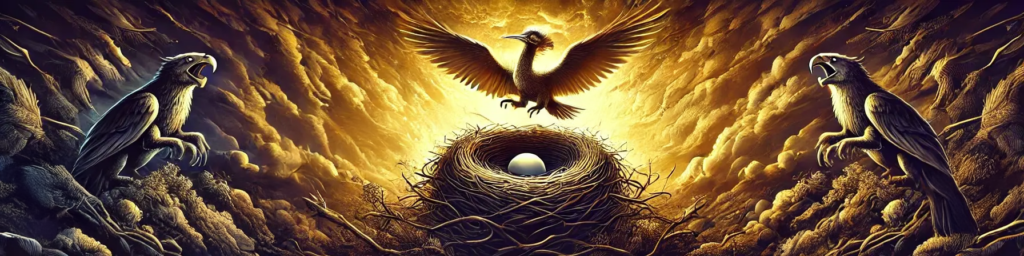
Welcome to Issue 23: Griffins, Possums, and Unlikely Friends
Some of the best friendships are also the strangest. Koko the gorilla and All-Ball the tailless tabby cat. Fum the black cat and Gebra the barn owl. And so, so, so many more delightful pairings of animals one wouldn’t usually expect to become friends.
Friendship is about enjoying another creature’s presence, but also, it’s about having empathy for someone other than yourself. Furry fiction asks us to look through the eyes of other kinds of creatures, an act that helps us develop empathy. There’s no better way to develop true, deep empathy for someone else than to listen to their stories, whether they’re a griffin, phoenix, possum, fox bard, penguin, or computer program.
* * *
To Their Rightful Owner by Reggie Kwok
Birds of Fortune by Kelsey Hutton
Fred and Frieda by Mary Jo Rabe
Little Joy by Jared Povanda
The Tale of the Penguin and the Puffin by Christina Hennemann
The City Above the City by Claude
* * *
Our most recent reading period was spectacularly successful, and we can’t wait to share the next year’s worth of issues with everyone, full of stories from so many different, extremely talented authors. Also, since we changed our guidelines earlier this year, we’ll be able to begin publishing longer stories again, starting with the next issue. For now, we are closed to submissions, but we plan to open again for the month of February, 2026.
As always, if you want to support Zooscape, check out our Patreon. Also, you can pick up e-book or paperback volumes of our first 16 issues bundled into five anthologies, complete with an illustration for every story. The fifth volume just came out today!
The Tale of the Penguin and the Puffin
by Christina Hennemann
 “The second she first spoke to him and heard his cackling laugh, Storm fell in love with Sunny.”
Once upon a time, a penguin lived on the vast, rugged wild west coast of Ireland. Nobody knew for sure how the penguin came to Ireland. It was a total mystery. The locals had many different theories: some said that the penguin lost its way in the endless ocean and was swept away by a massive thunderstorm. Others thought that maybe someone brought a penguin egg as a souvenir from the south pole. Some people believed that it could only be a miracle. Either way, people were very excited about the penguin, and newspapers all over Ireland wrote about it. The reporters interviewed the fishermen who had discovered the penguin and asked them many questions. The fishermen told the newspapers that they first spotted the penguin after a hurricane hit Ireland, which is why they called her Storm.
After a while, scientists became interested in Storm and wanted to populate Ireland with penguins to find out more about them. At the south pole, where penguins normally live, it is very cold, which makes it difficult to observe penguins, and the scientists thought it would be easier to study them in Ireland. So, one breeding season, they caught Storm and brought her to the zoo in Dublin. They hoped he would mate with one of the penguins there, but without success. Although there were many attractive penguins, Storm did not like any of them. The scientists did not understand why she would act like that. It was out of her nature, they said, because penguins were commonly known to fall in love quickly. When they examined Storm closer, they found that nothing was wrong with her. What the scientists couldn’t see, though, was that the famous penguin was already in love with someone else, and can you believe it? She was in love with no one else but a puffin.
During her first summer in Ireland, Storm met Sunny, a funny, cheerful puffin with the brightest beak of red and orange that Storm had ever seen. The second she first spoke to him and heard his cackling laugh, Storm fell in love with Sunny. Because Storm was the only penguin in Ireland and had never seen any other penguins, she thought that she was a puffin, just like Sunny and his flock. Sunny, the puffin, however, knew that Storm was different, but he liked her, too, and so they became friends. All summer long they played together, and caught plenty of fish with their clever hunting strategy: Storm dove and chased the fish to the water’s surface, and Sunny flew over the waves to catch the fish when they jumped up. The two of them always shared the fish they caught. In late summer, when the nights got colder in Ireland, they gently rubbed their beaks and feathers against each other to warm up, and often they just sat together in Storm’s nest to watch the beautiful orange sunset.
Storm was totally in love with Sunny. She thought of him day and night and missed him whenever he was spending time with the other puffins. As she couldn’t fly, she was all alone when Sunny went on his long spins across the sky. She watched from the ground, or the sea, and tried to find him amongst the flying flock of puffins. She always recognised him by his bright red beak, and by the black dot on his white chest. No other puffin had such a dot. Storm thought it was beautiful.
Sadly, Sunny did not want Storm to be his partner. He was trying to find a puffin partner. But no matter how many breeding seasons he spent in Ireland looking for a puffin partner, he never fell in love with any of them. He met so many wonderful puffins, but he didn’t like them as much as he liked Storm, and they didn’t make him laugh as hard as Storm. After a while, Sunny got very scared that he would always stay on his own, and that he might never have a partner and cute puffin chicks. He was very sad about his hopeless search. Storm comforted Sunny. She would always listen closely to his worries, and then she would gently pat his wing with her flipper and rub her beak against his chest. In moments like these, Storm thought to herself: “If only I could be your partner.”
One day, Storm took all her courage and told Sunny that she loved him. She said that she could be his partner, and that they could build a cosy nest to raise their chicks. That way, they would never be lonely. But Sunny only laughed loudly and asked her if she was crazy.
“You aren’t like me; you’re not a puffin!” he cackled.
Storm’s eyes filled up with tears.
“Oh, what am I then?” she whispered anxiously.
“You’re a penguin!” Sunny laughed. “Didn’t you know?”
Storm was in shock. She didn’t understand what a penguin was. Yes, she couldn’t fly, but Sunny couldn’t dive half as long as her. “Everybody is different!” she thought. She was very sad and hurt, but she tried hard to hide it. “Oh, of course I know that I am a penguin. I was only joking!” she lied. Then they both laughed out loud. After that, she never talked about being Sunny’s partner again.
Every autumn, the puffins left Ireland and only returned for the breeding season in spring. Storm was terribly lonely during these cold and dark months. She missed Sunny and counted the days until he would come back to her. Every autumn, Storm built a big and comfortable nest while Sunny was away to prepare for his return. She wanted him to have a cozy place beside her in the nest. Although Sunny had called her a penguin, Storm never really gave up hope that one day, Sunny would realise that she wasn’t so different from him after all, and that he could actually love her as she was.
Every spring Sunny returned with his flock of puffins, and every spring he came back without a puffin partner, but he would still not want to be more than friends with Storm, either. Often, Storm wished for her feelings to go away, but they didn’t. Storm knew her love for Sunny was meant to be. When penguins fall in love, it is forever. The same is true for puffins, but this particularly stubborn puffin never fell in love at all. “Lucky him,” the poor heartbroken Storm sometimes thought to herself, when she was secretly crying in her nest at night.
Finally, after many unsuccessful breeding seasons, Sunny gave up his search for a partner. He accepted that he was different from the other puffins and stopped looking for a puffin partner. He was very sad and disappointed, but he also felt a bit relieved that the stressful search was over. Storm comforted him and gently patted his wings with her flipper. Then she told Sunny about all the fantastic things they could do together.
“We wouldn’t see each other that often if you had a family!” Storm said dramatically.
Sunny nodded. “Yes, you’re right. I would miss you way too much!” he replied. Storm smiled, and her beak turned hot and orange.
The following weeks and months, the two of them spent more time together than ever and had so much fun working on their hunting skills, decorating Storm’s nest, and playing silly jokes on the other puffins.
That autumn, when the puffins left Ireland, Sunny decided to stay. He asked Storm if he could live with her during the winter. She was very happy and didn’t have to think twice before she said yes. Before Sunny could move in with her, however, they had to make Storm’s nest bigger so that the two of them would have enough space.
When winter came and it got very cold, the nest was ready. Storm wrapped her flippers around Sunny so that he would not freeze. He was not used to the cold, but Storm didn’t mind the cold and kept Sunny very warm. Storm and Sunny spent day and night together and were never lonely. Sunny often flew out to the sea to catch some fish when Storm was sleeping. He then surprised her with a nice breakfast when she woke up. The two made an excellent team. Despite the cold weather, Sunny enjoyed spending all year in Ireland. He never missed his flock, and he got so used to being with Storm that he never flew away in autumn again. Sometimes Sunny thought to himself: “If only Storm were a puffin. Then we could be partners and have a family.” Storm was very happy with Sunny. She knew that he still thought she was a penguin, but she felt as if Sunny was her partner already, so she never talked about it and just enjoyed being with him.
As long as they lived, Storm and Sunny were together. They spent years and years in happiness and shared the most finely decorated nest. Every now and then, scientists from all over the world came to observe the odd couple, but none of them could get close enough and make sense of what was going on. Sunny and Storm were too good at hiding from them.
Eventually, the scientists left for good and called the pair an ‘error of nature,’ and that was the end of their research. After a few years, however, an old Irish fisherman reported to the local newspaper that he had spotted flying penguin chicks with bright red-orange beaks on the coast. Never did he manage to photograph the miraculous animals, though. Every time he took out his camera, the chicks disappeared. The fisherman told the reporters that the chicks were playing hide-and-seek with him. Then the scientists came back and explored the area, but they saw no such flying penguins. Thus, nobody believed the fisherman’s story. People said he was a crazy old man, and that he was lonely and only looking for attention. After a while everybody forgot about his story. But the fisherman is still sure and swears to his children and grandchildren: if you’re lucky and observe patiently enough, you can see flying penguins on the west coast of Ireland. Just don’t bring your camera.
* * *
 About the Author
Christina Hennemann is a poet and prose writer based in Ireland. Her debut poetry pamphlet “Illuminations at Nightfall” was published in 2022 by Sunday Mornings at the River. She won the Luain Press Poetry Competition, was shortlisted in the Anthology Poetry Award and longlisted in the Cranked Anvil Short Story Competition. Her work appears in Brigids Gate Press, The Moth, Ink Sweat & Tears, fifth wheel and elsewhere. She is currently seeking representation for her debut novel. Find her online: www.christinahennemann.com or @chr_writer on Twitter & @c.h_92 on Instagram.
Little Joy
by Jared Povanda
 “If he were famous and loved, he’d start playing, and every word he sang would be honey. Milk and honey and pork shoulder so tender the meat would dissolve on his tongue.”
As the well-dressed pass him on his corner, the bard’s thorn-thick claws move like ink over the strings of his lute.
“Would you like to hear the story of Queen Paloma? The story of the Righteous Few? Any story at all?”
Some coins scatter his way, mirror stars beside his sooty paws, but no one stops and listens. This is a festival night, and the scent of pork fat dripping onto open fires draws the crowd as the bard’s music floats above disinterested heads.
Down the narrow road, wolf children rush past with colorful streamers, though one is slower than the others. They yip to one another, and the bard stops playing to watch. When was the last time he laughed among his den-fellows in such a way? The bard, most nights, curls up as tight as he can, as small as he can, bushy tail over his face, to be a compact ball of dirt and dirty fabric on the cold, unpaved earth. There is no money in art. Or, perhaps, there is simply no money in him. Stories, though, always fill his throat with tongues of light like a dragon whispering embers along his vocal cords. He wants to sing until he sears the sky.
One careful step at a time, he moves from his corner, and even as festival patrons part to allow him passage, he ignores their stares of contempt. They know nothing of how a little joy on a dark night can decide the difference between death and life for a fox.
The bard clasps his lute to his chest, calloused paws caressing old, warm wood, and peers at crisp ermine participating in a strange festival game. Some kind of sack toss. The ermine stand behind a white line and lob burlap bundles in high arcs to hit painted targets many paces away. The bard joins in with their barks, but because he has to keep his coins for tomorrow morning’s fish, he plucks a string and continues on before the urge to bet consumes him.
Outside of a raucous tavern, steps from the game and the ermine who play, a peacock with glossy, iridescent feathers passes to his left. She smells of apples, he realizes. Apples piquant with the faintest tinge of brandy. He follows the bobbing of her tallest feather until she drifts beyond view, the blackened feathers near her fragile legs hovering like his notes that never fell.
More daring than he’s been in many years, the bard finds himself stopping where the town’s roads fork. He becomes an island inside his mind. The festival fades away. If he were famous and loved, he’d start playing, and every word he sang would be honey. Milk and honey and pork shoulder so tender the meat would dissolve on his tongue. The bard dreams of this splendor, casting his consciousness far into the raven night until there’s a gentle tug on his tail. One of the wolves from before, streamer gone.
“Can I help you?”
“How much is a song, bard fox?”
“Free tonight. What would you like to hear?”
The wolf shrugs. There’s an ugly scar along the left side of his muzzle.
The bard begins to play a tune he remembers from his childhood. A song as lithe as one of the valley stoats. The bard sings of strange meerkats befriending storms and wicked snakes with knives inside their bellies. The improbable miracle of a mouse monk’s prayers to Dev’tal’an, and how faith stopped the demon blight from spreading into Sir Brown Bear’s home. The child wolf doesn’t move, doesn’t breathe until the last note disperses. But once the spell breaks, he shakes himself, not unlike a wet hound, and limps off with the barest hint of a smile on his battered face.
The bard once again holds his lute like a second heartbeat and watches the child go. He joins the thronging and aimless revelers, and even though he can’t afford anything here, he’s glad he chose to move from his corner. He acquired a new story tonight, and he supposes that stories can be better than coin when told well.
Near him, however, a percussion of sudden shouts arise as cold rain starts to fall. The bard is no stranger to these demon hours, and he gargles hot light in the back of his throat as he slips silent through new gaps in the thinning crowd. He circles around to his familiar corner, soaked to his skin.
The bard curls onto his side and rests his tail over his face once more, light trailing from between his sharp teeth as he thinks of the peacock who smelled of ripe fruit and liquor and how several torches coughed their deaths into storm-sodden air. He thinks, too, of the child wolf’s mutilated muzzle and how the other wolves in his pack left him behind, but then of the soft happiness on his face after an adventurous song rife with relief from evil. The fox thinks, and then he hums the bright beginnings of an ode he already knows he will call Little Joy.
* * *
 About the Author
Jared Povanda is a writer, poet, and freelance editor from upstate New York. He also edits for the literary journal Bulb Culture Collective. He has been nominated for the Pushcart Prize and multiple times for both Best of the Net and Best Microfiction, and he has been published in numerous literary journals including Wigleaf, Uncharted Magazine, and Full Mood Mag. You can find him online @JaredPovanda, jaredpovandawriting.wordpress.com, and in the Poets & Writers Directory
Fred and Frieda
by Mary Jo Rabe
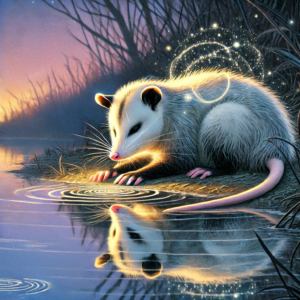 “Although he had no real hope that the microbes could help him remedy his past mistake, he decided to return to the duck pond and ask.”
Fred the Opossum laid his moderately chubby and maximally furry body down onto the dry, brown grass next to the noisy duck pond and diffidently dipped his claws into the murky, cold water. Some of the crunchy insect parts that he had had for dessert the day before floated away; most didn’t.
Fred should have cared or at least sloshed his paws in the water to clean them. It was to his obvious advantage to keep his grasping appendages free of obstruction. Plus, Fred usually liked to feel clean.
The mud at the bottom of the pond helped soothe sore paws. An opossum that tended to his body parts tended to live longer, which had been Fred’s major goal in life. Lately, though, he wondered what a longer life was good for.
The elderly ducks swimming close to the shore looked up but didn’t bother to quack. They correctly sensed no danger from Fred’s lethargic presence.
Even though he didn’t really feel like doing anything, Fred emptied his mind and tried to soak up some impressions from the microbes in the pond.
The microbes were only one-celled creatures individually. But when they joined together in their group mind, they were far superior in brainpower to all other creatures Fred had ever encountered. Their telepathic powers were incredible.
Fred was grateful to the microbes for even paying any attention to him. His thoughts must seem unbearably primitive in comparison.
However, he had to concentrate strenuously if he wanted to understand what the microbes communicated. Talking to the microbes often exhausted him. Their messages resulted slowly. Sometimes they were interrupted for long periods of time.
Fred had the necessary patience for such communication. However, as he got older, he did notice that he sometimes no longer had the physical vigor he needed for listening. Still, he enjoyed hearing from the microbes.
Other opossums with whom Fred had had sporadic contact in the past ridiculed him for talking to microbes. Fred no longer bothered to explain that he listened more than he talked. If other opossums didn’t want to access available information, he couldn’t force them. In addition, he had less and less desire to cajole impatient fools.
“What’s wrong?” the group mind of the microbes in the pond asked. “You seem a little despondent.”
“I honestly don’t know,” Fred said. “Maybe I’m getting old. Everything just seems so pointless, the same routine day after day.”
“Well,” the microbe group mind said. “We don’t really understand this aging thing you multi-celled creatures go through. Our minds exist together in the group and don’t degrade when we switch from one decaying, old, cellular creature to a brand new one.”
“Yeah,” Fred said. “Then you never have regrets?”
“Regrets?” the microbes asked. “We often evaluate our actions and ask ourselves if we chose the most effective method for what we hoped to accomplish. Sometimes we are satisfied with results, sometimes not. That’s when we brainstorm about possible different strategies for future events. Aren’t you satisfied with your results? It was only last month that we and dark energy helped you save the universe from being assimilated by a parallel universe and destroyed in the process.”
“That’s true,” Fred admitted. “That should have made me stay happy longer. I guess I have started reflecting on the fact that I am getting older and wish I had done some things differently in the past,” Fred said.
“Why not just do them differently in the future?” the microbe group mind asked. “That’s what we do.”
“The same situation is unlikely to happen again,” Fred said sadly. “A few years ago, out of purely selfish motives, I insulted a female opossum and drove her away from the farm. I didn’t want to share anything with her, not my turf nor the food from the humans in the farmhouse.”
“That is a logical decision, obviously beneficial for your own survival,” the microbes said. “Why do you regret it?”
“It was unnecessary,” Fred said. “The humans have shown themselves to be willing to feed any number of animals who show up at the door. Sometimes there are twenty or more cats who patrol the farms in this region, always on the prowl for better food. One more opossum wouldn’t have meant that I got less food. The farm is also spacious enough for any number of my species. And now I wish I had more opossum company, creatures on my wavelength, creatures no smarter than I am.”
“Then behave differently the next time an opossum wants to stay on the farm,” the microbes suggested
“There haven’t been many since she left,” Fred admitted. “She may have bad-mouthed me to others.”
“Well,” the microbe group mind said. “Then you want to change your actions in the past.”
“Right,” Fred said. “Unfortunately, that is impossible.”
“Maybe, maybe not,” the microbes said. “We’ve never thought about that before. Give us some time to brainstorm.” And their telepathic messages stopped.
Fred was always glad to do anything the microbes requested. Despite the huge difference in brain capacity, theirs being infinitely greater than his, they were his best friends.
Fred thought he’d stay at the pond for a while. It was pleasant enough here. It smelled like the hogs hadn’t been near the pond for some time now. Fred’s pink nose on his long, thin snout couldn’t detect even a whiff of hog excrement, just overly ripened corn from the fields.
Fred liked the pond. It was one of the reasons he decided to make his home on this farm. One of the previous farmers had dug the hole that became the pond thinking that it would be used by the farm animals. As far as Fred could determine, that didn’t happen all that often.
The pond was more or less hidden behind the three-story wooden barn, a shabby structure with weathered planks. Earlier, more prosperous farmers had probably painted it red. Some of the wooden slabs still had traces of that paint, though many of them were now missing. The current humans didn’t seem to be concerned with appearances.
Fred had always been impressed by the structure. It was significantly larger than the machine shed or the farmhouse. These human creatures might be clueless about many things, but they did construct striking buildings.
The sunlight was getting dimmer, and so Fred started thinking about supper. There were no clouds, and so it might not rain, which didn’t matter. His thick, gray fur protected him from hypothermia, and he quite enjoyed gyrating briskly to get the thick raindrops off his bristly hairs.
There would probably be some new, semi-feral farm cats blocking the door to the farmhouse. It was tiresome, always having to assert his opossum’s privilege and chase the cats away. He had nothing against the cats. They were free to eat as much as they wanted, but only after Fred was finished.
However, it was a nuisance having to re-establish the pecking order every time a new cat appeared. New cats had to be shown that Fred was in charge of all non-resident mammals on the farm.
While the cats did on occasion catch and kill aged or slow rodents, they never bothered to eat them. Instead, they lined up for the delicacies from the farmhouse. The humans who fed animals at the door were kind-hearted despite being generally incomprehensible.
The food they offered the visiting animals was excellent. He never was sure when exactly they would offer it to the outside guests each day, but Fred was flexible. He knew the food prepared by humans was worth waiting for. It was just as tasty in its own way as the carrion and insects that Fred munched on between meals.
Fred appreciated the humans in the farmhouse but had no desire to spend time with them. It was common knowledge, or perhaps inherited memories among opossums, that some humans consumed opossums, calling them tasty vittles. He didn’t have the feeling that the humans in this farmhouse wanted to eat him, but caution was a useful virtue.
So Fred scampered around the barn and down the hill to the two-story, old-fashioned farmhouse. At one time, it had probably been painted white, but now there were more gray boards than white.
His timing was correct. Just as he got to the farmhouse, the screen door opened and a tall, female human, followed by her child, brought out bowls of meat and milk and water. Again, the child seemed to understand that Fred was saying “hello.”
When the adult headed back into the house, Fred jumped up the steps to the door. Fred growled as he shoved his way through the crowd of cats, who, fortunately for them, quickly made way for him.
“Fred’s here,” the child shouted. Fred wasn’t afraid of the child. Fred, as a matter of fact, did have his own, genuine opossum name, but after the child had started calling him “Fred” a few years ago, Fred decided to claim it for himself. Now he associated the name “Fred” with pleasant memories of the food the humans provided.
The food made Fred feel energetic for the first time today. Although he had no real hope that the microbes could help him remedy his past mistake, he decided to return to the duck pond and ask. He thought he could see tiny waves on the surface of the pond water.
“Hey microbes,” Fred began his telepathic message. “Were you able to come up with anything?”
“Indirectly, perhaps,” the microbe group mind said. “There’s nothing we can do; we are just microbes, after all. However, we were able to send messages up and down the chain of structures in the universe, and dark energy has agreed to help you. It is grateful to you for informing it about the previous danger to the universe.”
“Help me how?” Fred asked. He didn’t want to indulge in too much wishful thinking. That only depressed him.
“You can’t travel into the past,” the microbe group mind transmitted patiently. “But we can send your brain waves out to the dark energy that is expanding the universe, and it can jump the thoughts back, though not very far. When exactly was this mistake you wish you hadn’t made?”
“Three years ago,” Fred said. “I still don’t understand. My thoughts go back in time, but I don’t?”
“Right,” the microbes said, this time not quite as patiently. “With the power of our group mind and dark energy, your thoughts can enter the mind of your previous self and perhaps influence him. There aren’t any guarantees, of course. If you recall, you were quite stubborn back then.”
“But will I know how much my thoughts today influence the actions of my previous self?” Fred asked.
“We’re not sure,” the microbes said. “Try to understand the situation. Depending on what effect your current thoughts have on your previous self, you may experience changes in the here and now, changes brought about by influencing your previous self. However, dark energy will prevent your possible actions from reversing the changes it made in the universe. Dark energy prefers the universe as it currently exists.”
“Fine with me,” Fred said. “Can anything go wrong?”
“Nothing can go wrong with the process,” the microbes said. “We and dark energy have investigated all eventualities. You just may not be happy with all the results, though, if there are changes you have to deal with due to new actions of your previous self. You could find yourself blacking out occasionally when your new memories conflict with the memories you have stored as of now.”
“But can I control the thoughts you send back?” Fred asked. “They aren’t that complicated. I just want to apologize to the female opossum and tell her I would be happy to share this farm with her.”
“Got that,” the microbes said. “We’ll send your brainwaves on to dark energy to be transmitted back to Fred the Opossum on this farm three years ago.”
* * *
Fred felt like he had passed out briefly, but then he felt like he was floating. He saw his previous self in the cornfield, munching some insects contentedly. My goodness, he had looked good back then; he never realized how good. He was slim and yet muscular with a thick, shiny fur.
Not sure exactly how to proceed, Fred, or rather his thoughts, floated above his previous self as previous self got up and scampered over to the farmhouse. When his previous self climbed up the porch stairs, he saw that the female opossum was already there.
The door opened, and the child yelled, “Fred’s there, and so is his girlfriend. I’m going to call her ‘Frieda’.”
Fred felt the jealous anger in his previous self’s mind. That was the reason he had driven the female opossum away. He had been jealous of the attention she got from the humans and that was why he hadn’t wanted to share anything with her. His previous self was putting a few choice words together to chase the female away.
“No,” he thought, hoping his thoughts would enter his previous self’s brain. “Be kind to the female. Make her feel at home. You have nothing to lose and everything to gain.”
His previous self shook its head violently, and so Fred hoped that meant the message had gotten through.
“Trust me,” Fred thought. “You know the value of kindness. Kindness creates more kindness. Think of the future, the world you want to live in. Get out of your own way and be kind to another opossum.”
His previous self seemed to inhale deeply. Then it barked softly to the female, “You are welcome here, both with the humans and on the whole farm. I know it’s frightening at first, but I’ve been here for over a year now, and I can recommend this location as a home. And, in my opinion, the young human gave you a pretty name. I like ‘Frieda’.”
The female looked skeptical but didn’t run away. Fred’s previous self then motioned for her to eat out of the meat bowl with him. When they finished, the previous Fred told the female she might like to follow him to the cornfields where they could find some tasty insects as dessert.
The two of them turned and left the farmhouse, at which point twenty feral cats stormed the porch and ate everything that was still there.
Fred was relieved. He really owed the microbes and dark energy for this favor.
* * *
Fred shook his head. “I must have passed out,” he called to the microbes. “Did it work?”
“Yes, of course,” the group mind answered. “We wouldn’t have suggested it if we didn’t calculate at least a fifty-one percent chance of success. Dark energy says you persuaded your previous self to be kind to the female opossum instead of scaring her away.”
“Thank you,” Fred said. “I never realized what a burden this memory was to me. Now I feel truly at peace with myself.”
“Naturally,” the microbes continued. “There have been a few changes in your life due to this change in behavior.”
“Huh?” Fred asked. “The changes have to be good, though, right?”
“The results are interesting, and not inopportune,” the microbe group mind transmitted. “It might be easier for you to discover them for yourself instead of asking us questions, though. We can’t always determine what is important to you because we have more pragmatic standards than you emotional creatures with no group mind to mediate your feelings do.”
“Okay,” Fred said. “What do I need to do?”
“Waddle down to the end of the lane and check out the new sign,” the microbes said.
That seemed to be odd advice. Fred, however, had taught himself to read human language long ago. He marched down the lane, well maybe not as fast as he once did. Underneath the mailbox was indeed a huge sign that said “Opossum Preserve. No Hunting!”
“That had to be good,” Fred thought. He had never had any trouble evading the clumsy hunters on the farm before, but it was good to know that they were no longer a threat.
He strolled back to the farmhouse. Strange, there weren’t any cats prowling around, but they were probably out checking out the food at other farms. Cats always suspected there was better food somewhere else. They were wrong, but cats never listened to Fred.
Suddenly a mob of young opossums dashed out of the cornfields and stood in front of him. “Are you all right, Dad?” one of them asked. “Mom was worried because you were so absent-minded after supper.”
“Yeah,” another one said. “Mom hoped we could find you in the cornfields or back at the duck pond. That’s where you always go to rest your mind.”
“You promised to show us your old hunting grounds in the woods,” another said. “You claimed we could find the best-tasting amphibians there.”
Fred tried to make some sense out of this unexpected turn of events. Obviously, he and Frieda had gotten on well, but now what? Fred had previously never considered giving up his solitary lifestyle, but apparently, he had changed his mind during the past three years.
“Uh,” he said. “I want to go to the duck pond first and clean off my claws. Wait for me at the farmhouse, and then we’ll go.”
The young opossums cheered and ran off. Fred charged up the hill to the barn and back down a different hill to the duck pond.
“What the,” he began.
“Yes,” the microbes said. “You and Frieda are quite a prolific pair of opossums. Every year there are at least ten new little opossums here on the farm. The humans noticed this a year ago and were able to get recognition and funding for making this farm an opossum preserve, where opossums can live safely and where researchers show up now and then to see what they can learn. This saved the farm from being sold.”
“Okay,” Fred said. “But what about me?”
“You have turned into an extroverted, happy father of many, many children,” the microbes said. “Apparently this was something you always wanted but never admitted to yourself.”
“But I don’t remember anything after Frieda and I walked to the cornfield,” Fred said.
“And you won’t,” the microbes agreed. “But you can create new memories, and Frieda can fill you in on what you don’t remember. She is used to your memory lapses. She thinks it is part of your personality.”
“I don’t know,” Fred said.
“We calculate that this will continue to go well,” the microbe group mind said. “Besides, you can always ask us for advice.”
“Then, thanks, I guess,” Fred said. “It’s all just a little much for me right now. But maybe you’re right. Maybe this is the kind of life I was yearning for.”
He turned around and walked back to the farmhouse where some thirty opossums were waiting for him. He didn’t want to disappoint them.
Still, he had one question. “Do any of you know what happened to all the cats?” Fred asked the group.
“Don’t you remember?” one opossum said. “Mom told them to leave the farm. She didn’t want any competition for food.”
Well, Fred could live with that. Now he had to find a way to learn all his kids’ names.
* * *
 About the Author
Mary Jo Rabe grew up on a farm in eastern Iowa, got degrees from Michigan State University (German and math) and University of Wisconsin-Milwaukee (library science). She worked in the library of the chancery office of the Archdiocese of Freiburg, Germany for 41 years, and lives with her husband in Titisee-Neustadt, Germany. She has published “Blue Sunset,” inspired by Spoon River Anthology and The Martian Chronicles, electronically and has had stories published in Fiction River, Pulphouse, Penumbric Speculative Fiction, Alien Dimensions, 4 Star Stories, Fabula Argentea, Crunchy with Chocolate, The Lorelei Signal, The Lost Librarian’s Grave, Draw Down the Moon, Dark Horses, Wyldblood Magazine, and other magazines and anthologies. You can find her blog at: https://maryjorabe.wordpress.com/